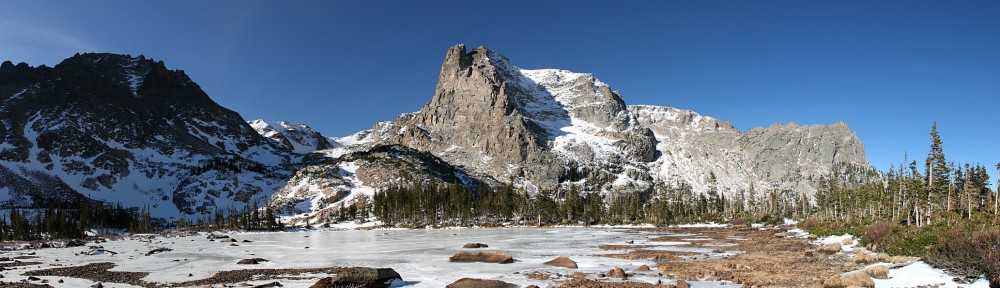
Hutcheson Lakes

About a week ago I decided it was time to hike to Cony Lake. Last time I tried to hike to Cony I took a break at Pear Lake where I managed to leave my the SLR and tripod. Although the mission was aborted, I enjoyed a long lunch at Pear.

It’s 9.2 miles to Cony. I’d forgotten how long it was until I checked the Foster guide for a refresher. I wasn’t sure I was ready for an eighteen and a half mile hike. I spent a couple days telling myself I could do it. By Friday morning, there was no wavering. All systems go for a 6am departure, boots on the trail by 7:30. Last year it took me three hours to get to Pear. It’s 2.2 miles from Pear to Cony, so that shouldn’t be more than an hour and a half. Two hours tops. Lunch at Cony by 12:30, half hour lunch, back to the car by 6pm.

Saturday dawned cool and cloudless but a bit hazy – smoke from the fires in Washington and Oregon? I hit the road a few minutes behind schedule but traffic was light and I put boots on the trail promptly at 7:30. I brought micro spikes with me, but at the last moment decided not to carry them.

The trail climbs steeply from the parking lot to the top of the first ridge, about six hundred feet in a bit over a half mile. The climb ends with a hairpin; turning west the trail borders a meadow then enters an aspen grove. At the junction with Allenspark trail, another long climb begins – six hundred more feet in a half mile. Shortly after the junction we enter the eastern end of the burn area from 1978. Nice views of Meeker, Longs, Pagoda, and Chiefs Head can still be had, but the trees are getting big enough the view will not be do open for long. From this vantage point, it’s clear how Chiefs Head got its name.

From here the trail flattens out again before a short descent to Finch Lake. We are five miles and 1400 vertical feet from the car in a shade under two hours. Finch Lake isn’t much to my taste – what it lacks in a nice view it makes up for with an abundance of mosquitoes. To now I’d only encountered a few hikers. Here I met a large family. They spent the night here and asked me about the trail to Pear.

From Finch to Pear is two miles and seven hundred vertical feet. Two short steep parts with an interlude in between. The east buttress of Mt. Copeland rises from the forest on the right as we pass a small pond on the left.

Pear Lake was a reservoir for most of the 20th century. There’s still a visible bathtub ring, but the vegetation is slowly overcoming that. Even another thirty years won’t erase all evidence; a large boulder on the northwest shore will be two toned for some time to come. I made it in three hours almost on the dot.

Last year I went around Pear lake to the right. I followed Foster’s route and took the vague trail on the left side. This petered out pretty quickly and by the time I started climbing I was on my own. A short distance away were some folks getting situated on a large rock overlooking Pear Lake. By now I’d seen only about a dozen people.

A small stream feeds Pear here, not a large amount of water, but in several small courses braided up the hillside. I went up the east side, far enough away to avoid the marshy spots. There are a couple of unnamed ponds showing on the map here, and perhaps a couple more that aren’t on the map. After passing one of these I came to the top of the ridge and saw Middle Hutcheson Lake below me.

I headed down the hill a bit to Cony Creek. According to the map in Foster’s guide, I should cross to the south side of the creek about here. It runs in two or three major channels and I could cross it fairly easily. But after having a good look around I decide to stay on the north side. After climbing a hundred feet or so, I saw another hiker on an outcropping below me, on the south side. I don’t know that he saw me; it didn’t look like he was climbing any further.

I didn’t want to deal with the krummholz and willow, so I tended to be higher on the slope. Just below Upper Hutcheson Lake I saw an older couple headed the other way. The were a bit upslope of me and said that was the better route. A few minutes later I arrived at the ponds immediately below Upper Hutcheson and saw another couple. They had been to Cony before and thought it was too early in the season to continue to Cony. There was too much snow. I followed them through a couple patches of willow and to the shore of the lake.

It was 12:15. From here, I’d have to cross the talus slopes above Upper Hutcheson to the inlet, then up two hundred feet to the ledge that hold Cony. I quickly decided to stop here and put Cony on the to-do list for some August or September. Even had I brought the spikes, I was still at least a half hour from Cony. Next time I try this, I think I can save at least fifteen minutes between Pear and Upper Hutcheson having now scouted the route.

I set up the cameras and ate my lunch. The clouds building over the divide were darkening and at 12:40 it started to sprinkle. I packed up and started down. The couple were fishing and decided to wait out the squall. It took me an hour and a half to hike up from Pear but only an hour down. I considered stopping here for a fruit break. The few sprinkles had stopped pretty quickly, but now it was starting up again with bigger raindrops.

By the Pear Creek campsite the sun was shinning again. Here I met a back country ranger. We chatted for five or ten minutes. I learned that much of the park is designated wilderness. I thought it was just a park, but everything a mile from any trail is wilderness. I refilled the water bottle from the creek and headed to Finch. To my chagrin, my knees started getting a bit sore on the steeper downhill sections.

I polished off half my remaining fruit but didn’t dally long. The mosquitoes made a snack of me. I carry some mosquito repellant wipes in the pack, but the seal had broken and they were dried out. Oh well.

On the uphill section immediately after Finch Lake, I came across a couple who had spent the night at Pear Creek. As it was mid afternoon by now, I asked what they did all morning. They had hiked to Cony Lake. Somehow I didn’t see them, but they must have passed me while I was eating lunch. They described their route and said it wasn’t difficult even with the snow.

After this point, my progress slowed considerably. Every downhill stretch gave me a fair amount of pain in the knees. This sometimes happens, but not often. In my ignorance, I will blame it on taking such a long hike without getting in proper hiking shape. I don’t normally tackle the longer hikes until I’ve done a few intermediate length ones first.

By the last mile, fatigue had set in as well. Too tired to properly pick my feet up, I was now stumbling over roots and rocks. This added to the discomfort. The first couple times I rested, my knees felt better for a while, but for the last couple of miles rest did not aid. I made it to the car promptly at six; were it not for the pain I would have finished 30 or 45 minutes earlier. So it goes.

Timetable

Up Down
Trailhead 07:30 AM 06:00 PM
Allenspark Trail Jct 08:05 AM 04:55 PM
Calypso Trail Jct 08:30 AM 04:25 PM
Finch Lake 09:25 AM 03:05 PM
Pear Lake 10:35 AM 01:45 PM
Upper Hutcheson Lake 12:10 PM 12:50 PM

Twin Sisters

The first time I hiked Twin Sisters was roughly thirty years ago. Saturday I hiked it for the second time.

I barely remember the trail. Relentlessly uphill, but not very steep. No streams or lakes, so you have to carry all your water. Not a long hike, and not much higher than many lakes I’ve visited. The only real thing Twin Sisters has to offer is the view of Long’s. That’s about all I remember of it. Lately, I’ve been thinking it might be fun to make this hike and try a time lapse of the sunrise on Long’s. When I saw the hillside after the floods I wondered if it affected the trail. I really had no idea where the trail was. So before I could consider doing the hike in the dark, I’d better know where I’m going.

I wasn’t too worried about getting an early start. Even if the parking lot at the trailhead was full, I could park at the East Lily Lake lot and add an extra four tenths of a mile each way. When I got there at nine I wasn’t surprised to see people parking on the roadside, so I didn’t bother going any farther and parked as well. I walked past about a dozen cars to see that the road is closed at the hairpin. The road above here severely damaged, passable only by four wheel drive.

At the trailhead, a notice about the flood damage included a map. The lower section of the switchbacks had been erased. About a half hour into the hike I arrived at the slide area. It’s flood damage, but considerably different than the Lawn Lake flood.

Change is constant. Although we think of geologic change being slow, it’s made up of short bursts of transformation. In the last few years, I’ve been able to see the effects of these dramatic events. I was on the trail to Bluebird Lake a few weeks after an avalanche tore through a section of forest. I hiked through burned forest a few weeks after the fires. I hiked to Lawn Lake shortly after that flood. I hiked from Mills Lake to Black Lake on both winter and summer routes shortly after the microburst there. And now this one. Is it a flood or a landslide or a little bit of both? In any event, nature’s power revealed.

The trail crosses the slide only once. The trail rises to a switchback and when it reaches the slide area again, a temporary trail climbs more or less straight up the hillside to the next section of trail. Repeat two or three times. Looking on the bright side, there are now nice open views here.

After the switchbacks the trail circles around to the north slope, giving a nice view of Carriage Hills and Lake Estes. If I’d have brought my long lens, I’d have looked for the house on Ramshorn. My pace slowed considerably here. To this point I’d only been passed by two pairs of hikers while passing quite a few people. A couple I had passed earlier looked like they might catch back up, but they slowed down when we timberline.

Technically, I didn’t actually summit. I went to the right of the antenna and found a spot to set up the cameras, eat my lunch and relax. There were quite a few people here, and perhaps an equal number on the near summit. I saw only a few hikers on the other summit.

The day was beautiful. I had to put the windbreaker on while having lunch, it was pleasantly cool with gusting winds. There was no handy ballast to secure the tripod for the SLR, but the GoPro sat low enough to the rocks to not be too affected. I sat there for about an hour watching rain clouds scud in from the northwest. I packed up and left before they arrived and only got sprinkled on for the last few minutes of the hike.

Lake Helene

Last Saturday Jerry and I hiked to Lake Helene. This was Plan B. Plan A was to hike from Bear Lake to Tourmaline Lake. I hiked to Tourmaline last year, from the Fern Lake trailhead. That’s the longer route, but I wanted to walk through the fire area. I wanted to return because the weather that day wasn’t very good for photography.

US 36 was closed for construction the last two times I headed to the park so this was my first look at any road repairs. For the time being, this is not a good route for the fun car. Both canyon sections are dirt. They’ve done a lot of blasting and it looks like there will either be very wide shoulders or an extra lane. I’ll be surprised if they don’t put in a left turn lane just before where the first passing lane starts.

My park pass expired in April so we didn’t get to use the express lane. By this late hour, the lower parking lot was full and the Bear Lake lot was about two-thirds full. We hit the trail a few minutes before nine.

We made fairly good time on the lower section of the trail. A half hour to the Flattop/Odessa trail junction. Up to here, there was little snow on the ground. From about a quarter mile past the trail junction all the way to Lake Helene there was quite a bit of snow. We brought microspikes with us, but I wasn’t expecting to install them so soon. By the end of the day, we’d passed dozens of other hikers but none had spikes. A few wore sneakers without socks, but at least I didn’t see anybody in sandals.

Following the trail was a pretty straight-forward exercise, for the most part. The snow lay on the ground in big ridges, sometimes across the trail but sometimes also along the trail, big drifts four feet deep or more. Seldom did the snow obscure the trail more than twenty yards, and in these areas there were blazes on the trees.

By the time we got to where the trail makes the hairpin turn and descends to Odessa Lake, the blazes led us up the slopes of Joe Mills Mountain. We ran into a couple who intended hiking to the Fern Lake trailhead. I knew we were no longer on the trail, but they didn’t. After taking in the view of Odessa Lake below, I got us down to the trail, showed them where it goes, and Jerry and I headed to Helene. The snow was slowing us down; we wouldn’t make it to Tourmaline by noon and Jerry was getting pretty tired. So Plan B it was, and we headed to Helene and searched for someplace not covered in snow to have our lunches.

We spent about an hour and a half relaxing over lunch. The day had started off quite reminiscent of last year – a solid, undifferentiated bank of clouds. For a while on the trail it seemed we’d end up with bright, sunny skies. In the end, it was more cloudy than not, and by the time we decided to head back things were looking decidedly threatening. We never did get rained on, but it was probably a close thing. There was a bit of lightning a short distance to the north.

When we got back to the car we ran in to the couple we ran into on the trail. They didn’t make it much past where I put them back on the trail. The snow was too deep for them so they turned around.

By now the parking lot was full. To keep folks from clogging up the parking lot, they have several rangers directing traffic. “No, you can’t wait for them to leave. There are spots on the other side. If you don’t find one, go around again. Keep moving.” I think I chatted briefly with each ranger. “People sure take a lot of pictures of your car!”

The Loch

Jerry and I hiked to the Loch. It was a relatively calm day near the divide, for a change. It was fairly warm, but the sky was nearly solid overcast. Again, we got a late start that was made even later due to another closure of highway 36. We didn’t hit the trail until about 11. But it’s a short hike, so no harm, no foul.

We took the winter route up – the fire trail to the junction, then up Icy Brook to the Loch. The ice on the lake is starting to get fairly rotten – crystallized and porous. We skirted along the south shore until the ice ended on the dry lake bottom. About a quarter of the lake’s summer surface area is dry right now; the lake is much shallower than I expected.

We found a place to set up the camera with some trees nearby to keep us out of the wind, should it arise (and it did, eventually). I normally have the camera pointing to a patch of sky above whatever dramatic peaks I’m nearby, but in this case I figured my best shot at getting any sort of interesting cloud action was to face it east. I’d have set up the SLR as well, but it was malfunctioning. On the way up, I tried to take some photos but, although the batteries are fully charged it wouldn’t do anything. Eventually, I took both battery packs out and swapped their location and I was back in business.

On the hike out, we decided to take the route past Alberta Falls. That turned out not to be the best choice, but so it goes. There was very little traffic this way, so the “beaten path” wasn’t very beaten. We weren’t using snow shoes, so we wanted a fair amount of traffic on the trail before us. The original plan was to follow the stream down (from the bridge on the North Longs Peak trail) to the falls, then take the trail from there. But it was soon obvious doing this with just micro spikes wouldn’t be the best choice. So we followed the footsteps on the summer trail.

The thing about following somebody else’s footprints is you’re assuming they knew what they were doing. There were several times I had my doubts. But every now and then we’d see some evidence that we were on the trail. In between these times, it seemed like the trail blazer was maliciously taking us on an excursion. It was all good, though, as we arrived at the falls to find a bunch of people sitting there enjoying the view of … the frozen falls. Not really much to look at when it’s frozen solid and covered with snow drifts.

Dream Lake

It has been ages since my last hike. So, last Saturday, with a favorable weather forecast, I headed up to the park for a walk in the snow. When I set out this morning, I figured I’d head to the Loch. It’s a short hike, so I was in no hurry to hit the road. I left a bit before 9, figuring I’d be at the trailhead by 10:30.

Last time I headed to Estes Park, US 36 was open and Colorado 7 was closed. Today it was the other way around due to blasting operations near mile marker 12. This was my first trip on 7 between Lyons and the junction with 72, where the canyon is quite narrow. I’m surprised how much of the road didn’t get washed out in some parts. The river channel was simply scoured out. Looked to me like most of the debris has been removed and long sections of river bank have been sculpted.

The section of road from Allens Park to Estes Park is getting pretty beat up. While 36 was closed in the immediate aftermath of the flooding, all logistical support for Estes went on this road resulting in long sections of fairly rough pavement with lots of potholes. Traffic was moving about the speed limit, which was in places faster than I wanted to go because the road is so beat up.

So, with the late start and the longer route to the trailhead, I arrived at Glacier Gorge parking lot later than I’d hoped. All the spots were taken except the parallel spots. An important rule driving the Elise is to never parallel park. I did stop there for a few minutes, though. The wind was fierce, I really didn’t want to hike in this. Snow was blowing in huge clouds from all the peaks. I didn’t want to hike to the Loch from Bear Lake, and didn’t want to hike very far, so I parked at Bear Lake and hiked to Dream.

I arrived at Dream at a quarter to noon. In winter, I take the winter route, up the drainage, from Nymph to Dream. A lot of folks follow the summer route. The two meet up again just below Dream. Here, the beaten path is six or eight feet wide, and goes onto the ice along the north shore. I looked for a spot on the south bank where I could set up the GoPro and have my picnic in the trees, out of the wind.

I went about half way across the lake where I found a small tree on a tuft of grass. I put the camera here, using the tree for support and as low to the ground as I could. I headed to the trees and looked for a picnic spot. The wind was fierce. When I stood with no trees in front of me, gusts occasionally knocked me off balance. I found I could get three or four trees deep from the lake and still find a window with a view.

After I ate, I stood watching the snow blow off the mountains, but after only a few minutes of this I was getting cold. I retreated into the trees, which helped. In the summer I have no problem finding a comfortable spot to watch the world go by for an hour. But in winter the winds are just relentless. I needed to do something, to move around and generate some warmth. I took the SLR out on the ice to see if there was anything interesting.

IMG_0509sThe ice looks like the top of a choppy lake. Little white caps of snow are on the ice. And the ice isn’t flat. The snow forms these odd little ice lattices; these lattices look like little dunes on the ice. I took several photos in an attempt to show what these things look like, but none show them very well. The jumble of white lines are not in the ice, or part of the surface of the ice. Like ripples of sand under moving water, these little walls of ice make many-celled miniature dunes on the thick ice.IMG_0516sI head back to my stuff and am quickly met by hikers coming through the trees. I thought it was pretty odd that they’d come that way. They even asked where most people hike, so I pointed to the other bank. I decided that I’d wait for them to enter the trees on the west side of the lake before I shut the camera off. When they got half way there they stopped for a conference. Then more hikers pop out of the trees along the same path as the first two. My little picnic area off the beaten path somehow became the beaten path. More hikers kept coming through the trees. Could non of these people follow a six foot wide road of footprints and ski tracks?

The hike back to the car was quite crowded. Just about everybody going up to Nymph was wearing snow shoes. There were a few skiers, and a few people in sneakers. I didn’t see anybody else using micro spikes. There’s really no need for snow shoes unless you’re going off the beaten path.

Mills Lake

Friday, November 29

My last hike was a few days before the big floods in September, nearly three months ago. That’s the longest time between hikes for me in nearly three years. All the roads to Estes Park are open now, so I figured it was past time to head up to the Park.

On the drive up I stopped in Lyons to mount the camera on the car. The repairs to US 36 are temporary and I was expecting a fair amount of flood damage in Apple Valley and just before Big Elk Meadows. The video does not do a great job of showing the extent of the damage, but I’ll see if I can put together a few minutes of interesting footage. I’m guessing it will be of little interest to anybody who is unfamiliar with the road.

Jerry and I were in Lyons last week for some pinball and a beer at Oskar Blue’s so I had already seen the debris lining the road from the light at the junction of CO 66 and US 36 into town. The water clearly was deep enough through here to deposit trees on the north side of the road. In some places, the river is about 500′ from the road in this stretch.

The next stretch of serious damage is in Apple Valley. The riverbed here has been scrubbed clean, no plants or structures standing in a rocky, sandy riverbed that is now much wider than the stream it accommodates. Where the road bends west the water ate away enough earth to cause the temporary road to be placed fifteen or twenty yards from its former “permanent” location. Yet only a few yards upstream the bridge at Apple Valley Road stands with no apparent sign of stress.

The worst stretch of damage starts here, where the canyon narrows. The road was washed away in several places. Most structures here were on the opposite side of the river from the road, and all the bridges were washed away. Somebody spray painted “We R OK” on a garage door. The occasional car is on the shoulder of the road at the bottom of a pile of other debris.

From where the road opens up and provides a passing lane to the top of the hill at Pinewood Springs there are only one or two spots that had minor damage. On the other side of Pinewood, the road goes through a short stretch of canyon alongside the Little Thompson River. The road is damaged from here to the turn for Big Elk Meadows, except where it was washed away entirely. I think there’s only one house in there, but I didn’t get a good look to see its fate. From there to Estes there is only one short stretch of additional damage, just past the trailhead near mile eight.

Being headed out for a short hike, I was on the road a few hours later than I’d normally make the drive. Traffic didn’t disappoint. For the most part, people were going ten to fifteen miles per hour less than the speed limit. It took me a hour to get from Lyons to the Glacier Gorge trailhead.

I brought spikes but not snowshoes. Based on my rather limited winter hiking, I figured the “beaten path” would be packed well enough that spikes would be sufficient. It wasn’t long before I was at the “Fire Trail” shortcut. I left the main trail here. It was a bit “thready” at first, with skiers going one way, snowshoers going another. The stream that flows here also tends to be a bit braided, and in winter the trail crosses the stream several times. These crossings were interesting at times. Without snowshoes, I postholed a few times and nearly got my feet wet. In several places, the trails of skiers and hikers coalesced, only to split again.

Sometimes it was easy to see which way I should go, sometimes I went up an unsuitable path and started postholing again. At other times, the path seemed to meander in an almost random fashion. By the time I got to the trail junction at the other end, I was fairly tired. What has always been a shortcut for me in the past probably took me longer than the route past Alberta Falls. So it goes.

The plan was to go to the Loch. In winter, I’ve always followed the Mills Lake trail to the bridge over Icy Brook, then follow the drainage up. This experience is based on hiking more in March than November. Right now there isn’t enough snow to go that way. It looks like nobody has even set foot off the trail here. So rather than backtrack to the trail to the Loch, I forged ahead to Mills Lake. Again, in winter I’m used to just going up the drainage but for now at least, I had to stick to the summer route.

Slogging up the “Fire Trail” I was overheating a bit. I just kept telling myself I’d be happy to be so warmly dressed when I got to the lake, and this turned out quite true. As expected, the wind was quite fierce here. I might even say “breathtaking” as that’s about what happened when a gust hit me when I got to the top of the large granite slabs just before reaching Mills.

A mound of ice forming on the west side of Mills Lake, near the outlet.

The challenge on these winter hikes is to find a nice spot to eat lunch in comfort. Ideally, I’d find a rock sitting in the sun but out of the wind. But this is winter at an alpine lake and such ideal spots are in short supply. I found a good enough spot to set up the cameras and managed to keep somewhat out of the wind, but after half an hour I was ready to head back down. I had to take my gloves off to deal with the SLR and in just those few moments my hands were quite cold. But just a few minutes down the trail, once back in the forest and out of the wind, I was comfortable again.

The Longs Peak massif from just below Mills Lake

Rather than slog down the way I came up, I headed down the trail past Alberta Falls. Again, my usual path in winter is to leave the trail just east of East Glacier Knob and head down Glacier Creek, but more snow is required. I’ll just have to come up again in a few weeks and see if there’s enough snow then.

View of the interesting north face of Flattop Mtn from near Mills Lake.

Here’s the video. I used both the GoPro and the SLR. The small tripod I take on hikes was insufficient against the wind at the lake and thus the SLR footage is too shaky to use. Meanwhile, the GoPro was shooting into the sun until it went behind Thatchtop. Tough conditions, but not a bad result.


Arrowhead Lake

Sunday, September 8

Until now, whenever I fell short of a hiking goal the destination would get placed on next year’s list of hikes. After making a premature turn on my last hike I decided I didn’t really want to wait the better part of a year to make another stab at it. So off I headed to the south eastern corner of the Fall River Pass quadrangle, on the Mount Ida trail towards Gorge Lakes.

Again Trail Ridge Road was traffic-free and fun to drive. I stopped at Rock Cut for a quick look at my destination then headed to the trailhead. I’ve taken photos here several times and was never happy with the result. This time I got a fairly good shot, and include it here. The red line is more or less the route I took, visiting first ‘Amore Lake’, then Love Lake, and finally Arrowhead Lake.

My route, more or less

Poudre Lake was shrouded in mist and a small cadre of photographers was there snapping away. I put boots on the trail twenty minutes earlier than last time and before long passed the point of my errant turn. When the trail got near the edge overlooking what I’ll now refer to as ‘Misplaced Valley’, I wandered over for a closer look.

Not far from there I left the trail and cut across the next ridge to a point where I’d get my first real look on the gorge.

Seven lakes are visible in this photo

A more intrepid hiker than myself might descend here. I’m not a big fan of steep descents, so I continue along the ridge line. My next landmark is cleverly named Point 11819. That is, it’s an unnamed point at 11,819′ above sea level. From here, that’s about a 600′ descent. At this point I considered abandoning the ridgeline and descending straight to Love Lake. It’s not too steep for me, but I figured I didn’t want to miss visiting ‘Amore Lake’ so I continued with the original plan.

Before leaving my vantage point, however, I should have used the telephoto lens to scope out the terrain surrounding the lakes below. Perhaps I’d have seen something to aid in my progress later. I guess I was just too wowed by the scenery to do anything like planning ahead.

Continuing down the ridgeline, I came to a ramp that led to ‘Amore Lake’. This is a pretty little officially unnamed pond. I skirted around the west side of it and went up and over the slight ridge separating it from Love Lake. I quickly found myself in difficult terrain. Trees on a steep rocky slope. I made my way easily enough through these and right into a patch of willow. I started flashing back to my hike to Keplinger Lake. But no worries, I was soon through this patch and descending another ramp to Love Lake.

From here, it looks like Love Lake and Arrowhead Lake are only a few yards apart. It’s more like a couple tenths of a mile and a hundred and fifty feet or so of elevation. Here’s where a bit of forethought would have come in handy. I continued along the west side of the lake, then up and over the slight rise. In retrospect, I think it would have been better to go on the east side of the lake and descend through the trees there. Why? Because I found myself in another giant patch of willow.

Before long, I gave up. You might say I technically didn’t reach Arrowhead Lake because I didn’t get close enough to put my toes in it. I’m going to count it anyway. I perched myself on a rock with a nice view of the lake and the surrounding mountains, set up the camera, and enjoyed my lunch. While relaxing, I surveyed the area in search of a way out that didn’t take me through the willow again. I thought I spied a wildlife trail and when I packed up to go, I headed that way.

This route was an illusion. Short of heading straight up the ridge there was no easy way out. So I forged through this patch of willow without too many new scratches on my legs. A few minutes after muscling my way through I was back on the shores of Love Lake where I refilled my water bottle.

Here I heard voices. I hadn’t seen anybody since early morning when I passed a couple on their way up Mount Ida. I met them at about treeline, more than five hours earlier. Scanning the slope above the lake I saw the first hiker coming through the willow in about the same place I went. He was talking to a companion, suggesting a route. After several minutes I saw four hikers total. Only the fourth found the route I intended to take out, missing the willow entirely.

I chatted with these guys for a few minutes. It was about 1:30 now. They asked if I went along the ridge above us and when I confirmed, they mentioned they’d seen me. This must have been nearly two hours earlier, as I’d spent an hour at Arrowhead. They came via Forest Canyon Pass. If I ever return here, I’ll give that route a shot for reasons that will become clear soon enough. I asked if they were spending the night, but they said that wasn’t in their plans. I wonder how long it took them to return to their car.

Gathering Storm

As we separated, it began to rain. It didn’t look to last too long so I didn’t bother with the poncho yet. The next mile or so from here would be grueling, gaining about a thousand feet. I considered cutting across ‘Misplaced Valley’ and returning to the trail using the same route I explored three weeks ago. The idea was, I’d need to gain about 400′ less elevation. But when I saw where I was, I decided to stay on my route in. To cut across here, I’d have to go down a few hundred feet so there’d be no real savings.

Arrowhead Lake and Mount Julian

So I continued my climb. A few minutes later it started raining again. I had to often pause to take in the scenery. And to take in oxygen. I stopped and faced nearly due east. The wind was at my back, rain coming down at enough of an angle to keep my front dry. Judging by the clouds above me and the prevailing winds, I figured the rain would stop shortly. I continued my slog up the ridge.

Feathered friends

Subtly, the wind shifted. I was under the edge of the rain cloud, but it was now moving south to north. I’d be right under this edge for a while unless the wind shifted back. The rain turned to hail for a short while and I donned the poncho. Looking to the north, things were getting ugly. I saw lightning strike on the other side of Trail Ridge Road. In the grand scheme of things, this is not very far – three or four miles as the ptarmigan flies.

This was not a happy development. I reckoned I was still two and a half hours away from the trailhead, and nearly the entire way is above treeline. I intended to stay well below the top of the ridge in order to gain as little elevation as necessary. This now seemed like a doubly good idea considering the weather. I couldn’t really increase my pace as I was climbing steadily. And I had to cross the occasional pile of rocks, which were now slippery with rain.

I took fairly regular breathers. I’d pick a point ahead, tell myself not to pause again until I reached it, pause for a few seconds and repeat. During one of these many pauses, I heard elk bugling below me in ‘Misplaced Valley’. ‘Tis the season! I wasn’t seeing any lightning ahead of me, but my vision was somewhat limited by the hood of the poncho. Thunder did occasionally boom, reassuringly distant. During my pauses I’d scan the slopes north of TRR – that’s where all the excitement was.

On the way up the Mount Ida trail, both this time and three weeks ago, I was thinking I’d have preferred the trail to be closer to the top of the ridge. Now, though, I was somewhat chagrined that it wasn’t a bit lower. When I regained the trail, I still wasn’t seeing any lightning but the thunder was noticeably more numerous but thankfully still some distance away.

I now increased my pace. The rain was coming down fairly steadily, and my poncho had developed a tear. If I let go of it, the poncho would slip backwards and the tear would get bigger, so I had to keep a hand on it. The pleasant morning walk and the hour lazing in the sun at Arrowhead now seemed like distant memories. I was no longer having any fun.

By the time I reached treeline, the peals of thunder were almost continuous and the lightning strikes were around me in all directions. Thankfully, none appeared to be within a mile, but still too close for comfort. I was happy now to be in the trees. Again I heard the bugle of an elk, much closer now than when I was atop the ridge. Normally, elk are seen and not heard. Today it was the opposite.

When I finally reached the car, it was raining quite heavily. To add to the fun, I had just had the car detailed. It was as clean as it had ever been since I bought it. When getting off the trail, I’ve always been able to sit in the open car door and change from boots to driving shoes but not today – muddy boots in the nice clean car. Oh, well.

It rained nearly all the way to Lyons. Between the three hours or so of rain while hiking and another hour and a half on the drive it was a pretty good downpour. But that was only a hint of what was to come. As I write this, both Estes Park and Lyons are cut off from the world; roads covered by debris or washed away. Nearly a whole year’s rain has fallen in the last couple days. I’ve seen video of downtown Estes Park and the water is perhaps as high as it was when the Lawn Lake damn burst back in 1982.

Timetable

 UpDown
Trailhead (10,758′)07:40 AM04:50 PM
Milner Pass trail jct07:55 AM04:35 PM
Unknown trail jct08:25 AM04:10 PM
Overlook @ 12,440′10:25 AM 
Arrowhead Lake (11,120′)11:30 AM12:30 PM

Navigational Error

I’m still in catch-up mode. I used my business trip last week as the excuse for the late report on my Haynach Lake hike. No such excuse this week. It was just a busy week.

August 17, 2013

I won’t exaggerate and say I’ve been over Trail Ridge Road hundreds of times – it’s only in the dozens. And I don’t always stop along the way to enjoy the view. But I have spent a fair amount of time at the Rock Cut looking across the valley at Gorge Lakes, thinking how marvelous it would be to visit them. It has only been the last few years that I’ve even considered actually trying to hike there.

Lisa Foster gives us four possible routes. One way would be to park at the Rock Cut, make the steep descent to the Big Thompson river, find a potentially precarious crossing on a downed tree, then make the climb up the other side. Her description of this route is such that I’m unlikely ever to make the attempt. Another option is up Forest Canyon, which also sounds much too difficult for me. The other two are variations on a theme involving the trail to the summit of Mount Ida, one of which involves a steep descent. I’m not a fan of steep descents.

So I decided to attempt to reach Arrowhead Lake by going up the Mount Ida trail then contouring along the ridge a few hundred feet below ‘Jagor Point’ to ‘Lake Amour’, Love Lake, and up to my destination. I have not been on the Mount Ida trail before. I felt there was a fairly decent chance of spotting some bighorn sheep (which I haven’t seen since childhood) and was looking forward to it since deciding on this hike shortly after returning from Haynach Lake.

The trail starts at Milner Pass, so the most direct route is a drive over Trail Ridge east to west. So far this summer I’ve only driven the road west to east after my west side hikes, always in late afternoon weekend traffic. That means I’ve crawled along in something like a tundra version of rush hour – a nice view, but a frustrating drive in a sports car.

On a Saturday morning before eight it’s another story. I had an almost unimpeded drive; from below Rainbow Curve on the east side to Milner Pass on the west side I only encountered one other car going my direction and was able to pass him as soon as I caught him. Not that I wanted to go particularly fast, but it was a comfortable speed not grossly illegal.

I hit the parking lot in plenty of time to get geared up and on the trail by eight. I again scored the end spot closest to the trail and chatted with another hiker while I changed shoes and strapped on the pack, camera, and tripod. It was then I realized I left my map on the kitchen counter. It’s not the first time I’ve managed to do this, so I wasn’t particularly bothered. It was yet another beautiful morning in the park and I felt I’d studied the map well enough to do without.

Not far up the trail I found this notice:

ATTENTION!!!


MOUNT IDA HIKERS


The hike from here to the summit of Mount Ida is 3.5 miles of exposed tundra without a maintained trail and few reference points. You will need to pay strict attention to weather and terrain. A map and compass along with a strong sense of direction are paramount to a safe return.


Several hikers have been lost in an attempt to return from Mount Ida to their starting point. Don’t be one of them.

I am not deterred. I really did intend to have a map, but I never carry a compass. And I feel I have a strong sense of direction, in spite of making silly mistakes like wandering off in the wrong direction along Grand Ditch on my way to Lake of the Clouds. Ahem.

Not long after this sign I ran into a couple guys loaded down with camping and fishing gear. They were also on their way to Arrowhead Lake. We chatted a bit before I continued on. They had gone less than a mile before taking a break; I would clearly make much better time than them.

Before long I was above treeline and able to take in the view of the Never Summer range and the verdant valley immediately below me. Contrary to the warning sign, the trail looked quite well maintained and easy to follow. In addition, there were several obvious game trails criss-crossing the slope below me. Although saw a deer very near the trailhead, no big game was in evidence. I did see a mother marmot with her adolescent child scurry off the trail in front of me, too quick to get a picture.

Not far above treeline there’s a fork in the trail. I paused here to slather on some SPF and consider my route. Even had I had my map, it wouldn’t have been much help. Though the trail on the ground appears well maintained, it appears not at all on my map. But I must bear to the right, for that leads to the higher ground. So I continue on my way.

The trail isn’t particularly steep, but I paused many times to catch my breath and study the nice views. I wondered how long before I’d see the fishermen on the trail below me. Instead of them, I saw a lone hiker in a white shirt. Every few minutes I’d pause and notice that although this hiker seemed to be standing still, he was closer each time. About the fourth or fifth pause I finally caught him not standing still. He was running.

It was about this time I realized I could use the speedometer app on my phone to determine my elevation. I was at about 11,800′ when he caught me and we chatted. I asked if he’d done this hike before. He hadn’t. He also confessed that he didn’t have a map either and was a bit disconcerted by the warning sign from earlier. He had never been in the park before and was visiting from D.C. I congratulated him on his ability to run up this trail, the better part of twelve thousand feet above sea level.

He continued up the trail ahead of me and there was still no sign of the fishermen. According to my phone, I was now a bit above 12,000′. I looked to the northeast and decided it was time to leave the trail and head toward ‘Jagor Point’, which I decided was ‘right over there’.

I am now forced to decide how to continue this tale. The title of this entry is a bit of foreshadowing. Shall I keep my readers with me in my ignorance of my actual location, or cut to the chase and reveal my error now? Of course, even asking the question here provides its own answer.

Had I had my map, I’d have known I really needed to gain another few hundred feet of elevation before leaving the trail. In fact, I was one valley short of Gorge Lakes. When I reached what I thought was the saddle between ‘Jagor Point’ and Mount Ida, I was perhaps a mile short of there.

Recall that my plan was to contour around this ridge. From my map study, I decided the descent from the saddle was probably too steep for my comfort. But standing where I was I decided it really wasn’t that steep after all. I saw several lakes below me and headed more or less directly toward them, heading to the body of water at the top of the valley.

It was an easy descent, not too much loose talus. I quickly made it to the grassy meadows below. There I saw a few places where the grass was matted down where four or five elk or other large animals had lain down. A bit farther along, I saw an elk lying in a meadow and got the camera ready for a picture. Taking off the lens cap, I inadvertently clicked it against the barrel of the lens. The elk snapped his head in my direction and upon seeing me, he got up and cantered off to the trees toward my right. Dang.

By now it should have been obvious to me I wasn’t where I intended to be. I expected to make about a thousand foot descent from the ridge to the gorge. I probably only went half that distance. The lakes I was going to were substantial, all easily visible from Trail Ridge Road. The ponds I was heading to were much smaller. But I was blissfully unaware. It was a pleasant day and I was in beautiful surroundings. And I have a strong sense of direction.

IMG_9843sI had veered left when the elk ran to the right. A few minutes later, the elk dashed from right to left not far in front of me, followed by another one I hadn’t seen a few moments ago. I snapped a couple photos as they ran by, then continued to the pond in front of me. After a few minutes at this pond I headed down the valley to visit the other “lakes” I had spied from above. The walking was easy. There were a few marshy spots but the few clusters of willow were easily avoided.

I hiked from one lake to another, thinking that if I managed to stay high enough along the base of the ridge I’d soon come to Arrowhead Lake. I made it to the end of the ridge without coming to anything remotely like Arrowhead Lake and still hadn’t realized I wasn’t in the right place.

IMG_9856sOn many of these off-trail hikes I’ve come across piles of bones, bleached white. Some ribs or vertebrae, perhaps a pelvis. Always more than a single bone, always less than a full skeleton. Sometimes I can’t decide what sort of animal it was, and it’s never clear to me how long these bones have been there. This time I found a single leg bone, with skin still attached. Where’s the rest of the beast? Did some carnivore or scavenger make off with just this one?

By noon I had been through this valley without finding a pleasant shore for my picnic, so I found a nice outcropping of rocks with a view of Trail Ridge Road opposite. It was quite hazy due to forest fires in distant Idaho and the clouds didn’t look very entertaining so I didn’t bother setting up the cameras.

IMG_9870sAfter lunch, I worked my way along the ridge in the direction of the Mount Ida trail and an easy hike back to the car. Here well off the trail I found a bit of a puzzle. What is the purpose of these funnels? They don’t look like rain gauges to me, and they’re not hooked up to anything.

I quickly regained the trail and made a mental note of where the hiker should leave the trail to contour below ‘Jagor Point’. Ha ha. I made quick time back to tree line where I ran into a group of hikers led by a ranger. A bit farther down the trail I heard a commotion ahead of me and spotted an elk trotting down the trail. I followed him, snapping pictures. He caught up to a friend where the trail switches back. The two elk continued south, I followed the trail north.

I was back to the trailhead by 1:20, the earliest return to the car all summer. I figured I’d be home pretty early, easily by 4:00. After all, it only took me two hours to make the trip in the morning. It couldn’t take an extra forty minutes due to traffic, could it? Silly question. Of course it could. About a half mile before reaching the Rock Cut I found myself in an impromptu parking lot. This was clearly more than a half dozen cars ignoring the signs instructing drivers not to stop on the road, taking pictures of elk in the far distance. I got the camera out and spied flashing lights at the Rock Cut parking lot. Somebody was having a bad afternoon. We were stopped here for more than a half hour.

When I got home, I consulted the map and compared it to my notes. I visited a lake at 11,500′. There is no lake in Gorge Lakes at 11,500. Nor at 11,350′. So I finally accepted that I’d made a major navigational blunder. But no matter. As I always say when I fail to reach my desired destination, “There’s always another day.” I had a very enjoyable walk in the park, saw some wildlife in its natural habitat, got some exercise, and had a picnic above treeline. What’s not good about such a day?

Maybe next time I won’t forget my map.

Haynach Lakes

I had a business trip last week, so this report from last week’s hike is a bit delayed. Sometimes I can crank these things out pretty quickly, sometimes it takes forever. I thought this one was particularly interesting, so it has taken a bit longer.

Saturday, August 10, 2013

This hike has is the longest (most miles) I’ve hiked in a day, but in the end it turned out fairly easy. I knocked it off in less than nine hours, including nearly an hour at the lake and a couple short breaks on the way back to the car. I wanted to put boots on the trail by 7:30 and to be at Haynach by noon. And I wanted to see a moose.

As it’s been on my list for a while; I spent quite a bit of time looking at the maps. I broke it down into four parts. From the trailhead to the junction with the Tonahutu trail. Something like 1.8 miles and a 600′ climb. This puts you over the “divide” between Tonahutu Creek and the Kawuneeche Valley, the source of the Colorado river. Then 3.5 miles to Granite Falls, edging around Big Meadows for quite a ways and only gaining about 400′. Section three is Granite Falls to the junction with the Haynach Spur trail: 2 miles and 600′. Finally, the last mile and a half and another 600′ gain. The Foster guide has the total distance 8.7 miles and 2,260′ of elevation gain. It’s long, but not much of a climb.

I didn’t quite put boots on the trail on my target time, but did reach the Green Mountain trailhead parking lot at almost exactly 7:30. There were a handful of cars in the parking lot, all covered with dew. I backed into the end spot closest to the trail. It’s a two hour drive from home, up I-70 then over Berthoud pass. Very little traffic, as usual. Around Fraser there was ground fog but cloudless skies. By Grand Lake it was soup – I never saw the lake even though it’s within yards of the road in many places. But it was clear again by the park entrance and at the trailhead.

Based on the weather forecast, I thought there was a real chance it might be cool enough to wear jeans but I stuck with the shorts. It was pretty chilly; I had turned the heater on in the car in Winter Park. When I got out of the car I was thinking maybe I should have worn jeans after all. But the trail starts off fairly steep and I was warmed up before long. This part of the trail was very wet, both in the morning and afternoon.

After a steep start you reach the first meadow. There are three or four meadows near the trail with short climbs in between. Then the trail descends slightly to Big Meadows and meets the lower Tonahutu trail. At just after eight, all these meadows were misty. Near the trail junction, two people were out in Big Meadows talking loudly enough, I’m guessing, to be heard a mile away. Big Meadows is something like a half mile wide and three miles long, wider at the north end than the south.

Then I met a couple on their way back to the trailhead. They had intended to camp at Haynach Lake but had difficulty with the altitude so they stayed at the Sunset camp site instead. They were from Kissimmee, FL. He said he bought a new tent for the trip, but neglected to open the package before reaching the camp site. No stakes. I asked if they’d seen any wildlife. Just squirrels.

Big Meadows

The trail goes north here. At first the trail is adjacent to the meadow, providing a nice view of Big Meadows. Somewhere in here I was hoping to see moose. I stopped and looked whenever there was a nice view but no luck. Soon you pass two derelict log structures; I’m sure that even when they were new they were not much more than basic structure. Next the trail climbs a bit to a junction with the Onahu Creek trail. On the first tree past the sign was stapled a notice.

Trail Condition Warning:

Due to a recent wildfire in the upper Tonahutu drainage various travel hazards exist in the next several miles. Use caution and good judgment when crossing the affected area.

POTENTIAL HAZARDS INCLUDE:

  • FALLING TREES
  • SLOPE INSTABILITY AND MUD SLIDES
  • COLLAPSING TRAIL TREAD
  • FLOWING DEBRIS ACROSS TRAILS
  • DIFFICULTY FOLLOWING DESIGNATED TRAILS DUE TO FIRE DAMAGE
  • DAMAGE TO BRIDGES
  • POSSIBLE RE-IGNITION OF FIRE

I had forgotten all about the Big Meadows fire. The fire started in early June. By the 20th it was declared 95% contained. This meant they had established secure fire lines around it. They expected that the fire might still occasionally be seen throughout the summer, until a significant weather event put it out. In the mean time, the upper Tonahutu Trail would remain closed. I later heard from a hiker that this was the first weekend the trail was open.

Big Meadows fire

At the end of Big Meadows the trail takes a right turn. The valley narrows and you can finally hear Tonahutu Creek. Here is where the fire damage starts. It’s a lot different than the kind of damage the Fern Lake trail passes through. On that trail, it’s the opposite side of the valley that’s burned. Here, the trail passes right through the most devastated areas. Only a few blades of grass are growing. Everything is black – the still standing tree trunks, ground roots, the ground, the rocks. Some of the rocks got so hot a burned layer has broken off.

Granite Falls was not burned. It is an aptly named falls, tumbling down large slabs of granite. Easy access to both the top and bottom of the falls. Above the falls is another meadow. After that is the largest and most devastated burn area on the hike. Pretty much the entire forest below Tonahutu Meadow campsite. Today, not a blade of grass grows there. All the burn areas still smell strongly of smoke, but it is strongest here. This is probably the last spot to go out, just a week or two ago.

East of Tonahutu Meadows at first looks to be undamaged. From here all the way to the creek that drains Haynach Lake, fire dripped down the mountain like wax down a burning candle. Untouched forest for twenty or thirty yards, then a narrow strip that is burned. Many trees are burned only on one side. A few may even still be alive. There are a lot of downed trees here, blocking or partially blocking the trail. I doubt any livestock could pass.

Finally I arrive at the spur trail to Haynach. It starts very steeply, climbing almost straight up the slope, now out of earshot of any flowing water. This section is the steepest part of the hike. The climb moderates, and the trail skirts a meadow giving the first real mountain view of the hike. There are some wildflowers, but nothing like last week. The meadows are stair-stepped here like on the first section of the trail, but with bigger climbs in between. And the meadows are larger and provide nice views of the southern buttress of Nakai Peak.

The trail goes through a couple of these meadows, becoming less a trail and more a faint suggestion of where to walk. Just below my destination, I hear a noise like distant thunder but not very loud. And there are no visible clouds. Then I see an elk. She sees me and is gone before I can get a picture, her hooves hitting rock. Perhaps the thunder was her sister or cousin scrambling over some rocks.

The final meadow before the lake is really a series of large puddles, almost like rice paddies. Shallow enough to grow grass, but quite large. They’re even on three levels, terraced. Long blades of grass float in the deeper sections.

Haynach_fragment_crop

At last I arrive at Haynach Lake. On the map, it looks to me like a hammer-head shark from above, head to the right and in a furious turn, tail fin nearly touching head, with a small dorsal fin between. The trail ends in the grass a few yards from the lake, where the mouth of the shark would be. There is a tumble of large rocks right there, so I set up the camera and dive into my picnic.

While passing through those open meadows I was worried I wouldn’t have many clouds to capture in time lapse, but that wasn’t a problem by the time I arrived at the lake. In fact, the clouds were looking distinctly unfriendly. By the time I took the second bite of my sandwich, graupel started to fall. I could see they were widely dispersed by watching the surface of the lake. Ripples about six feet apart. That didn’t last long, though, and the graupel turned to pea-sized hail and it was coming down fast.

I scrambled to get the SLR out of harm’s way but left the GoPro running. I found refuge among a couple scrawny trees. That, too, didn’t last long. By the time I was done eating it had quit hailing (and never did rain), and some patches of blue sky were visible. I wandered towards the tail fin to get a different view. I thought it was worth the price of admission.

IMG_9818
Scorched earth; rebirth

On the hike back to the car, I had a fruit break at Granite Falls and studied the burned parts in a bit more detail. It looks like there hasn’t been much rain since the fire went out. In a few places, burned material has been washed down the slope like little lava flows. A couple of spots there was enough water flowing to expose unburned ground, badly eroding a few feet of trail. Any sort of moderate rain fall will certainly leave visible scars. And almost all the tree trunks are still standing. I expect 90% of them to fall in the next few years. With dead roots, a fairly stiff breeze will be all it takes. Fire is an integral element of the forest ecology. Lodgepole pine cones often need exposure to extreme heat to release their seeds. But seeing the forest like this, it’s hard to think of it as part of a process of renewal.

There were quite a few more hikers on the lower section of the trail. I didn’t meet anybody for the better part of four hours – between Granite Falls on the way up and a bit below the Haynach spur on the way down – but from Granite Falls to the car I came across dozens.

Approaching the car, I evaluated the day. I’d missed my target starting time but still made it to the lake before noon. Even spending nearly an hour at the lake, I’d be back to the car before 4:30. And I had the unexpected experience of walking through a freshly burned forest. I saw an elk but I didn’t see any moose.

Spot the Moose

Then, not more than twenty feet from my car there’s a moose. The guy hiking in front of me had stopped and was signaling me to be quiet. It took me a few seconds to spot the moose. At first I thought it was a cow but it was a young bull with small antlers. I hike 17.4 miles hoping to see a moose and when I see him, a family piles out of a minivan and takes pictures of him.

Over Trail Ridge Road, traffic not as bad as last time, but still lots of people who disregard all signage. Do not stop on roadway. Use pullouts. Ooh! There’s an elk! Stop the car right in the middle of the road and get a picture! Pullout, shmullout.

I’d have gone home the way I came, but I’m out of beer so I decided to pick up a case at the Estes Park Brewery. Six o’clock by the time I get there, so I call Genae and tell her I’ll eat here. Fish and chips. Traffic not so bad to Lyons, but they had to stop cars to clear a motorcycle from the road. The flatbed arrived just a few cars ahead of me so we got waved by while they were positioning the truck.

A long day, but well worth it.

Timetable

 UpDown
Trailhead (8,800′)07:40 AM04:20 PM
Tonahutu trail jct08:20 AM03:45 PM
Granite Falls (9,800′)09:40 AM02:20 PM
Haynach spur trail10:45 AM01:20 PM
Haynach Lake (11,060′)11:45 AM12:35 PM

Pipit Lake

Sunday, August 4

Within days of my failure to reach Lake of the Clouds, I decided that Pipit Lake would the be the next destination. I was all set to go on July 28 but the weather was bad so I delayed the hike for a week. Then on Saturday night I consulted the maps again and thought perhaps I’d hike to Junco Lake instead. Both Junco and Pipit require reaching Bluebird Lake first, both are the same distance, and Junco is at a slightly higher elevation. At one point I thought I’d make my decision only when I reached Bluebird, but as I’m hiking alone I thought it was better if I had a definite route planned before leaving the house. Always let people know where you’re going.

Before going to bed I decided to stick with the original plan – Pipit it was. I’ll save Junco Lake for next summer.

On my last hike, I walked alongside the Grand Ditch, a water diversion project started a century ago and still in operation. Bluebird Lake features in the history of water projects in Wild Basin, too. Back in 1915 the Arbuckle Reservoir Company received approval from the state engineer to build a dam at Bluebird Lake (Arbuckle Reservoir #2). I’m having a hard time imagining the effort required to get tools and materials to the lake. Bars of steel reinforcement were chained in bundles to an axle beam connecting two wagon wheels, with the end dragging along the ground behind a team of four horses. Sacks of cement were carried by donkeys, as were the parts of the disassembled rock crusher and the car engine used to run it.

Today, the trail between Ouzel Lake and Bluebird Lake hardly looks like a pack trail. While most pack trails in the park are quite wide and much improved, this section of trail is narrow and rocky with relatively few obvious improvements. In places, it’s packed dirt a few inches wide running through waist high grasses. The last section of trail is quite steep, switching back and forth. But I’ve gotten ahead of myself.

I hit the trail a bit before eight on another brilliant, nearly cloudless morning. Based on the cool temps when I left the house, I was expecting it to be a bit brisk at first but was pleasantly surprised it was quite nice – warm and calm. The first few miles of this trail can be quite crowded; the sandals and no water crowd visiting Copeland Falls, those with a bottle of water making it to Calypso Cascades or Ouzel Falls.

Not long after Ouzel Falls, the Thunder Lake trail meets the Bluebird Lake trail. I stopped here for a few minutes to apply sunscreen. After the junction, the trail climbs to the top of a ridge that was burned back in 1978. Lower on the trail, before Ouzel Falls, the forest almost seems back to its pre-fire condition when you’re hiking through it, but from above the fire’s path is still clear. Here on top of the ridge, the forest has made little progress and the views of the surrounding mountains are still clear and dramatic. While the views are fantastic, it means the hiker is left exposed to the sun and wind for an extended time. It was too early to be hot yet, but I was expecting it to be a bit on the warm side on my way down.

Here I chatted with a couple who had spent the night at Ouzel Lake. He said he’d heard moose were in the area but he didn’t see any. “If there were moose here, they’d have been around the lake where there’s lots of vegetation for them. There are no moose here.”

Spot the Hikers

I was dreading, a bit, the section of trail between the Ouzel junction and Bluebird Lake. The trail climbs quite steeply, gaining about a thousand feet in less than two miles. As soon as the trail reenters the forest, there’s a large field of debris left by an avalanche that roared through the trees a few years ago. I stopped here to snack on some fruit but was hounded by mosquitoes so I didn’t dally long.

After a short forest section the trail passes through a series of meadows and rock piles. The meadows are a riot of wildflowers – red and yellow, blue and purple, white. When I say I hiked through mile after mile of wildflowers I’m not being hyperbolic. The last mile or so of the trail to Bluebird, plus the mile from there to Pipit were through these fantastic fields of flowers.

I reached Bluebird in good time. There were six or eight other hikers here, perched on rocks here and there near where the trail ends at the outlet stream. I made my way down into the little chasm the outlet stream passes through; crossed it on some rocks and made my way up the other side. This is where the dam was. There’s no sign of it; a testament to the skill of the rangers who cleared it out. Lisa Foster notes the obvious “bathtub ring” around the lake as indication it used to be dammed up, but I think nature has done a good job of erasing it.

Bluebird Lake and Mt. Copeland

Now on the north side of the lake, I gained elevation slowly as I worked my way west. I wanted to be above a large rock outcropping on the west side of the lake. There is no trail here. I occasionally found a faint path, but the route traverses a lot of talus and I saw few cairns. I made my way up a gully above the rock outcropping and ran into a wall of willow. I immediately flashed back to my hike to Keplinger. But here I was back in the clear after only a few feet and a few minutes later found myself at the edge of Lark Pond.

It occurs to me how many lakes in the area are named after birds: Finch Lake, Bluebird Lake, Lark Pond, Chickadee Pond, Falcon Lake. Those are the obvious ones. Pipit, Junco, and Ouzel are also birds. A few miles away, as the ptarmigan flies, is Ptarmigan Lake. How many more lakes here are named for birds?

Lark Pond

From Lark Pond it’s only a few more minutes and a few more feet of elevation to reach Pipit Lake. I was going to say “walk across the tundra and rocks”, but it’s not really tundra here, is it? I don’t generally think of wildflowers when I think tundra. Although the flowers aren’t as dense here as lower on the trail, they’re still quite abundant. I made a point to walk on rocks where I could. Not just to avoid stepping on the flowers, but the ground is marshy in places as well. It looked to me like water was flowing in braids through this area only a few days ago.

Reaching Pipit Lake, I set up the cameras and tucked into my lunch. There’s no shade here, and no shelter from the wind. But it was fairly calm, so not a problem. After only a few bites I was wishing there was a bit more of a breeze, to keep the rich insect life out of my face. I found it better to pace back and forth a bit.

Pipit Lake pano

I’ve been taking a can of soda with me on these hikes for as long as I can remember. I’ve never had a problem with the carbonation before. But today when I opened the can, it fizzed right out of the can. I kept sucking it up but it kept boiling over. By the time it calmed down, I was left with only about two thirds of a can and a sticky hand. I was nearly out of water now, so it was a great time to refill.

I’ve been using a SteriPEN for about a year now and am quite pleased with it. I used to carry two one liter bottles of water. On the longer hikes, I found myself husbanding my water supply somewhat so that I didn’t run out of water before making it back to the trailhead. Now I don’t worry about it at all. I carry one bottle and the device and can drink as much as I want. On this hike, I refilled twice – once at Pipit Lake and again at Ouzel Falls on my way out.

So after getting more water at the outlet of Pipit Lake, I head back past Lark Pond and down to Bluebird Lake. Before long I see another hiker thirty or forty yards ahead of me. How can this be? I hadn’t seen anybody for quite a while, certainly not at Lark Pond or Pipit Lake. I caught up to her a few minutes later and we hiked together until just below Bluebird. She hit the trail at 5:45 and hiked to Isolation Lake. This lake is nestled at about 12,000′ in a cranny between Isolation Peak and Mahana Peak. Looking at the map, I had decided it was beyond my ability, but she told me the hardest part of the hike was crossing the area where we met. Just angle up the slope a little higher than I went to get to Lark Pond and it would be easy to get to.

Wildflowers abound

Further down the trail, still above Ouzel, I met a couple of hikers who told me they’d seen two bull moose farther down the trail. They were below Chickadee Pond and heading west. The next hikers repeated the story. I kept my eyes peeled and occasionally used the camera’s telephoto lens to aid in the search but no luck. The next hikers I caught up to also failed to see the moose. So, contrary to the hikers I met in the morning, moose are in the Ouzel Lake area if you’re lucky enough to see them.

On the hike out, it clouded up a bit (as is not unusual). This made the section through the burn area more pleasant than I was expecting; instead of dealing with bright sunshine on a warm afternoon it was slightly overcast and quite comfortable.

I took a final break at Ouzel Falls for more fruit and a refill of water. Fatigue was finally setting in and my pace slowed a bit. From Ouzel Falls on down the trail is quite crowded. I could see or hear other hikers the rest of the way.

Back at the car I was approached by a couple of park rangers. “We saw your car and wanted to chat with you.” They told me they’d seen me parked at the Sandbeach trailhead last month and were happy to see I didn’t have any hail damage. Evidently it hailed hard enough to set off the car’s alarm. I had no idea. We talked about how often people take pictures of my car. They were amused that with such natural beauty around people would take pictures of a car in the parking lot. We also talked about the sorry state of the dirt road to the trailhead. It’s in serious need of grading. I had to crawl along quite slowly not to fall into the holes. It’s noticeably worse now than it was when I hiked from the Finch Lake trailhead.

And here’s the obligatory time lapse:

Timetable

Up Down
Trailhead 07:40 AM 04:00 PM
Campground shortcut 08:05 AM 03:35 PM
Calypso Cascades 08:15 AM 03:20 PM
Ouzel Falls 08:35 AM 02:50 PM
Bluebird trail jct 08:45 AM 02:40 PM
Ouzel trail jct 09:35 AM 02:05 PM
Bluebird Lake 11:00 AM 01:05 PM
Pipit Lake 11:50 AM 12:30 PM