Cony Was the Plan

Sunday, June 30

About a week ago I decided that my next hike would be to Cony Lake. It’s an ambitious hike for me – 9.2 miles each way and about a net 3,000′ elevation gain. If I made it all the way, I’d visit four new lakes – Cony Lake and the three Hutcheson lakes, Lower, Middle, and Upper. I realized the significant probability that I’d fall short, but even if I didn’t make it all the way, I’d likely bag 3 of the 4 lakes. Or so was the plan.

To get to Cony Lake, the fun really begins at Pear Lake. On my old topo maps (1958), Pear Lake is listed as Pear Reservoir. Around the beginning of the 20th century irrigationists wanting to increase the water supply for farmers and ranchers in the area constructed reservoirs at Sandbeach, Bluebird, and Pear Lakes. These three were all returned to their natural size after the Lawn Lake dam failed in 1982.

Pear Lake is seven miles from the Finch Lake trailhead in Wild Basin. From the parking lot, the trail traverses a ridge, quickly climbing about 500′ before a switchback at the top. From there, it levels off, passing through aspen glens and skirting meadows before reaching the first Allenspark trail junction. Here the trail begins another climb of about 600′. There’s another trail junction here, with another trail to Allenspark to the left, Calypso Cascades to the right, and Finch Lake straight ahead.

Now the trail passes through part of the Ouzel fire burn. Some of the new growth is getting IMG_7401slarge, as you might expect after thirty five years. But there is still a dramatic view of all the mountains surrounding Wild Basin. Forest fires are a destructive force, no doubt about it, but a natural part of the forest’s life cycle. Here, aspen and pine are growing amidst the gray trunks of the burned trees and wildflowers blanket the ground.

The trail is still climbing here, but not nearly as steeply or relentlessly as before. After a while, another ridge is topped and the trail descends to reach Finch lake, perhaps 250 or 300′ feet below. Finch Lake is surrounded by forest and has an outlet but no obvious inlet streams. It doesn’t feature any very dramatic views, but it’s a pleasant lake.

The next section of trail, from Finch to Pear, is two miles and climbs less than 700′. The trail goes slightly downhill at first, crossing the outlet from Finch and shortly thereafter crossing Cony Creek. This section of trail doesn’t offer much in the way of views but it’s pretty nonetheless, passing through thin forest and alongside occasional meadows.

I arrived at Pear Lake in three hours, which pleased me quite a bit. I was feeling pretty good, no fatigue after 7 miles and two-thirds of the total elevation gain. It seemed to me I had a very good chance of making it all the way to Cony. This is where things started to go wrong.

It wasn’t clear to me which way to circle the lake. I started on the south side but the trail petered out and I didn’t think it was the right way. So I circled back and attacked it from the other side. But first, I thought, it was time for a break. Although I’d stopped to chat with other hikers, take sips of water, and photograph the scenery, I hadn’t sat down since I left the trailhead. It was now time for a short break – have a seat and eat some fruit.

After this short break, I continued on my way. I found an intermittent trail around the lake and up one of the inlet streams. I wasn’t sure I was on the path as indicated in Foster’s guide, but I was seeing the occasional cairn. I figured as long as I was going up, I couldn’t be too far off. After a short while, I had climbed perhaps three hundred feet and came across a small unnamed pond. Checking the map, I decided that if I continued more or less due south and crossed a small rise on the other side of the pond, I’d find myself above Lower Hutcheson Lake. But first, I should take a picture of this pond. Where I realized I had left my camera and tripod at Pear Lake where I had my break.

It only took me a few seconds to assess the situation. I could leave a thousand dollars worth of camera gear and continue, or I could abandon Cony Lake and return to fetch my gear. I figured it was unlikely anybody would wander off with my stuff if I continued, but I certainly didn’t want the camera to get rained on, which was a real possibility. So abandon Cony Lake it was. I hate when I do stupid stuff.

I probably could have made it to Lower Hutcheson Lake, but I figured it was now late enough to have lunch right here at Pear, so I set up the GoPro and tucked into my picnic. I wasn’t going to use the SLR for time lapse but after a while decided to set it up after all. The clouds were quite interesting – to the south there were two layers moving in different directions at different speeds. While the cameras were rolling, I wandered around a bit. After a while, I noticed some very low level clouds approaching from the north. These clouds very quickly arrived at Pear, skimming just a few feet above the water. Fantastic stuff! The disappointment of not hiking any farther was somewhat offset by the show the skies put on. If the video came out, I’d have a fantastic sequence.

Thunder was rumbling in the distance and with the lake fully engulfed in cloud, I decided it was time to hit the trail. It started sprinkling and before long was coming down hard enough to warrant getting the poncho out. I must have caught just the tail end of this storm as the rain stopped completely before I was back at Finch. From there on down the trail, there were numerous puddles that weren’t there on the way up. Some sections of the trail were quite muddy, but now it was noticeably wetter.

IMG_7914sThe thunder continued. It was fairly distant, not much loud cracking – mostly just rumbling and grumbling. But I was certain I risked getting rained on in a substantial way, so I kept up a pretty quick pace. Before long I was on the final stretch back to the trailhead: at the top of the ridge overlooking the entrance to Wild Basin. On the way up I noticed that there were Columbines lining both sides of the trail here. I generally don’t see them until higher elevation. I have a bunch of Columbine pictures but they’re one of my favorite flowers and I couldn’t help but stop and take another picture.

This is a pack trail and, judging by the amount of horse dung, gets quite a bit of horse traffic. So I’m always looking to avoid stepping in it. A few yards farther down the trail I stepped over something else: I thought, “That looks like bear shit. I don’t recall seeing that on the way up.” Not that I’m taking notes on the kinds of shit I see; it could have been there before and I just didn’t notice.

A few yards farther down the trail I see a bear sitting on the trail. He (she?) is maybe thirty yards away. It’s the first bear I’ve ever seen while hiking, maybe even the first bear I’ve seen in the wild, at least since I was about six and we went to Yellowstone. But here’s a bear, sitting on the trail I need to take to get to my car. I do a quick mental inventory of what food I’m carrying – just a few grapes and some potato chips. I do a quick assessment of escape routes – just the one, back up the trail. I think of the old joke about running away from bears: “I don’t need to outrun the bear, I just need to outrun you!” But I’m alone.

I am quick enough with the camera to get a nice photo or two, all the while shouting things like “Bear! Don’t bother me and I won’t bother you!” I had passed some other hikers back up the trail and expected to have company any time now, but nobody caught up to me. Perhaps they’d taken the trail to Allenspark?

IMG_7917sAfter a few nervous moments, the bear got up and headed straight down the slope, off the trail. I waited a short time before resuming the hike. The bear left the trail, but I couldn’t see him for very long and had no real idea where he was. Let’s just say my situational awareness now was at a peak. I didn’t dally long but did make an unsuccessful effort to locate the beast. For the rest of the hike I paid a fair amount of attention to what was behind me until I was back at the car.

All in all, although I was disappointed that I didn’t reach my destination due to my own stupidity, had I not made that error, I wouldn’t have witnessed the amazing cloud show and wouldn’t have seen a bear. So I can’t complain much. And not making it to Cony means I’ll just have to do this hike again. Although probably not this year.

Finally, here’s the time lapse. This is most of the GoPro footage, which suffers from variable exposure (because it’s automatic) and all the footage from the SLR. It wasn’t particularly windy, at least where the cameras were standing, so I’m not sure how to explain the motion of the SLR. So, technically, the video is not great. But I do like the content.

Timetable

There Back
Trailhead 07:00:00 AM 03:50:00 PM
Allenspark trail jct 07:35:00 AM 03:15:00 PM
Calypso trail jct 08:00:00 AM 02:55:00 PM
Finch Lake 09:00:00 AM 01:30:00 PM
Pear Lake 10:05:00 PM 12:30:00 PM

Tourmaline Lake

Sunday, June 16

Tourmaline is a gemstone that comes in a wide variety of colors. More technically, tourmaline is a crystal boron silicate mineral compounded with elements such as aluminum, iron, magnesium, sodium, lithium, or potassium. Whatever that means. Was the lake given this name because tourmaline can be found there, or because of the color? I have no idea.

There are two obvious routes to reach Tourmaline Lake. In either case, you get there by visiting Odessa Lake first, meaning you can start either at Bear Lake or the Fern Lake trailhead. It is nearly a mile shorter starting from Bear Lake, but I chose to start at the Fern Lake trailhead for two reasons. First, the trail from Bear Lake descends about 500′ between Lake Helene and Odessa Lake, meaning I’d have to do an uphill stretch on the way back. I like to get most of my uphill hiking done before lunch. Second, and more importantly, I haven’t hiked from the Fern Lake trailhead since last fall’s fire.

The fire started on October 9 in rugged terrain near the Pool. It was still burning November 30 when seventy mile per hour winds pushed it to Moraine Park. Except for a small stand of trees damaged on the south side, Moraine Park looks almost untouched by the fire – the grass is regrown and although many of the shrubs along the stream were burned many of them are now sprouting green leaves. It appears to me that many of those shrubs have black bark on the trunks (stems?) so it may be that fewer of them burned than I originally surmised.

I arrived at the trailhead shortly after eight and was on the trail by 8:20. It was a pleasant sunny morning. Forecast for Denver was a high of 84, so I figured maybe ten degrees cooler at the trailhead and another few degrees at Tourmaline. The weather report suggested a fifty percent chance of rain. But at eight, there were no clouds in the sky and no wind to speak of.

IMG_7376

Burned area south of the Big Thompson

Within a couple hundred yards of the trailhead, I could see large burned areas across the river on the south side of the valley. In my mind, I always felt the section of this trail, from the trailhead to the Pool, is very similar to the lower section of the Thunder Lake trail in Wild Basin. Both run alongside the north bank of a large, boisterous stream and have very gentle gradients. On the Thunder Lake trail, you don’t get to the burn area of the Ouzel fire until well after you cross the river. On the Fern Lake trail, there is very little fire damage on the trail itself. There are a few small burned spots right along the trail before arriving at the Pool.

IMG_7381s

Looking towards Trail Ridge Road

At the Pool, the trail crosses to the south side of the Big Thompson and splits: Cub Lake to the left, Fern Lake up and to the right. Not long after that junction, the Fern Lake trail crosses Fern Creek. This crossing is a simple log bridge – two logs side by side, cut flat for a walkway, with a smaller log serving as a railing. Here the fire crossed the creek with burned trees and blackened ground on both sides of the creek. But the bridge was, strangely, untouched. From here the trail climbs steadily and zig-zags a couple of times reaching Fern Falls before finally flattening and straightening on the final approach to Fern Lake. At times the hiker is presented with a view of the terrain on the north side of the valley. That is where most of the fire burned, all the way up to the tree line.

I didn’t see any snow on the ground until reaching Fern Lake, where a snow bank covered the trail. By now the skies along the divide were no longer blue. Trying to be witty I might say the weather performed alchemy, transforming cobalt to lead. But the clouds weren’t that gray. At Fern Lake the trail crosses the outlet then passes through a boulder field before regaining the forest. From here to the Odessa Lake spur, the trail climbs steadily and provides the occasional view of Fern Lake through the trees.

The spur trail to Odessa Lake crosses the stream once again. The trail here is quite close to the stream. There is quite a bit of runoff and the trail here is wet and muddy. The trail dumps you at the northern end of the lake with a nice view of Notchtop. To get to Tourmaline Lake, circle to the west and south until reaching Tourmaline Creek. From here, there’s not much of a trail. Just follow the stream. I occasionally found a faint trail or a few cairns, but that was the exception.

The hike gets steep here. From trailhead to Tourmaline Lake the total elevation gain is 2,470′ over 5.4 miles. But the elevation gain from Odessa to Tourmaline is 560′ of that and in only about a half mile. The stream falls down the mountainside in braids and quite often underneath piles of boulders. I took my time on the steep parts, taking in the view of Joe Mills Mountain. The trail from Odessa to Bear Lake is a visible gash on the far side of the valley.

Here the clouds got productive. After one steep ascent the route flattens out a bit. This is where the graupel started falling. Neither snow nor hail, but something in between it melted fairly quickly when it hit the boulders, making them somewhat slippery. I put my windbreaker on (just shorts and Hawaiian shirt necessary until now) and the little pellets were now quite audible. After a short while the trail gets steep again for the final assault on the lake. There was some snow on the ground. I came prepared with micro spikes but never put them on. I postholed in a couple of places but the snow wasn’t much of an issue.

Tourmaline pano

Tourmaline pano

Arriving at the lake, I set up the GoPro for a timelapse before tucking in to my picnic lunch. The sky was solid formless cloud with no apparent motion. I let the camera run anyway, as you never know what you’ll get. (In this case, I got nothing. So no time lapse video for this lake. Yet.) But because of the clouds, I didn’t bother setting up the SLR for a time lapse and instead climbed up a pile of boulders in an attempt to get a nicer angle.

Tourmaline Lake

Tourmaline Lake

Seems a turkey sandwich always tastes better when I’m sitting at an alpine lake, even if it has been slightly smashed in the pack. And even if the clouds are starting to look a bit threatening. I didn’t dawdle long. I often linger for an hour or so, to make sure I take in all I can. But I didn’t like the looks of things, so I packed up and headed down the mountain. Just in time to get graupeled on again. I managed to retrace my steps, finding most of the trail fragments and cairns I saw on the way up.

On the final steep part before reaching Odessa, the precipitation changed to rain and thunder started rumbling through the valley. At first, it was just a light sprinkle but by the time I reached Odessa I decided it was more likely to get worse before it got better so I dug the poncho out of the pack. It rained steadily from there to Fern Lake, then only lightly until clearing up at Fern Falls.

Rain lashes Fern Lake

Rain lashes Fern Lake

Not long after Fern Falls, the clouds had completely disappeared.

I took a number of photos of the burned sections right along the trail, but most of them are not very interesting – or perhaps misleading. Posting a few pictures of burned trees along the trail may give the impression there’s more damage than there really is. As I said earlier, it is often just a few feet of burn where the fire crossed the trail. But I will post one more, a panorama built from three photos around a bend in the trail. Note that the trees appear undamaged; only the deadfall actually burned.

Burned section of trail

Burned section of trail

All in all, a quite enjoyable hike. I’d like to revisit the lake with better weather, perhaps next time from Bear Lake.

Timetable


There Back
Trailhead 08:20:00 AM 03:50:00 PM
The Pool 09:00:00 AM 03:05:00 PM
Fern Lake 10:10:00 AM 02:00:00 PM
Odessa Lake 11:00:00 AM 01:30:00 PM
Tourmaline Lake 12:10:00 PM 12:55:00 PM

Emerald Lake

I called Jerry last week and suggested a hike. He reminded me that Memorial Day was coming up and said we should hike to Emerald Lake. I’ve already hiked there once this year, but of course Jerry was correct: it was Memorial Day weekend.

Something like thirty years ago, Jerry and I first hiked to Emerald Lake on Memorial Day weekend. That was probably the first time I’d hiked on snow. We had a good time and repeated it the next year, and the year after that. By then it started to feel like a tradition so we kept going to Emerald Lake on Memorial Day weekend every year, unless we did it the week before or the week after. We started taking other friends along. We had a different group each year.

We lost track of how many years we went. No, that’s not true – we never kept track. We didn’t know how many times we opened the season with Emerald Lake, but it was certainly in the teens. One year I considered making t-shirts: “The Umpteenth Annual Emerald Lake Hike”. When Jerry moved to Albuquerque, I continued the hike with other friends for a while. Then, of course, we moved to Phoenix and I went years without visiting Emerald Lake.

The hike this time of year has always been a snow hike, and the lake has always been frozen over. I had never heard of microspikes before recently, so all those years it was just hiking boots without traction. I always had difficulties with two places on the trail. One just above Nymph Lake where we traverse steep snow and one at Dream Lake that’s not so steep but is along the water. I’m much more comfortable now with the microspikes.

At Emerald Lake, the ice breaks up around the edges near the outlet first. Sometimes, it’s still a few inches thick but won’t support any weight – it’s in hexagonal pieces as long and thick as your finger. If you toss a rock near the edge of the ice, a bunch of these pieces break off, tinkling a bit like wind chimes as they float. One year smaller rocks weren’t busting the ice, so Chris tried to throw a bigger one in. He lost his footing and went into the drink with the rock.

We generally had good weather. Once it was calm and cloudy, with the ceiling just above our heads when we arrived at the parking lot. When we got to Dream Lake, we couldn’t see the other end of the lake; we’d hiked into the clouds.

Saturday was a fine day, with a deep blue nearly cloudless sky. We sometimes take these blue skies for granted here in Colorado, but we really shouldn’t. You don’t see skies this blue in L.A. or Ohio, and not really that often in Phoenix. On a clear day, as you climb to higher elevations the blue just gets deeper and deeper. It’s almost purple when you look straight up when standing on the summit of a high peak. Anyway, a fine day: car thermometer read 64 at the parking lot, only the barest wisp of a cloud visible, and no wind.

As usual, there were quite a few people on the trail. Just a few yards from Bear Lake we passed a couple hikers who said they were surprised to find snow there. I had to laugh a little to myself. The mountains are at perhaps their most beautiful right now; I seldom see Longs Peak with more snow on it. Didn’t they look at the mountains as they drove to Estes Park?

We were never out of sight or earshot of other hikers. I only saw one other person wearing spikes – most were in sneakers, and most of those wore socks that didn’t cover their ankles. Most were also empty handed – not carrying food or water. But it’s a short hike, and I should applaud them getting that far, as something like 99% of visitors to the park don’t get more than a hundred yards from their cars.

At Dream Lake we scouted the route to Haiyaha. Not too many tracks along the summer route to the lake and as I was the only one with spikes we stuck with the original plan to lunch at Emerald. We took a short break for a snack before continuing.

Before long, we were at the lake and found a nice vantage point to watch the world go by. Most people tend to congregate where the trail dumps hikers at the lake’s edge; we went clockwise a short way around the lake from there, climbing the rocky slope to the shade of some trees.

Skiers in the couloirAlmost immediately, somebody saw a group of skiers near the top of one of the couloirs above the lake. I shot a couple of pictures before setting the camera up for the time lapse. Click on the picture to enlarge it; the skiers are plainly visible not far from the top.

We were there for about an hour. The skiers took their time getting down; they hiked past us as we were packing up. They told us they put boots on the trail at eight and hiked to the top of Flattop. There was another group of skiers above them, but they were taking much longer to descend.

I was hoping the skiers would show up in the time lapse. Maybe not so much the skiers themselves, as at best they’d just be specks, but the tracks they left were plainly visible to the eye. There were already a couple of bright white tracks through the dusty snow and these guys crossed them to make a couple of double helixes. But the snow is too white, the dust plainly visible to the human eye washed out on the camera image.

I shot time laps with both the GoPro and the SLR. Although it was cloudless when we hit the trail, I figured that by noon we’d likely see some clouds. Starting about the time we got to the lake the thin wisps of cloud built up, never getting very thick, but by mid afternoon filled the whole sky with overcast. This time I prefer the footage from the GoPro as the canyon is so narrow the wider angle works better. I made this video longer than the usual time lapse. It’s about two thirds of the total footage shot, so you’ll sometimes notice the same clouds twice.

Timetable

Out Back
Trailhead 10:00 AM 01:25 PM
Emerald Lake 11:35 AM 12:35 PM

Mills Lake

Many people consider Mills Lake to be the prettiest lake in the park. It sits at the northern end of Glacier Gorge and has nice views of the peaks to the south. It’s an easy two and a half mile hike, climbing only about 750 feet to an elevation of 9,940. Its beauty and ease of access mean it is generally quite crowded. Yesterday, though, I spent an hour or so watching the world and saw nobody else at the lake or on the trail.

Mills Lake is named for Enos Abijah Mills (1870-1922), who was instrumental in the creation of Rocky Mountain National Park. Mills purchased Longs Peak House in 1901 and turned it into the famous Long’s Peak Inn and acted as a climbing guide on Long’s Peak. He summitted the peak 304 times.

It was somewhat windy at the trailhead, and maybe a bit cooler than I was hoping for. The forecast for Denver was a high in the mid-60’s, but at 10am at Glacier Gorge Junction the outlook didn’t seem so warm. Once on the trail, the wind wasn’t an issue. There were only a dozen or so cars in the parking lot and the only people I saw on the trail all day were two couples within a few hundred yards of the trailhead.

I took the Fire Trail shortcut to the Mills/Loch/Haiyaha trail junction. The snow on the “beaten path” was well packed, and my microspikes were sufficient. It was obvious, though, that stepping off the path meant postholing in deep snow. Just below the lake, the trail crosses the outlet stream. In the depths of winter, rather than hiking up the summer trail it’s easier just to follow the stream. By now, though, the stream was thawing enough that I stayed on the summer trail.

I arrived at the lake just in time to see the peaks to the south disappear in a cloud of snow. By the time I got the camera set up for the time lapse, the little squall had come down the valley and a light snow was blowing in my face. You never know how long these little storms last, though, so I let the camera roll and had my lunch.

I had picked a spot mostly out of the wind, which can be extreme on these alpine lakes, but I didn’t really have a comfortable place to sit. So I stood, taking a few bites of my sandwich and setting it back in my pack to grab a few chips or a sip from my soda. Before long I heard some noises. I thought perhaps some hikers had arrived but when I turned to look, I saw it was a small bird sitting on a tree branch about a foot and a half from my shoulder. It sat there nicely, as if posing for a photo. The camera was busy doing the time lapse, so I reached into my pocket for the phone. I had taken my eyes off the bird to do this and when I turned back to face him, he was gone.

He didn’t go far. He was now perched on my pack and managed to peck at my sandwich, the corner of which was poking out of its plastic bag.

Brash BirdThe storm cleared after a short while, revealing a dramatic view of Pagoda, Chief’s Head, and Keyboard of the Winds. Had I managed to get the camera rolling ten minutes earlier, I’d have captured the whole thing. With the “storm” over and lunch consumed, I headed back. While the weather at Mills was wintery, the view to the north was much more spring-like.

Mills OutletIn summer, I like to take longer hikes to get away from the crowds. But the rest of the year, it’s possible to get away from everybody and enjoy the scenery without taking the whole day. This hike was less than three hours start to finish, including an hour at the lake.

Here’s the time lapse:

The Loch

Last month, Jerry and I failed to navigate to Lake Haiyaha to see the igloos at Stomp IX. That didn’t seem to dissuade Jerry from taking another short winter hike with me, so this time we went to The Loch. I’ve been there many times, but don’t generally make it the destination – it’s just somewhere on the way to somewhere else. It’s a short hike, and in summer it is typically quite crowded. But I find myself more willing to take the shorter hikes in winter.

We hit the trail at about 11. I’m usually on the trail quite a bit earlier than that, but this being such a short hike there was no need to hurry. The weather forecast for Denver was for a warm day, about 70, with a slight chance of rain. Which, of course, tells us nothing of what to expect near the Continental Divide. We dressed warmly; I wore a sweater and my new heavy coat, with a baseball cap to keep the sun out of my eyes, a knit cap for warmth, and my new gloves. I wore the micro-spikes. Jerry decided against snow shoes, which turned out okay. He slipped a bit here and there, but wasn’t the only one without traction aid on the trail.

We managed to find a parking space at the Glacier Gorge lot, which surprised me. With the weather being so nice I figured there’d be quite a few people out on the trails and expected that lot to fill up early. Once on the trail, it wasn’t long before we were thinking we’d dressed too warmly. Hats and gloves were off and jackets unzipped before we made it to the junction with the Fire trail.

TracksWe were expecting a bit more fresh snow than we saw, but I still have a hard time figuring out exactly how old the freshest snow is. We saw a lot of animal tracks and spent some time discussing what sort of animal made each track. We came across an area where there were lots of small tracks and I saw one I thought would make an interesting picture. Before I left the house, I searched for the SLR batteries. I charged one but couldn’t find the other. When I went to take a photo of the tracks, the camera died. So the SLR was not so much a camera as an anchor. I shot the tracks with the cell phone, but I’m sure I’d have had better results with the real camera. I like the way the light went through the snow, illuminating the tracks from underneath.

Taking the Fire trail really does cut down on the traffic. We saw only one other group of hikers before we got to the Mills/Loch/Haiyaha trail junction, but the trail was nicely packed and we had no trouble without snow shoes. We ran into more hikers at the junction. They were headed to the Loch as well. They followed the sign, which put them on the summer trail. We headed up the Mills Lake trail a few yards to the bridge, then up the drainage. This seems to be a navigation problem for lots of hikers. We caught another group who were on their way to Mills. The tracks split at the bridge – right to the Loch, left to Mills. These folks went right before realizing their error.

Snow Cave EntranceGoing up the drainage, the trail gets a bit steep in places. Jerry had a bit of difficulty on theses steeper spots without traction. He joked that going down might be From Insidemore fun – he’d probably have to do it on his backside rather than on his feet. Just before getting to the top of the climb, some hikers on their way down said it was quite windy at the lake. It’s almost always windy at these lakes in winter, so no surprise there.

Once we got to the top, we were delighted to find that somebody had made a snow cave. JerryHard to say how long it’s been there, but long enough for several people to carve their initials on the interior walls. Looks to me like it took quite a bit of effort. The floor of the cave is the grassy meadow. It’s not quite tall enough for me to stand up in, but there was plenty of room for Jerry and me.

On the lake proper, the wind was blowing quite nicely. Snow wasn’t falling from the sky, but quite a bit of it was blowing around along the ground. We found a spot in the trees, mostly out of the wind. I started the camera and we retreated to the trees for lunch. Soon, the clouds came down the valley and snow began to fall.

Here’s the time lapse:

On the way down from the lake, we caught up to a bigger group clearly enjoying their descent. A couple of the girls fell on their butts, accompanied by much laughing. My micro spikes were providing sufficient traction on the steep snow, but it was quicker and more fun to sit down at the top and slide down.The Descent

When possible, I like to take a different route out than we followed on the way in. Jerry hadn’t done any winter hiking in the area, so I suggested we go down past Alberta Falls. I had a bit of doubt when we left the main trail. It looked like nobody had gone this way since the last snowfall. I didn’t want to get into any snow that would be difficult without snow shoes, but it was easy enough to find a “beaten path”. Some footprints were there, just covered by more recent snow. We quickly found the bridge over the stream and re-entered the drainage there.

After a short while, we came across some folks coming up. They said they wanted to go to Mills Lake, but I was skeptical they’d make it. We met at a place where the there’s about an eight foot climb up either ice or rocks. Jerry and I slid down here and I was wondering how you’d climb back up, even if you had spikes. Those folks were wearing sneakers; clearly not prepared to deal with snow. They must have made it to the top of that little bit, as a few minutes later we heard the squeals of laughter as they slid back down.

We ran into a few other folks on their way to Mills. These were better prepared for winter hiking, but they’d not been here before. I did my best to tell them how to get there. They’d be able to follow our tracks except a stretch where we walked across barren rock.

STOMP Fail

Every year about this time, the folks over atย Rocky Mountain National Park Forums put together a little shindig they call “STOMP”. This is the ninth year. They hike up to Lake Haiyaha, build a couple of igloos and spend a couple of nights. Not everybody wants to sleep in an igloo, though, so there’s a bigger get together on the Saturday of the week allowing the day trippers to get involved with a hike to the igloos followed by a dinner that evening.

Those of us just doing the Saturday hike were to meet up at 8am at the Bear Lake parking lot. I didn’t really want to spend all day on this hike, particularly as it’s a fairly short one. And it would be fairly cold. And I wasn’t that interested in getting up early on a Saturday. I figured I’d be able to follow the tracks of those who did get there on time so wasn’t too concerned about not finding my way. I roughly knew the way. I’ve only ever taken the summer route, and I knew that wasn’t going to happen this time. How hard can it be to follow a path taken by 15 or 20 people just a few hours earlier?

Jerry went with me. I’m somewhat prepared for winter hiking, he’s a bit less. I have a pair of snow shoes, some micro spikes, ski pants and gaiters. I also just recenly bought a decent winter coat and a pair of gloves with fairly long gauntlets. Jerry has ski bibs, hat, gloves and boots and that’s about it. When we got to the parking lot, I gave him the snow shoes and I took the spikes. I figured if we stayed on the beaten path, the snow would be packed enough I wouldn’t need the floatation the snow shoes provide and if I did occasionaly posthole the gaiters would keep my feet dry. If I gave Jerry the spikes and I took the snow shoes, his feet would be wet pretty quickly.

The weather was about normal for the area – mostly cloudy along the divide, wind obviously blowing hard above treeline, and cold but not bitter. The weather wonks predicted snow in the area by noon or shortly thereafter. From the looks of things, it was snowing not far from where we were going.

We hit the trail a bit before 11am and found the rock marking Ed’s departure from the trail without problems. I’d been this way with Ed a couple of times before, but both when there wasn’t any snow. Every time I hike in the snow I’m taken by how different the terrain looks. In some places, there might be only a few inches of snow but a few feet away it may have drifted ten feet deep. Streams and large rocks that may be used as landmarks may be covered completely. Nonetheless, the trail was well trod and easy to follow; snow shoes not necessary.

The forest was quite pretty in its winter clothes, even with the weather closing in. The clouds were not far above us; it was snowing lightly and the gusty wind blew the snow along the ground when we weren’t in denser forest.

I thought if we encountered anybody on this trail they’d be members of the STOMP party. After a few minutes we caught up to a group going our direction. I thought this was a good sign – somebody that might have been up and down this part of the trail. I asked where they were going, expecting to hear something about igloos, but they said they were looking for Bear Lake. I told them they were going in the wrong direction – Bear Lake is behind us. They thanked us and turned around.

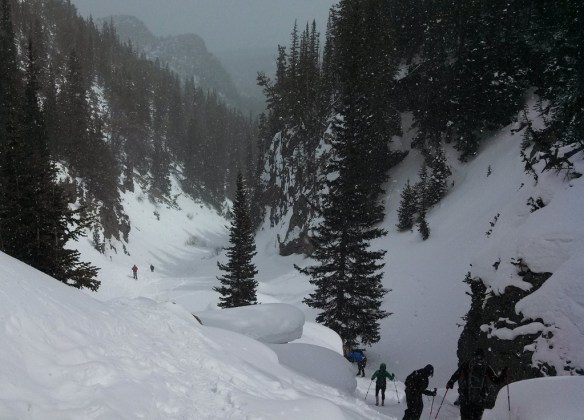
We continued on our way. Before long, it became obvious to me that the trail we were following wouldn’t take us to Lake Haiyaha. We were a bit north of where we needed to go. I had come down from Haiyaha last spring on the steep slope directly in front of us and knew we were unlikely to make it up that way. We needed to go to our left and up a more moderate slope. I knew if we’d just reach the top of that ridge the lake would be an easy hike. The trail we were intending to follow must have gone left somewhere that we went straight. But I certainly didn’t see any tracks that way. Blowing snow clearly obscured the correct path.

So we took off cross-country. Jerry took the lead as he was wearing the snow shoes. At times, even he was sinking a foot into the snow. I was often postholing quite badly behind him. Where the slope got steeper he had trouble with traction. We crested a ridge only to reveal another ridge above it. We topped that one to find yet another. I was sometimes sinking hip deep in the snow, crawling to get out. On the plus side, I was warm and dry, all my winter gear doing the job. But I was getting pretty worn out.

It was now about 1pm. I didn’t think Jerry would keep buying that we just had to gain one more ridge and we’d be back on the trail. We chatted about it for a few minutes and decided to back track the way we came. On the way, we kept a lookout for a nice place to sit and eat our lunches. In places we were quite surprised how steeply we had climbed. Soon we found a nice downed tree, barkless and gray, not covered with snow. We ate quickly as we had to take our gloves off.

By the time we were done and on our way again, my fingers were so cold I couldn’t feel them. I wasn’t particularly concerned. I knew that once we were exerting ourselves again I’d warm right up. This was true, it was only five or ten minutes before my fingers were warm again. The snow had stopped falling and sun was sparkling on the snow.

We again ran into other hikers; two groups of four or five hikers each.

“Where are you coming from?” they asked.
“The middle of nowhere. We didn’t get where we were going.”
“Where’s that?”
“Lake Haiyaha. Where you headed?”
“We’re trying to find Bear Lake.”
“Well, you’re heading in the wrong direction.”

One group took off down the trail in front of Jerry and I, the other lagged behind. I’d been looking for signs of tracks I might have missed but didn’t see any. We did come to a fork in the trail, though. The group behind us said the other hikers had gone that way only to reach a dead end. I thought the proper way was to the left and went that way. The group in front of us had by now turned around saying this way was a dead end also. In fact, the trail went nicely up the hill to gain the proper trail from Bear to Nymph. We could even see hikers on that trail. I hollered at the other hikers to follow me and we all got where we were going.

As two of them passed me, one said to the other “I wasn’t worried.” Perhaps he should have been. Granted, Jerry and I never made it to Haiyaha, but we were never lost. I knew exactly where I was. I just missed the tracks to the lake. These folks evidently had no idea where they were and seemed unable to follow fairly obvious tracks. I wonder how long they’d have been wandering around there.

Jerry and I made it back to the car by 3pm. Which left us three hours before pizza. I suggested we grab a beer at the brew pub and off we went. After a couple beers and some appetizers we headed to the shindig. We were still quite early so we sat in the car chatting and watching the clouds creep in from the west. The clouds looked like a big down blanket, slowly slipping over the divide, smothering the Bear Lake area.

Cars started arriving, so we went inside. There was a good turn out, a couple dozen folks at least. All had made it to Haiyaha but us, but no matter. People introduced themselves with their real names and their handles on the forum. I was surprised to find out that folks came from quite a distance for this little shindig. One couple flew in from Brooklyn.

As we were leaving, Mike suggested that we could still make it to the igloos if we wanted. He expected at least one of them to stand for another few weeks. I’m not sure I’ll make the attempt. I know I don’t want to take the summer route and I clearly demonstrated I can’t follow Ed’s route.

Maybe next year I’ll be willing to meet the Saturday group at the appointed time.

Ouzel Lake

Mike and I talked about hiking to Pipit Lake. It hadn’t really occurred to me to hike there in winter; I guess I’m still stuck in the “hiking is for summer” mindset. But after trading a few emails on Tuesday, we decided to go the next day. It would be the best weather for at least the next week.

I picked Mike up at the park and ride and we headed to the park. His bus was a few minutes late, and we were in the teeth of rush hour traffic into Boulder so we didn’t exactly get an early start. The Wild Basin entrance station is closed for winter – that is, there is no ranger there. That’s pretty much standard year around, if you arrive early enough. Up the road we go, only to find the gate closed before the road crosses the river. This was new to me. I really had no idea when that gate was ever closed. I thought perhaps it got closed when snow piled up on the road.

We geared up and started up the road. The thermometer read 44 degrees when we left the car at 9:00. On the drive up, the sky was mostly cloudy, with some rather ominous looking dark clouds to the west. At the trailhead, though, it was clear blue skies above us and to the west, with fairly strong winds. It took us twenty minutes to reach the trailhead; we figured we’d hiked a mile already.

We made good time on the first part of the trail to the campsite shortcut. We’d passed a few trees that had fallen across the trail, something I’d not seen here before. Approaching Calypso Cascades, there was a spot where water flows over the trail. There are several logs serving as steps; water had filled the spaces between the logs and frozen making terraces of ice – miniature skating rinks.

From Calypso Cascades to a bit past Ouzel Falls the trail is on a north facing slope and is now covered with ice or packed snow. There’s not much snow on the ground, just on the trail. I don’t know how this season compares to normal, I suspect it might be drier than usual, but it’s still early.

We took a short break at Ouzel Falls. A great mass of ice has built up at the base and it looks like the ice at the left side forms each night and melts during the day. A large chunk fell off while we were sitting there.

Continuing, we paused for a minute or two at the next trail junction, where the Thunder Lake trail goes right and Ouzel/Bluebird goes left. We would soon be atop the ridge which had burned back in 1978 and I anticipated it would be quite windy. Time to put on a hat to keep the ears warm. Gaining the top of the ridge, the wind was breathtaking at times. The occasional gust stopped me in my tracks. There is no shelter on this section of trail, which is not so good when it’s windy or in the summer sun. But it’s always good for the open views of the surrounding mountains.

At the lake I set up the GoPro for a time lapse. I didn’t bother with the SLR as there were very few clouds, just a few small ones above the nearby peaks that dissipated before they moved too far. Also, I found that the original battery for the SLR had died after taking only a handful of shots during the hike to the lake.

We looked for a place out of the wind to have our picnic lunches and ended up at the campsite. No view, but mostly out of the wind. After a short while, I went back to the shore of the lake and retrieved the camera. I had placed it on a rock only an inch or so above the ice. It was the best I could do, but not good enough. The wind had blown it over. I managed to salvage the footage. I didn’t do any fancy cropping to simulate pans or zooms; all the camera motion is caused by the wind. The first segment is at half normal speed (two seconds per minute) while the second segment is normal (one second per minute).

On the way out, we opted to continue a short way up the Thunder Lake trail to the upper junction of the campsite shortcut. It’s always nice to see a little different terrain. I think the shortcut saves six or seven tenths of a mile when hiking to Thunder Lake, but we had to go four tenths to get to it. So the hike out was a few tenths shorter than the hike in. We were also on the sunny side of the valley so we took another short break there.

By now I was figuring we were the only visitors to Wild Basin. I was surprised when we encountered three groups of hikers heading toward Calypso Cascades (two couples and a solo hiker). In retrospect, we probably would have met somebody at Ouzel Falls. We were the first ones to the end of the road in the morning, but when we returned to the car there were about a dozen other cars there. Not alone in Wild Basin, but only meeting five other people on that lower section of main trail is about as much solitude as can be expected.

Timetable

Car 09:00 AM
Trailhead 09:20 AM
Campsite shortcut (bottom) 09:50 AM
Calypso Cascades 10:00 AM
Ouzel Falls 10:30 AM
Thunder/Ouzel jct 10:50 AM
Ouzel/Bluebird jct 11:35 AM
Arrive Ouzel Lake 11:50 AM
Depart Ouzel Lake 12:35 PM
Ouzel/Bluebird jct 12:50 PM
Thunder/Ouzel jct 01:25 PM
Campsite shortcut (top) 01:35 PM
Campsite shortcut (bottom) 02:10 PM
Trailhead 02:40 PM
Car 03:00 PM

Button Rock Mtn

Ed and I planned on hiking to one of the several glacial knobs in the vicinity of Mills Lake or The Loch. I was going to leave the house by 7:15 or so to meet him at his place. Unfortunately, the Fern Lake fire had been fanned during the night by winds gusting to 75 mph, causing the park to be closed. Highway 66 was closed and everybody west of Mary’s Lake road had been evacuated. The fire burned three miles to the east in a half hour during the early morning hours. The Fern Lake fire has now been burning nearly two months and has consumed over 3500 acres, including Moraine Park.

So Ed suggested a Plan B – we hike to the top of Button Rock Mountain. The trailhead is a short distance up the road to Big Elk Meadows, just past Pinewood Springs on US 36. The hike starts up a rough four-wheel-drive track before heading cross country on a trail Ed has been working on for a couple of decades.

In the lower elevations, forest service crews are clearing the dead trees. First they cut up the dead wood and stack it in cones, very similar to what the park service has done along the roads in RMNP. In the park they’ve been burning the cones when conditions are favorable. Here, though, they use a large chipper. We couldn’t see the chipper in action, as it was on the opposite slope of a ridge we hiked away from, but we heard it operating from the time we put boots on the trail until about lunch time. As we gained elevation we could see the extent of the area already cleared. This is a substantial amount of work.

I wonder how much of a difference it makes clearing the dead trees this way. The wood is still there, just in a different form – chips spread out over the forest floor instead of being in log form. Not as concentrated, closer to the ground, I guess it won’t burn as easily or as hotly.

I’d never have found Ed’s trail without his guidance. The lower part of his trail was covered by chips laid down in the last couple of weeks. Before long, we got to an indistinct trail. As we hiked, he pointed out rocks he’d moved, or trees he’d cut or rearranged. He doesn’t want the trail to be too obvious, but easy enough to follow once you’re on it. When we neared the summit, the trail again became to vague for me to follow without his help. Near the top was a picnic table made from dead trees – trunks sawn in half with a chainsaw.

The view from the top was quite nice – Longs Peak and Twin Sisters pretty much due west; the peaks of Wild Basin to their left, and the summits of the Mummy Range not totally obscured by intervening terrain. All the summits were snow capped and shrouded by clouds. Smoke from the Fern Lake fire was faint but visible, smearing the sky along the horizon.

The peaks to the west are too far away for any interesting time lapse footage from the GoPro. And I’m disappointed once again with battery performance from the SLR. I charged both batteries a couple of days ago. The Canon battery was pretty much dead from the start and the after market battery only lasted for 100 shots.

The hike was a nice change of pace, but all in all I prefer hiking in the park. As I said, we could hear the chipper running continuously for about three hours. Our hike was also punctuated by more or less constant gunfire. And along the four-wheel-drive road there was quite a bit of trash ranging from water bottles and broken plastic to spent shotgun shells and even discarded clothing.

Lake Helene

As I mentioned in an earlier post, I’ve been wanting to hike to Tourmaline Lake. It’s in a small canyon west of Odessa Lake, which can be reached from either the Fern Lake or Bear Lake trailhead. I was all set to go there via the Fern Lake route when the fire broke out and every trail north and west of Bear Lake was closed. The Fern Lake trailhead is still closed, but hikers are now allowed to get to Odessa Lake from the Bear Lake side.

Taken from Bear Lake road in Moraine Park.

Once snow is on the ground, I’m less inclined to take the longer hikes. From Bear Lake, Tourmaline Lake is about 4.5 miles. That’s about two-thirds of a mile less than from the Fern Lake trailhead but it’s probably not any easier – the highest point on the trail from Bear Lake is near Two Rivers Lake, which is higher than Tourmaline Lake. Then you descend about 600′ to Odessa before gaining those 600′ back. On the return, you get to do the up and down again.

I didn’t really know how much snow to expect. The updates for the fire said it snowed two inches one day. I figure that probably won’t obstruct the trail but there’s no trail from Odessa to Tourmaline. Also, it’s always pretty windy up there, so two inches of snow could get redistributed in drifts. And always wanting to travel light, I didn’t want to take snow shoes. So I set off toward Tourmaline Lake with the expectation that I might not actually make it there.

The day started off crisp and clear but a bit on the breezy side. I arrived at Bear Lake at about 8:30 and was thinking at first that I might not have dressed warmly enough. I was expecting a fairly warm day for this time of year and wore a couple of shirts and a windbreaker, along with gloves and a knit cap. But I figured it was still pretty early; it would probably get 20 degrees warmer by noon and the hike would get me warmed up. By 8:45 I had my boots on and was on the trail. As I said, I didn’t take snow shoes but I did put my micro spikes in the pack.

The path around Bear Lake was a sheet of ice. The first part of the trail is the same as that for Flattop Mtn. The trail goes up the side of a ridge, initially on the sunny south facing side, then crosses to the north face. Where the sun shines on it, it was covered with ice but once reaching the north face it is just packed snow. There isn’t a lot of snow on the ground yet and the trail is quite easy to follow.

Although I thought I was hiking slower than usual, I reached the Flattop/Odessa trail junction in my usual time. The trail is in forest and affords no views except for a couple of places where you can see Bierstadt Lake and points east. From here the trail bends more to the west along the foot of Flattop Mtn, climbing slowly but steadily. Two Rivers Lake and Lake Helene are off the trail to the left under the craggy north face of Flattop and the dramatic Notchtop.

After catching a glimpse of Two Rivers Lake through the trees, the trail starts to descend slightly. Here the snow was getting a bit deeper on the trail where the wind piled it up in small drifts. The trail makes a sharp turn to the north but all the footprints in the snow headed off the trail towards Lake Helene. I continued along the trail which gets a bit steeper now. Very quickly Odessa Lake came into view, partially frozen over. Also very quickly, the drifts on the trail got much deeper. I decided I can wait to reach Tourmaline Lake until next summer, but I still wanted to go a bit farther down the trail with the idea of getting a better view of the burn area. Alas, there was no end of the deep drifts in sight so I turned around and headed for Lake Helene.

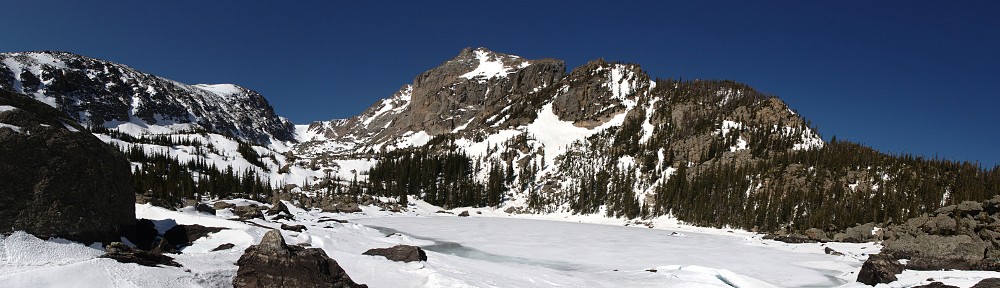
I left the trail a bit before I came to everybody else’s footprints. There is a vague trail that leads to Helene’s outlet stream. Topping this small scramble of rocks I found myself at the northern end of the lake. Winter hiking is still new for me, and I’m still surprised how much lower the water level is compared to spring and summer. I could walk twenty feet or more from the grassy summer shore to the edge of the ice today. And it is solid ice, already supporting my weight.

I walked around the lake taking pictures and looking for a sunny spot on a rock, out of the wind. There aren’t any. I might have been disappointed, if it had been closer to lunch time, or if the sky wasn’t absolutely cloudless. After wandering around for about twenty minutes, I headed back toward Bear Lake.

I thought about stopping at Two Rivers Lake, but figured I’d also fail to find a sunny spot out of the wind and there was no prospect of clouds for an interesting time lapse. And I’d stopped there back in April so it’s not like I haven’t been there recently. I was a bit hungry, though, and didn’t want to wait to eat until I got back to Bear Lake. Before long I found a nice sunny becalmed rock and tucked in.

My sandwich was already a memory when the birds arrived, begging. Two little chickadees (I think; I don’t know birds) were interested in my lunch. I don’t feed the wildlife, at least not intentionally. One bird was quite brave, flitting from one spot to another, all within arm’s length. After a few minutes of this, he got even more brave and landed between my feet and found a crumb of bread I’d dropped.

On my way again, I shortly arrived at a place where the trail traverses a talus field and has a view of Joe Mills Mtn. By now some clouds were forming. I decided to set up the GoPro and grab a quick time lapse. I found myself in the shade with no place to sit down and relax so I wandered up and down the trail a bit to keep warm. There was one spot with a small break in the trees where I could see to the north – a slightly obstructed view of the fire area.

By now it was a very pleasant day; it had warmed up nicely and the winds had died down a bit. Because I was hoping for a longer hike, I was back to the car quite early. And because my little time lapse segment was quite short, I set the camera up with a view of the parking lot and let it run a few minutes.

Timetable

Out In
Trailhead 08:45 AM 01:10 PM
Flattop/Odessa jct 09:12 AM 12:44 PM
Lake Helene 10:35 AM 10:55 AM


Twin Lakes FAIL

Not far off the Campsite Shortcut trail, two small lakes lie on a small bench on the hillside. They’re called Twin Lakes presumably due to their being next to each other because they’re not twins in any other regard.

The Foster guide says to take the Campsite Shortcut trail to the Siskin campsite, then head directly uphill 400 vertical feet. I copied that page from the guide and printed out a section of the 7.5′ topo map and headed off. I didn’t bother getting an early start, as it’s a fairly short hike – something like 3.3 miles to the first lake. I decided to make it a loop and visit Ouzel Falls and Calypso Cascades on the way back.

The main trail from the Wild Basin trailhead is a busy and well maintained trail. The first section runs alongside North St. Vrain Creek. Most hikers along this section go only to Calypso Cascades or Ouzel Falls; it’s pretty common to see folks wearing flip-flops and carrying no water. Just before the main trail crosses the creek, there’s a turn off for the campsites – thus the Campsite Shortcut trail. When heading to Thunder Lake or Lion Lake, I always take this route to save some distance and get away from the crowds.

Not being a camper, I never paid much attention to these campsites. So even though I’ve been up and down this trail several times, I needed to watch for the sign to Siskin. I was a bit surprised to reach the Thunder Lake trail junction having only noticed one campsite, and that wasn’t Siskin. Clearly, I was not paying close enough attention, so I turned around and headed back. I didn’t want to go too far, so I decided to just head uphill and use the map to find my way.

Bushwhacking here isn’t that difficult. The slope wasn’t terribly steep, and there wasn’t that much deadfall to deal with. Before long, I had gained quite a bit of elevation. Being in a forest, though, I didn’t have a clear view of any landmarks. I don’t carry GPS so I wasn’t sure where I was in relation to the lakes. At one point I decided I had climbed higher than the lakes, so I zig zagged down a bit. I even thought I saw water once but was mistaken. Next I felt I’d descended too far, so I zig zagged up a bit.

By 12:15 I found myself on a pile of large boulders sitting in the sun with a nice view of the valleys to the west. I decided it was a pleasant enough place to have my lunch and watch the world go by. I set up the SLR for a time lapse ate my sandwich. It only took a few minutes for the battery to discharge completely. Clearly, I’ll need to get the battery grip for the camera if I’m going to get serious with it.

After lunch, I set off in search of the lakes again. I had decided that I was, indeed, a couple of hundred feet too high. So I zig zagged down the slope. It wasn’t long before I had gone down too far and still no sign of the lake. I headed more or less due west intending to meed the Thunder Lake trail to complete my planned loop. The forest floor here was fairly flat and walking was very easy. After a few minutes of walking through this flat area I came across a campsite. I guessed it was Siskin, but saw no signs. Clearly, I wouldn’t find Twin Lakes today. For the rest of the afternoon, U2’s I Still Haven’t Found What I’m Looking For kept bouncing around my brain.

Not long after reaching the campsite, I found a trail. I wasn’t sure whether it was the shortcut or the main trail, so I kept going west. When I found a pile of horse dung I knew I was on the main trail, as no livestock is allowed on the shortcut. Except llamas, and I doubted llama dung looked like horse dung. So I turned around. A few hundred yards down the trail I found a sign for the Siskin campsite. Had I known it wasn’t on the shortcut but on the Thunder Lake trail, I have no doubt I’d have found the lakes. I was probably just a few yards east of them at some point.

I hadn’t encountered other hikers since I left the trailhead. From Ouzel Falls back to the trailhead, the trail was much more crowded as expected. Not as crowded as a mid-summer day, but I didn’t go more than five minutes without running into somebody.

At Ouzel Falls I set up both cameras for time lapses. This was an experiment – I didn’t really know what to expect. In the end, though, none of the time lapse footage was worthwhile. The wind moved the tripod during the first SLR segment and I didn’t deal with the lighting at the falls properly.

The weather was quite nice – sunny and warm with a few clouds scattered here and there. It was a bit windy; the pines didn’t so much “whisper” as mildly roar, but on the forest floor the wind was never much of an issue.

Timetable

Trailhead 10:20 AM
Campsite Shortcut 10:50 AM
Leave trail 11:35 AM
Return to trail 01:20 PM
Ouzel Falls 01:50 PM
Calypso Cascades 02:40 PM
Trailhead 03:15 PM