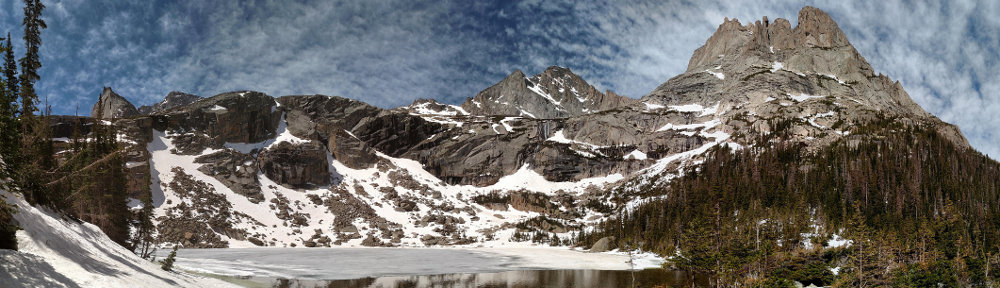
Watanga Lake

Friday, July 3

Last week when musing on the difficulties of bagging new lakes, I broke the challenges down into longer hikes, more bushwhacking, and more remote trailheads. This week I pulled Watanga Lake out of the Foster guide. It is reached from the Roaring Fork trailhead which is situated on Arapaho Bay, the southwestern extreme of Lake Granby. I would put it in the “remote trailhead” category. It’s not any farther than the other jumping off points on the west side of the park but it’s at the end of a ten mile dirt road. The road supports quite a bit of RV traffic and is quite smooth, but it is covered with stones. The speed limit is 25, but I probably never topped 15.

Watanga Lake is in the Indian Peaks Wilderness Area, about two tenths of a mile south of the RMNP boundary. There’s a self service permit kiosk just off US 34, at the end of the pavement. Day use is $5. About ten miles up the road, make a left turn towards the Roaring Fork campground. The trailhead is on the right.

The first couple hundred yards of trail are forested and flat. There’s a sign here announcing your entrance to the IPWA. Immediately the trail starts climbing steeply. It looks to me like a fire burned through here a few decades ago; many dead trees are standing, but there are aspen and some young pine with a smattering of mature pine. The trail is sunny, but the views of Lake Granby are still somewhat obscured.

The trail just keeps going up and up. When the trail bends to the northwest it looks to me like the trees have gone from dead by fire to dead by beetle. The ascent moderates a bit, but continues to climb. About a mile in we’ve climbed nine hundred feet and reach the first river crossing.

I would call this an unimproved trail. It is just a path, well traveled, but a path. No bars to

The first bridge is in the best condition…

divert flowing water, no rocks line the trail, nothing resembling a stair step. There are sawn log bridges, but no milled lumber anywhere. The Roaring Fork river is too wide here to be crossed with a log. Here is the only structure that could be called an improvement. In the middle of the river is a triangular log pier that supports two spans of logs. It’s a unique bridge in my experience. It was the first of what turned out to be nine water crossings, where each bridge was sketchier than the last, until the stream was small enough for me to leap across.

After this first crossing, the trail mellows out quite a bit. The next two miles only climb another seven hundred feet with the Roaring Fork river audible much of the time. Just before the confluence of Watanga Creek and the Roaring Fork there’s a trail junction. Watanga Lake is to the left. I passed a couple of hikers on the climb who were going to more distant lakes on the Roaring Fork trail.

Shortly after the trail junction, we make our sixth or seventh river crossing. We went from a double span to a long single span, two logs wide, to a single log, to a single broken log (still quite serviceable) and finally to a broken log replaced with a skinny limb. I arrived there at the same time a group of four hikers and a dog arrived on the other side.

I waited patiently and watched their crossing operation. They had a short length of white cord. They tied it onto a tree and the first guy kept it under tension to aid the crossing. I don’t think he stood a chance of making it without the cord. He was in full-cowboy attire: cowboy hat, blue jeans (with a circle worn in one back pocket), and cowboy boots, missing only the shirt with snaps. Using the cord, he crossed without incident, as did the next guy.

The third guy, wearing trail running shoes, lost his balance and went in the drink getting soaked nearly up to his knees. The last guy on the other side tied the cord to the dog’s harness and the second guy pulled the dog across. The dog looked terrified during the act and quite happy afterwards. Then they tied the cord to a tree on this side and tossed the free end to the last hiker, who then crossed without incident.

In the middle of this operation they asked if I wanted to use the cord, but I figured I wouldn’t do any better than the guy who soaked both his feet so I declined. I had decided to take boots and socks off and ford the stream as that’s what I’d need to do when returning.

The water was almost knee deep, moving quickly, and quite cold. The rocks were slippery but I had no problem making my way across. I did it a lot quicker than they did, and one of them had wet feet for the rest of his hike.

Before we parted, I asked, “How far to the lake? Two miles or so?” They said that was about right, but one of them also said they’d left the lake a half hour ago so I thought it was probably less. But they also said it felt like it took them three hours to get there from this point. I didn’t take that seriously.

A short distance past the ford the trail crosses the river again then begins to climb steeply. The last mile or so climbs another seven hundred feet. I generally don’t sit down before reaching my destination. I’ll often pause for a breather; take a sip of water or snap a photo, chat with other hikers. But I don’t sit down. This final climb took me off my feet. Part of the climb is on a hillside in full sunshine. After several switchbacks I sat in a little patch of shade and ate some fruit.

Somewhat refreshed, I pushed on, vanquished the final climb and arrived at Watanga Lake. The hike in took me three hours. This was a bit longer than I expected. Of course, there was the delay at the ford. But more annoying was that the trail was much steeper than I expected. Last week I said that the trail to Timber Lake climbed a bit more than the typical five mile hike. This trail is shorter but climbs five hundred feet more. I clearly didn’t pay any attention to that statistic when planning the hike.

Dogs were common hiking companions on this trail. Only myself and one couple lacked a canine. At the lake was a guy with three dogs. He fished, they ranged over a wide area. The dogs were small, smaller, and smallest.

The lake is scenic, but not dramatic. It’s small and shallow, with a large marshy area to the west. On my way out I ventured that way looking for another picture but there was no better view than where I sat and ate. Found a few nice flat rocks next to a handy snowbank to chill my beverage. It never ceases to amaze me how much better food tastes when enjoyed in a beautiful setting after three hours of hiking.

On the way down realized how fast the trail climbed. The guy at the lake complained about it, but I think he was complaining more about the sixty pound pack and herding the dogs. Hefting an extra sixty pounds, yeesh. That’s why I ‘m a day tripper. It took me three hours to get to the lake, but that includes probably twenty minutes watching those four guys cross the stream.

As I approached the ford, I was thinking how much more efficiently I crossed than they did. It took them quite a while and one went in the drink. But on my second crossing, I tossed one boot short and bounced into a puddle. Dang. It was standing upright, but it landed on its side. Maybe it didn’t get wet inside. Alas, it was pretty well soaked.

I sopped as much as I could with a paper towel, but it still felt pretty wet. I opened the tongue wide and set it down with as much sun shining in as I could. I took a short break and ate my cherries. Resigned to a wet foot for the remainder of the day I packed up and put the boots back on. For about thirty seconds my foot felt wet but after that it felt normal.

I made it back to the car shortly before four. No shade at the car, toasty, a bit dusty. Between the hot sun and the slow dusty drive to the highway I elected to keep the top on. I almost always return over Trail Ridge but figured the traffic there would be very bad so I drove back the way I came.

I stopped for a cold soda in Granby. There was a couple in a Polaris. Technically, they rode their Polaris; legally it’s a motorcycle and of course they get wet when it rains. Everybody was so busy asking them questions they didn’t notice me. It’s not often my car isn’t the center of attention.

Traffic moved pretty well, pretty much the speed limit all the way to Winter Park. I dispatched some slower cars going up the pass. People moved at a reasonable speed on the down side and before long we’re to I-70. The westbound traffic was horrendous. It only appeared to be stop-and-go in short blips, but it never moved fast, all the way to the bottom of Floyd Hill. And I’m sure it was that way all the way to the Eisenhower tunnel. Quite the contrast from what it was in the morning.

Fitbit app (GPS) says 4.51 miles, wristband recorded 5.97 miles with only 80 more paces on the way out. Foster says 4.8. Just a tad short of 25,000 paces for the round trip. Depending on how often the app queries the satellite, the GPS may read short on all the switchbacks. But I wouldn’t expect three tenths short, so I’ll assume the lower number is the most accurate.

Timber Lake

I’ve been aching to hike to lakes I haven’t been to yet. It’s been a long time since I bagged a new lake. No, that’s wrong. On the contrary, it was as recent as October, and half my hikes last year were new. Is going to new places getting to be an obsession for me? “My name is Dave, and I’m an addict.”

Unfortunately, my hunger for bagging another lake is getting harder to sate. I’ve picked all the low hanging fruit and to get to new lakes I have to go farther afield. The remaining ones are farther away, with more bushwhacking, and longer drives to the trailheads. This year I’m planning an 18 mile hike and a 22 mile hike. But it’s too early to try either of those; there is still too much snow on the ground for me to attempt either. If I can’t have a new item from the menu, what haven’t I had for a while?

After giving the question some thought I decided on Timber Lake. I was there once before, thirty odd years ago with my brother. Just that one visit, half a lifetime ago, and I somehow didn’t take a camera. It’s the only lake I’ve visited only once and last visited more than six years ago. This lake will look about as new to me as one I haven’t been to.

Foster lists the hike to to Timber Lake at 5.0 miles and a 2,000 foot climb. The sign at the trailhead indicates 5.3 miles, and from the topo maps it appears closer to 2,100′. Either way, it’s a greater than average climb for a five mile hike.

It’s a west side hike, the last trailhead before the switchbacks on Trail Ridge Road. I figured if I hit the trail by nine I could be at the lake easily by noon, so I didn’t need to hit the road too early. I made a leisurely start, leaving the house a few minutes before seven. I took my time on the drive; top off and a jacket on, a bit on the cool side at 70mph, but not uncomfortable. It looked to be another beautiful day. As I went farther north, though, it became a bit overcast.

Being a west side hike, I figure two hours to reach the trailhead. I went the speed limit the whole way with the possible exception of Berthoud Pass. And as it’s a few more miles into the park than the other trailheads I didn’t get on the trail until nearly 9:30.

IMG_5035sAt the trailhead there was a notice of a detour on the trail due to a landslide, more damage from the floods of nearly two years ago. I was in this vicinity when it started raining then, traversing the ridge immediately to the north of Timber Lake, to and from the Gorge Lakes. I will never forget that one – above treeline for an eternity with lightning striking on the other side of Trail Ridge Road.

The Timber Lake trail doesn’t start climbing until you’ve gone nearly a mile through a mixed forest of pine and aspen. The trees are widely spaced and the ground is covered with grass. You can hear the cars on Trail Ridge until the trail finds the crease made by Beaver Creek and the rushing water drowns out the noise.

After crossing Beaver Creek the trail starts climbing. There are many trails that will climb 400 feet in a kilometer. (Yes, I know. Mixing my units.) For most improved trails, that’s a typical steep section; you may have one or two of these separated by level or nearly level sections. Here it’s twice that – you climb about 900 feet in the two kilometers after crossing Beaver Creek.

The detour was marked with this tape

The detour was marked with this tape

That’s when you arrive at the detour. On my way to this point I pondered what the damage would look like. I was picturing something like the landslide on Twin Sisters but I decided it wouldn’t be like that. On Twin Sisters you cross the landslide area, you don’t detour around it. On Twin Sisters a couple of switchbacks were washed away; you hike along the trail, then climb straight up the slope until you retain the trail; repeat until above the slide.

So I wasn’t surprised to see that the detour takes us straight up the slope. The footing isn’t great; I bet it’s treacherous when it’s wet. The detour goes straight up the slope gaining another 200 feet before contouring along the slope for a while. At the top there’s one spot where the soil has slipped several inches but is still somewhat held together by roots – the top of the landslide. At this point the detour falls straight down the slope a hundred and fifty feet or so and regains the trail.

Prior to the detour, the trail was pretty much free of roots and rocks making it easy to maintain a steady stride. This eased the steep climb somewhat. After the detour the trail features a more typical number of rocks and roots, slowing my pace a bit. All this time the trail has been rising along the side of the valley, a couple hundred feet above Timber Creek. About four miles in, the stream has climbed to meet the trail.

The trail rises steeply again, another two hundred feet in a series of switchbacks, before depositing us at the base of a high, dog-leg valley. The final mile and a quarter to Timber Lake only climbs another 400 feet, skirting the north side of wide open meadows. Timber Creek meanders here in places. But, to me, “meander” connotes slow. The water here is not slow.

The lake is about three times longer than it is wide, and lies more or less north-south in its valley. I arrived at the lake a few minutes before noon. On the way up, I encountered a half dozen or so hikers who were going down but saw no others going my way. I figured I’d stay about an hour and guessed that a handful of other hikers would arrive during that time. I want to maximize my personal space, so I made my way along the western shore to the north end.

The clouds looked to be more dramatic to the south over the mountains, but I didn’t want to shoot directly into the sun. I set the camera up facing the lake’s outlet and the valley beyond. A few feet above the south west shore of Timber Lake is a shallow pond. It has a nice view; I waved “hello” to a pair of hikers who were there enjoying it. By the time I packed up, three other pairs of hikers had spread out on the north east side of Timber Lake where the trail deposited them.

After eating my lunch I watched a large bird soar high above me. It was too far away to be sure, but it was a big bird so I’m guessing an Eagle. He was expending very little energy, gliding back and forth high about the ridge to my east. It amazes me that they can see their prey from such a height.

I began my hike out by continuing around the lake to the eastern shore. Circumnavigating the lake is fairly easy; no trees to speak of, and very little willow. There is some talus at the southern end, but it’s mostly covered with snow right now. The portions that weren’t snow covered were like saturates sponges. It was this way all the way around the lake. Right now, it would be misleading to identify the inlet for Timber Lake. There are a number of trickles that will remain when the snow is all gone, but until then the entire shoreline feeds the lake.

On the way down I decided I’d investigate the landslide area. You’re not supposed to continue down the trail past the detour but curiosity overcame me. By now I was thinking perhaps it would be more like where the Lawn Lake flood undercut that trail. That would certainly call for a detour. There’s a traffic cone block the trail. A short distance beyond it I arrived at the landslide area.

It wasn’t nearly as dramatic as I had envisioned. If I didn’t know it was a landslide, it might have taken me a minute to figure it out. There’s no view; it’s in the middle of forest and it’s not at all like Twin Sisters or Roaring River. Nothing has been washed away. The trees and bushes and grass is still there, but the trees are mostly uprooted, lying at odd angles. The ground didn’t wash away in the flood, it just lost cohesion and slid a short way downhill.

IMG_6364sThere is a small stream here, if you want to call it that. What channel may have existed before isn’t there any more, and the water has spread itself out – over and among and through. What might it take to make things slip some more? It’s hard to say how wide the slide is – twenty or thirty feet perhaps. But I wouldn’t want to be on it were it to let go. This one is tiny compared to the landslides that have been in the news in recent years, but think of the results if this thing let go. It’s about five hundred feet from the the top of the slide down to Timber Creek.

Managing the detour on the way out was not fun. but it was all downhill after that. Between refilling my water supply, the side trip to see the landslide, and chatting with a group from Oregon it took me a half hour longer on the way out than the way in. I was back to the car by four.

I used the app for the Fitbit on the way up. It drained my phone battery to 32% in the two and a half hours it took to reach the lake. At the lake, I put the phone on airplane mode and when I powered it up back at the car it magically was back to 39% charged. Odd. But clearly I won’t be able to use the app on any hikes longer than three hours. (I have a charger in the car, so it was 100% when I hit the trail.)

I would like to use the app another time or two to get a better sense of how well the wristband measures distance. The app, using GPS, said the hike up was 5.6 miles. That compares well to the 5.3 miles indicated on the sign plus going to the far end of the lake. It was just short of fourteen thousand steps. The wristband game me a distance of 7.1 miles on the way out. That was 14,825 steps, so using the same number of steps per mile as the ascent would put it at more like 5.95 miles.

It credited me with climbing 283 flights of stairs. Around the house, it tends to undercount stairs slightly. They count a ten foot rise as a flight, so that 283 isn’t far off. Net elevation gain to the lake would be something like 210 flights. Every trail has its ups and downs. Throw in the detour and 283 sounds reasonable.

The Fitbit says I burned about 1,800 calories on the way up, another 1,700 on the way down, and a total for the day of nearly 5,900. Typically it shows me burning about 2,600 a day.

As to my heart rate, it breaks my activity into three categories: fat burning, cardio, and peak. They determine these by calculating max heart rate as 220 minus my age. Fat burning is more than 50% of max, cardio is more than 70% of max, and peak is more than 85% of max which for me is about 140. It recorded me in the peak category for 70 minutes on the way up and 15 minutes on the way down. I was in the cardio zone 74 and 126 minutes, and fat burning 15 and 37 minutes.

Okay, enough of that.

By the time I was back to the car, the weather was starting to turn. I heard thunder rumble once just before reaching the car and the clouds over Trail Ridge looked a bit threatening. I elected to leave the top on the car for the drive home.

Traffic on Trail Ridge was sometimes painfully slow. A large herd of elk was grazing right next to the road near the lava cliffs so everybody slowed to a walk. I saw a few lightning strikes over the CCY area but only got sprinkled on. It took an hour to get from the parking lot to the eastern gates of the park.ย  From Estes Park to Lyons we went nearly the speed limit, and sped up again between Lyons and Boulder. Then I ran into a jam – they were carrying the torch for the Special Olympics. I caught them between Jay Road and the Diagonal. That was another ten or fifteen minutes.

All in all, not a bad way to spend the day.

Lake Helene

I’ve developed a real appreciation for Lake Helene. It only recently made it on to my radar. I had hiked from Bear Lake to Fern Lake several times before venturing the couple hundred yards off the trail. The hike is a bit on the short side for me so I’ve been doing it either in winter or late spring, most recently last Sunday.

Jerry and I hiked it last year, a bit earlier in June. We hiked over quite a bit of snow, from not much after the Flattop trail junction all the way to the lake. This time there was not as much snow in spite of the cooler and wetter May. But I get ahead of myself.

As it’s a shorter hike, I didn’t need to get up at the crack of dawn. I left the house around seven and stopped in Boulder for breakfast. I arrived at the Bear Lake parking lot at about a quarter to nine. I was surprised none of the signs suggested I park at the shuttle parking lot. It was a near thing. I snagged one of the last few parking places in time to hear the rangers “call it” – the parking lot was full.

The forecast for Denver was a pleasant but warm day with a high in the mid-90’s. I was expecting the usual brilliant blue skies, but it’s been more humid than normal so visibility wasn’t as good as normal. Perhaps we’re also getting some smoke from the forest fires in California. Other than the haze, though, it was fairly clear.

I wanted to use the Fitbit to log the hike, but the Android app was wonky again so I just pushed the button on the wristband. I’d try the app again for the return trip. I had no intention of using it both directions, as my battery life has been poor lately and I suspect the Fitbit app makes it even worse.

IMG_5030_stitch_crop_resize

Notchtop over Lake Helene

I arrived at Lake Helene a bit after ten and looked for a nice sunny spot to sit and watch the world go by. I made my way to a peninsula of talus surrounded by a sea of snow that stretched about a hundred yards in all directions. Mid-90’s in Denver and here I am, sitting in the pleasantly cool sun on a rock in the snow.

I set up the camera facing down the valley to the north and surveyed the sky. Although the mornings are often cloudless here beneath the divide, it’s typical to see clouds form by eleven or noon. You don’t need time lapse to see them move; they’re generally quite boisterous. Today, though, it was just a thin veil of high clouds with little apparent motion. That’s okay; variety is a good thing.

I spent about two hours not doing much. The snow is melting everywhere around me, just about everywhere I can see. The rocks on Notchtop are streaked dark with water. Lake Helene is brimming at its banks. The falls are too far away to hear, but there is a slight breeze whispering through the pines. Occasional gusts kicked up, painting ripples on the surface of the lake.

Being that there is no official trail to Lake Helene it doesn’t see many visitors. It’s obvious people come here; there is a faint trail and I found footprints in the snow. At this time there are probably fifty people at Emerald Lake, and on the trail there you’re never out of sight or ear-shot of other hikers. Here, I had the illusion of solitude. While I was there, a couple of hikers appeared at the outlet but they were far enough away I never heard them and between here and the Flattop trail junction I met fewer than a dozen other hikers.

According to the Fitbit app, it’s three and a quarter miles. The bracelet comes up with 3.8 miles, but it’s not using GPS. I suspect the shorter distance is more correct. Comparing the data in the two logs, I see pretty much what I’d expect. It took me fifteen minutes longer on the way up than the way back, and I was working harder, burning about 30% more calories.

Back at Bear Lake there was a steady stream of cars arriving at the parking lot. I guess most of these folks figured the signs saying the parking lot was full aren’t intended for them. Strangely, nobody waited for me to back out of my spot. The last guy to pass me waved me by. “Did you just leave that spot?” He thought he might back up and snag that spot, but he never stood a chance. Probably took me 10 minutes to get out of the parking lot. Very crowded.

On the way out of the park, the signs said all the parking lots were full and visitors should try again after 4pm. I’ve never seen any indication that all the parking lots were full before. I don’t recall seeing the shuttle parking lot more than half full. Busy day.

Emerald Lake

Sunday, May 31

The last weekend in May is my traditional jumping off point for the summer hiking season. Following tradition, I visited Emerald Lake.

As it’s a very short hike, I could enjoy a lazy morning. I left the house just after nine and had a pleasant drive in spite of the expected heavy traffic. Before I reached Boulder I realized I forgot to bring the spikes. I never had spikes until a few years ago, so I knew I’d have no problem getting to Emerald, but I’m much more comfortable hiking on snow when I have some traction. And it looks like Longs Peak has more snow now than is typical for this time of year – heck, more than is typical for any time of year – and after a very wet and cool May I was expecting to see more snow at Bear Lake than usual.

I arrived at the Bear Lake parking lot at about 10:45, late enough that I had to park near the bottom of the parking lot. There wasn’t as much snow at Bear Lake as I was expecting; clearly what’s been falling in recent weeks has been melting pretty quickly.

I recently bought a Fitbit Charge HR and this hike was the “shakedown cruise” for it. I played around with it on the Black Hills trip and for the Bolder Boulder, but the Android app crashed and I didn’t collect any useful data. I can use it with or without the phone app. If I don’t use the phone, it collects steps taken, flights of stairs climbed (1 for each 10′ gained), my heart rate, and exercise duration. Using the phone as well, I get a map of my hike. My concern is, if I use the phone, how long will the battery last?

I launched the app at 10:52, right at the car, and started walking. I followed the summer route as there wasn’t enough snow to take the winter route. According to the Fitbit, it was 1.82 miles from the car to Emerald Lake. It took me 48 minutes and I gained 818 feet of elevation.

fitbit_map

One of the reasons I wanted this particular model of Fitbit is to collect a log of my heart rate. I’ve talked to people using older ones, and you need to use a chest strap to get a log of your heart rate, or stop every now and then and query the device to get your current pulse. Here’s what my heart did on this short hike:

fitbit_heartThis was just the hike to the lake. I stopped the app there and restarted it for the return trip. Oddly, I had a higher peak heart rate going down than I did going up. I don’t expect to get similar results on my much longer and more strenuous hikes. Unfortunately, when I got back to the car I managed to plug the phone into the charger without noting how low the battery was, so I still have no idea how well it will work for an all-day hike. I’m guessing I’ll be able to use the app on the hike to where ever I’m going, and not use the app on the way out.

There were fewer hikers than I was expecting. I guess the snow had most of them turning around at Nymph Lake. I did overhear a few amusing snippets of conversation. Near Dream Lake: “Where does all the water come from? Snow melt?” Keep in mind, they hiked half the way here over snow. At Emerald Lake as I was leaving, a young couple arrived, looked around for a few seconds, took a picture to prove they’d been there, and turned around to leave. The young woman calls out to a friend, not yet to the lake, “Hardly worth the trouble, it’s not very scenic.” I have several complaints about hiking to Emerald Lake but lack of scenery isn’t one of them.

I had the SLR up and running for the time lapse by 11:52. Readers of the Black Hills posts will recall that the GoPro was a casualty of that trip, so I only had the one camera. I managed to forget to put the lens hood on it, so when it started sprinkling I stopped and packed up as the lens would get wet right away. This turned out to be a good thing, as the graupel started falling almost immediately.

I beat the squall to Dream Lake and figured I’d set up the camera to continue the time lapse. Unfortunately, I ran into some unknown technical difficulty. The timer wasn’t working. It was counting down properly: “0:02… 0:01…” but no shutter release. Very frustrating. I reset it several times to no avail and by the time I gave up, the graupel started falling here. I had planned to snack on my berries while the camera ran for a while, but so it goes.

IMG_2698sThere’s a nice open view of Glacier Gorge and the Longs Peak complex from the trail below Dream Lake, so I stopped there and ate my blackberries and raspberries. There were squalls over Longs, just as when I paused here on the way up. Very scenic. The weather didn’t follow me past Dream Lake – from my rock with a view to the car, no more precipitation.

I had a lazy drive down the mountain in an unbroken string of traffic from Estes to Lyons.

The time lapse is a bit on the short side this time, but so it goes.

Lake Haiyaha

Saturday, March 7

Some of the folks on the RMNP forum get together every year for a Stomp. I forgot all about it last year, and the year before Jerry and I made it for the pizza dinner but never got to the lake. So this was my first Stomp.

I’m not a big fan of snowshoes. I generally only go on commonly traveled paths in the snow so I can get by with the microspikes. Our route to Haiyaha is off-trail, though, so I definitely needed the floatation the snowshoes provide. I took poles, too. I don’t use trek poles when hiking but figured they might be good with the snowshoes, but won’t again.

This was only my second winter hike to Haiyaha. The first time, I took the summer route. I won’t go that way again in snow. There are a couple places where you traverse steep snow and I’m not a big fan. Ed’s way is a much nicer route. By the time I hiked out, it had been pretty well traveled. I think I could find my way again, now that I’ve been that way.

With the weather the way it’s been lately, I figured the road to Bear Lake would be snowpacked and icy so I arranged to drive Genae’s car, stranding her at home for the day. But Friday was clear and warm – bright sunshine, brilliant blue cloudless skies all day. It was nearly 70 here at the house and the snow almost completely melted from the pavement in the cul-de-sac. I decided to take the Lotus.

Up at 5:30, out the door a few minutes before 6:00. Grab a breakfast sandwich at Burger King in Boulder and head up the canyon. Coming down Pole Hill into Estes, the Mummy range blanketed in brilliant white snow, the sky above the deepest blue, and again not a cloud in the sky, not even contrails.

I took the “shortcut” by the hospital out of habit. It avoids the traffic through the village, but that’s not a concern in winter. I also tend to go up Riverside rather than 36. Just a couple hundred yards past the brewery I saw an animal cross the road. It was in shadow, but looked too small for a deer or elk, and might have been gray instead of tan. When I got there, I saw the coyote standing forty feet from the road. When I passed Manor RV park I got a bonus – a flock of about a dozen turkeys crossed the road. (I just learned the group name for turkeys is not a flock. It’s either a rafter or gang, take your pick.)

A sign near the park entrance warned the road was icy and recommended 4WD or AWD. Not a good sign when you’re RWD with bald tires. But as I suspected, the sun did it’s work yesterday and the road was clear all the way to Bear Lake. There were a couple of icy patches where the wind blows snow across the road, but even the parking lot was mostly free of snow.

I connected with the group and after introductions (where I apologized in advance for forgetting nearly everybody’s name), we hit the trail about 8:15. We set a leisurely pace, which suited me just fine. I find snowshoeing much more tiring than hiking. I have to alter my gait so I don’t trip over my own shoes and of course there’s the weight. It doesn’t seem like much, but compounded over thousands of steps it adds up.

Before long we were off the trail. We weren’t exactly blazing a new trail, as we had Ed’s (days old) track to follow, but the track was generally faint and fully blown over in a couple of spots. All in all, though, the going was fairly easy. It’s not a long hike, there are only a couple of sections with much of a grade, and it has pleasant views. I saw no other hikers, although a couple did catch the end of our group just as we got to the lake.

It took us a bit over two hours to make the trip. We went to the igloo and met Ed and the rest of the gang and socialized for a while. A bit after noon, most of the gang left. It was lunch time, though, so I sat on the rock above the igloo and enjoyed the view and my picnic. I didn’t exactly eat and run, but soon said my goodbyes and headed back.

IMG_1738s

The igloo is sheltered by an enormous rock; the floor is about level with the top of the door.

When I hiked to Emerald last month, I was only able to shoot a handful of pictures – the batteries weren’t working well in the cold. This time, I carried them in my pocket to keep them warm. There wasn’t any point in setting the cameras up for time lapse as there were no clouds all day. So the next order of duty was to put the batteries in the camera and check out the ice on the lake.

I’ve been to ten lakes in the park when they’ve been iced over. Lake Haiyaha is unusual. Many of the lakes seem to maintain the same level in winter as summer. At Lake Helene the water level drops a foot or two, but it’s so shallow that the water is quite far from the summer shore. Haiyaha sits next to a large boulder field. Some of the rocks are as big as houses, some as big as cars. When it gets cold it ices up. At the same time, less water flows into the lake than out and the water level drops. Not a foot or two, but eight or ten.

There are a number of large boulders that are fully submerged until the lake drains and they punch through the ice. I wonder how long it must take – it takes a long time to drain a lake and the water drops very gradually. When the ice makes contact with the rock, the pressure will build up slowly but inexorably. As more ice is lifted from the water, the bottom surface of the ice is put under tension. Ice doesn’t handle tension well – I bet it makes quite an interesting sound when cracks.

IMG_1749s

Icy volcanoes

Now, a line of these rocks poke through the ice like glacier shrouded volcanoes. The broken faces of the ice are no longer razor sharp – wind and blowing snow have softened, almost melted, the edges. It’s crystallizing on the top, but under that zone it’s the palest blue glass. Up close you see the bubbles lined up like beads on a curtain. My pictures don’t do it justice.

IMG_1753s

Blue ice

I probably spent half an hour soaking it in.

IMG_1764s

Wind sculpted snow

The hike out was uneventful. I heard voices occasionally but never saw anybody else until I regained the trail. (Again, am I hearing voices, or am I hearing voices?) A few other parties had done round trips on the track by the time I started down, so it was very easy to follow and often well packed. For a while I thought I maybe could do it in spicks instead of snowshoes, but that would have been optimistic.

Back at the car, I considered taking the top off for the drive home. That would have been a bit optimistic, too. And besides, by this time I realized I hadn’t even thought of sunscreen and had burned my face. Oops.

Cars and Hiking

Not only was Saturday the first Saturday of the month, it was forecast to be a gorgeous day. I decided it was time for the first hike of the season, so I planned for my umpteenth hike to Emerald Lake. Being the first Saturday, it was also time for Cars & Coffee in Lafayette. As Emerald Lake is a short hike, that left me plenty of time to check out the cars before heading to the Park.

Kent showed up this time in his new BMW i8. It’s a beautiful car and drew quite a crowd. IMG_1455s IMG_1458s

For some time I’ve considered taking the Chrysler instead of the Lotus. That’s sort of a joke, but only sort of. I still think they’re one of the better looking cars produced in the last few decades. But mine is starting to look rough around the edges. The clear coat is starting to peel off one of the repairs. But not a bad looking car for going on 16 years old.

Just after Kent rolled in with the i8, I saw a 300M show up. His is a 2000 (mine’s a 1999). He’s entered it into a number of shows and won some awards. He takes real pride of ownership, in spite of telling me he’s had all sorts of problems with it. As mine is finally starting to exhibit problems other than cosmetic, we chatted a bit about possible solutions to my undiagnosed problems. I may have to see if he’s willing to give me an assist on my repairs. Anyway, it was good to see the 300M represented.

As for the hike, not much to tell. I’ve done that hike dozens of time. Saturday, the wind was fierce at the lake. I was prepared to shoot a time lapse, but it was just too windy to sit there for any length of time. I made my way back to Nymph Lake for my picnic. The Park was quite crowded. From Nymph to Dream, I take the “winter route” while most take the summer route. There is one place where I can see hikers on that trail from below. There were about thirty people in a line, all within arms length of each other.

In spite of the crowds and the wind, it was good to get back on the trail after a few months off.

Twin Lakes and Sandbeach Lake

Sunday, October 26

A couple weeks ago I met Gale on the trail to Lawn Lake and we exchanged emails. This week, she asked if she could tag along, if I was planning on a hike on Sunday. Well, I had no plans when she asked but that was easy to remedy.

A couple years ago I followed Foster’s directions in an attempt to find Twin Lakes in Wild Basin. She says “finding these lakes is a bit of an orienteering challenge”. I fell short of that challenge and figured it was about time I made a second attempt. I studied the map for a while, finally suggesting that Gale accompany me on my second assault. Over three or four days, my plan evolved a few times with my final idea being after we visit Twin Lakes, we cross the ridge, bushwhack up to Sandbeach Lake and hike out on that trail.

We met at the Sandbeach Lake trailhead shortly after eight. I left my car there and she drove us to the Thunder Lake trailhead. We put boots on the trail before eight thirty. It was sunny and mostly clear; the only clouds were hanging over the Divide. It was also windy. I think I used the phrase “a bit breezy.” What I really meant was more like “it was savagely windy.” But the hike would be through forest the whole way; the only time I expected to deal with the wind was when we were hanging out at the lakes.

Rather than follow Foster’s directions this time, my plan was to hike up the Thunder Lake trail until we reached about 9800′ elevation, then contour east along the slope to the lakes. I’m generally low tech when I’m hiking. I don’t carry a GPS unit with me. I do carry a smart phone, though. I use a speedometer app when I’m in the car because the car can’t be trusted to tell me how fast I’m going. This app also shows the elevation, which can be handy in cases like this.

Shortly after regaining the main trail after the campground shortcut, we arrived at a couple of switchbacks. The eastern end of one of these was conveniently close to our target elevation so we headed off trail there. As is usual when off trail, we couldn’t go in a straight line. I kept thinking we were going downhill, but every time I checked our elevation we were still on target. It was in here I saw the only wildlife on the hike: I spooked a very large rabbit who made very good speed in spite of his girth.

We weren’t making great time, what with finding the best route past rock outcrops or through dense pockets of trees. But it didn’t take too long to arrive at the larger of the Twin Lakes. This is the westernmost, larger one. These lakes are snow fed, neither has an inlet or outlet stream. They’re pretty shallow and, again, I’ve been to larger unnamed ponds in the park. But the view to the west from this lake was very nice. As expected, the wind was quite strong here. At times the wind gusts were so strong they kicked spray up ten or fifteen feet above the water.

We found a place more or less out of the wind and I set up the SLR to do the time lapse. We sat and ate part of our lunches and watched the world go by for about a half hour. Upon retrieving the camera I saw that I neglected to use my usual settings. There are a number of things I have to change from my usual shooting – turn off auto-focus, turn off stability, set it on full manual and set the proper exposure, configure the timer. And change it from storing raw images with large, fine JPG to a smaller image. This is the first time I’ve managed to forget this part. So I filled the memory card pretty quickly. Oops. I’ve been meaning to buy a bigger card; perhaps this error will be the impetus for me to get it done.

After getting our gear together, we headed the short distance to the other Twin Lake. It’s just a few yards away, and up a few feet of elevation. We passed through a little aspen grove. This one turned out to be perhaps the most interesting aspen grove I’ve walked through. Some beaver had been busy here, gnawing through dozens of trees. Some had been downed, chewed through completely. Others were still works in progress. The wood chips looked fairly fresh; I doubt this work was abandoned, but what do I know?

I didn’t see anything like a beaver lodge in either lake, and there are no streams here. The beaver must be in one of the lakes, though. These were pretty big trees; there was no other possible body of water this lumber could be taken to, unless that beaver has access to a helicopter or something. Which probably means I wouldn’t recognize a beaver lodge if I was standing on it.

There is almost no view at the smaller of the two lakes, so we didn’t dally there long. From here, we headed almost straight up slope. We only needed to gain about two hundred feet to top the ridge. We passed a couple of cairns and came across what I think is a wildlife trail. After topping the ridge, a small unnamed pond was next, just below us. The pond sits, as is common, surrounded by marshy grass. Being nearly November, it was mostly dried out.

Sandbeach Creek feeds this pond. The map also shows a gully a bit to the west of the creek. We found ourselves ascending this gully rather than the creek. The gully is clearly a flowing stream during spring and summer; now it’s dry but verdant, filled with moss covered rocks, darkly green in the shade of the forest. In places, it looks like there is dried mud covering some of the rocks. It’s not mud, but a dried fibrous sheet a couple millimeters thick.

The gully opened into a clearing where we hopped up a pile of rocks about thirty feet high before returning to another mossy section. Here I decided we needed to head a bit more towards the east. “Just over this next rise we’ll find the lake.” It wasn’t the first time I said it, but I was finally correct. We emerged on the shore of Sandbeach Lake just a few yards to the west of the outlet stream.

It was calm here on the lee shore. It was also mostly devoid of an interesting view, so we circled counter clockwise toward the trail. The wind was quite intense on the east side of the lake. And because this used to be a reservoir like Lawn Lake, there aren’t any trees along the shore to provide shelter. We retreated into the forest, found a nice rock to sit on, and ate more of our lunches. I decided not to set up either camera as I figured neither would be able to sit still in this wind. So it goes. It’s unlikely I have enough footage to bother with a video this time.

There were a few other hikers there. We talked to two guys who spent the night there. They had heard there was an alternate route back to the trailhead. I got my map out and showed them a route I considered for this hike. And, as we no longer needed it, I gave them the map.

The hike out was uneventful. The wind seemed to be dying down a bit, and the skies remained clear overhead. Crossing Hunters Creek, I wondered if there was a bridge there that was washed away last September. There are just sawn logs there now. Perhaps I’m just misremembering. We arrived at my car a few minutes before three, still feeling fresh and in agreement that it was a fun hike. The off trail excursion was pleasant and the beaver activity at the lakes was unusual and quite interesting.

On a final note… I regularly wonder how often my car shows up on Instagram or Facebook. People are always taking pictures when I’m at stop lights or in parking lots. This evening, my son found my car on Facebook. It’s a picture taken today, at the trailhead. Too funny.

Lawn Lake Time Lapse

As I suspected, the SLR was moved around by the wind. But it turns out not to be that big of a loss, as I had it facing too far east. Most of the clouds were dissipated before making it much past the left side of the image. In spite of these difficulties, I included a few seconds of that view anyway.

Having put the Lawn Lake time lapse to bed, I must be ready to take another hike.

Lawn Lake

October 11

Wednesday I started thinking about where to hike next. At first I was thinking it might be a good time to try Spectacle Lakes. You either climb steep slabs or climb straight up the stream. This late in the season, that stream will be as dry as ever. Then I searched the message boards for trip reports. The consensus is you should have a hiking partner. So Spectacle Lakes is a no go, for now. Still, I haven’t been up towards Ypsilon Lake in a while so I decided Fay Lakes would be a good destination. I could bag three more lakes on one shot, and it’s not a terribly long hike.

The forecast for Denver was good weather, with a high in the low seventies. It rained Thursday night, snowed above nine thousand feet, or so the weather wonks said. Should be a gorgeous day for a hike.

I arrived at the Lawn Lake trailhead about eight and was kitted up and on the trail a few minutes later. It was a brisk, clear morning. Lots of tourists were already in the park, lining the roads watching the herds of elk. Only a few cars were at the trailhead, though.

About thirty five minutes into the hike, I reached the Ypsilon trail junction. I met the two hikers who hit the trail as I was putting my boots on. “You probably already know the bridge is out.” I didn’t. I scouted it out anyway. There were a couple of logs laid across the water. Old, gray, dead logs. I put a foot on them and they moved under my partial weight. And they were covered with frost. I decided Lawn Lake would be a nice enough place for a picnic, so back I went to the main trail.

IMG_0206sThe trail was undercut in a few places by the flooding last September. A few more short stretches of trail have disappeared into the abyss. Other than that, and the bridge, there really isn’t much damage from last year’s floods.

I caught Gail and Glen a bit farther up the trail. We hiked together for a while, chatting. Before long we started seeing traces of snow on the ground. They stopped for a break and I continued. The snow was deeper after a while; not more than an inch, and not entirely covering the trail. There were some boot prints and after a bit I saw the first animal print.

At first I thought it might be a mountain lion. There was just the one print. A few yards along there were a couple more. Claws prominent with each print, so not a cat. Dogs are not allowed in the park and I don’t think we have wolves. These prints followed the trail for two miles or so, never short cutting the switchbacks, never stepping off the trail.IMG_0209fIt struck me as odd until I thought about it. I’ve run into all sorts of animals using the trails. I met a lame moose on the trail near Verna Lake. He wouldn’t get off the trail, I had so shoo him along. Last spring I met that bear sitting in the middle of the trail. And I can’t count the number of times I’ve seen various sorts of animal pooh. Obviously, animals use the trails too. Trails make travel easier, why wouldn’t animals use them?

Having spotted these nice tracks I began to wonder when the beastie put them down. It had to have been Friday evening. The snow was fairly soft when the prints were made. Many of them were quite well formed. Even at nine thirty the snow on the trail was still quite solid, refrozen overnight. So they had to be put down some time late afternoon or early evening.

I made it to Lawn Lake shortly after eleven. It is clearly no longer summer here at 11,000′. It is clear directly overhead, and to the east. Some gray clouds are sitting on the divide. The wind is shredding the clouds, tearing chunks off and sending them eastward and evaporating them. It happens with such ferocity It doesn’t take a time lapse video to see it.

With it so windy a couple thousand feet overhead, it’s no surprise it’s windy at the lake as well. And there are no trees within a hundred yards of the water. The lake covered a much larger area when it was dammed and even in thirty two years, no trees have filled the void.

Mummy Mtn

I set the cameras up and took refuge on the southeast side of the only large boulder near the outlet. I put the GoPro nearly in the water, right up against the bank and as far out of the wind as possible. I put the SLR on the tripod to the lee side of a rock, but none of the rocks were that big. The camera was still in the breeze. I haven’t looked at the pictures yet, so I don’t know how much the camera moved.

It has always been the case until now that I sat on my rock or log and watched the same sky the cameras were filming. My wind sheltering boulder blocked my sight of everything north and west so I watched mostly to the south. The only gray cloud in the sky was behind me, sitting over the Saddle. Although it was clear overhead, I occasionally had snow fall on me. Not flakes, little pellets. But not quite graupel.

Lawn Lake

It was a bit on the cool side but not bad if you stayed both out of the wind and in the sun. I sat there about forty five minutes, which was long enough for me to be ready to get moving again. Before leaving, I wandered over to the breach in the dam and checked things out. At the other reclaimed reservoirs, there really isn’t much sign that they were ever dammed. At Pear and Bluebird there’s the obvious bathtub ring, but that’s it. Same for Sandbeach. I guess the earthen berm here is too large to bother with.

Heading down the trail I started running into people. I didn’t see Gail and Glen again, but chatted with a couple who said “Are you Dave? We just met Gail and Glen.” The next hikers were headed to Crystal Lakes. I said it was a bit breezy. “Breezy or windy?” They said they didn’t want to fight the wind. I wished them luck; they might get weather in addition to wind.

IMG_1184sOn the way down I couldn’t help but notice how quickly the snow was melting. I’m guessing the snow line raised a thousand feet or so between nine and one. The coyote prints were still there, mixed in with several times as many boot prints as before. I’d been wearing my windbreaker the whole day, finally took it off half way back to the car.

I stopped for a fruit break where I had a nice view of Longs Peak and considered shooting a few more minutes of time lapse, but I didn’t have enough free memory to make it worthwhile. I just need to go out and get a bigger memory card and be done with it.

I made it back to the car before three and headed home. Before leaving the park, I stopped at one of the many overlooks and got a picture of the clouds over the Bear Lake area. When I got back in the car, there was an older guy there admiring it. I said hello, but he just nodded and smiled. I’m guessing he didn’t speak much English.

I keep falling farther behind in putting the videos together. I’d hoped to have the one for Tourmaline Lake done by now. I’m real close, really. So now I “owe” two videos. Stay tuned!

Timetable


Up Down
Trailhead 08:08 AM 02:46 PM
Lawn Lake 11:10 AM 11:55 AM