Portland Trip: Day 15 – Grand Tetons to Denver

September 6, 2014

Immediately on exiting the park I made a wrong turn. On the map, it looked to me like I needed to make a right and within a few miles I’d make a left. Clearly, I was deranged. I stopped at one of the many scenic pullouts for a picture and to ask which way to US 287. A biker had come from where I was headed, but he was unable to tell me where to go. He was from St. Louis, and he was so enthralled by the mountains he didn’t really know where he was or where he was headed.

I got my navigation straightened out. Here, US 287 and US 26 are conjoined, By now, US 26 was an old friend. And, in theory, I could take US 287 to within a few miles of my house. The road in the first 30 miles or so east of the Tetons is quite interesting and scenic. But we are in Wyoming, where most of the interesting bits are on the borders. The terrain quickly transitions to high desert.

The speed limits in Wyoming are a bit higher than in Idaho, but I didn’t really want to chance another ticket so I kept to my 5-8 mph over the limit strategy. Soon a big diesel pickup towing a Wells Cargo trailer passed me, so I sped up and followed him at a respectful distance. We made good time until a construction zone where they were essentially rebuilding the road. I was at the end of a line where we waited for a pilot car. A few miles later we arrived at the junction where US 287 headed south and US 26 continued east. Obviously, I’d be in Riverton well before dark and wouldn’t be stopping there. So the argument could be made that I should have followed 287 to Lander. But the pickup stayed on 26 and I followed him.

I stopped for an early dinner at the Arby’s in Riverton. There was a high school girls athletic team still ordering, so I had a long wait. That’s okay, it was time to figure out my navigation. I didn’t want to backtrack to Lander and didn’t want to follow US 26 to Casper and I-25. So I brought the atlas in from the car. That led to a conversation with a farmer from South Dakota. The unfortunate fellow was in Riverton with his wife when she had to go to the hospital. That left him in Riverton with a few days to kill. We talked about a number of things, but I was curious what he planted, how he decided what to plant, and so on. He has corn and beans now, and rotates his crops with peas or whatever the canner will give him a good price for.

IMG_8841s

Seismic Crew Ahead

I decided WY 135 was the way to go. Fuel was the next stop after food, and at the gas station I talked with a local. I asked him if WY 135 was a good road. He said yes, and directed me: right at end of Main St., go across the bridge, make a left turn at the green sign, keep to the right at the junction with WY 136. At the junction with US 287 there’s a rest stop. His directions were spot on, and it was as good a road as he said. It was well travelled but not crowded and passed through some interesting landscapes.

After a few minutes at the rest stop, I continued east and south on US 287. I went slightly under speed limit until a faster guy came along. I tried to keep a good distance from him, a quarter mile or so. We made good time. After a while another car came up from behind, going about five miles per hour faster than me. She wouldn’t pass until I slowed down to about 60, then she sped up to 75 again. Now I’ve lost my pace truck, so I went back to slightly under the limit. To the east, several thunderstorms were in progress, maybe 20 miles away this way, perhaps 25 that way. Not real active, but throwing a nice lightning bolt every few minutes.

IMG_8848s

I soon caught up to the last car to pass me. She had caught a truck and was unwilling to pass. I passed them both, and she followed me past the truck. I knew she’d be on my tail for a while as she wanted to go faster but seemed to have difficulty passing people. Luckily I caught another truck and managed to peel her off. The car is so low, tailgaters are particularly annoying after dark.

I arrived in Rawlins not long after dark. I was not tired at all. The drive has been pleasant, interesting to watch, and with little traffic. I won’t stop for the night here and head to Laramie where I’ll again decide whether to stop or continue.

It’s I-80 from Rawlins to Laramie. Now that it’s dark, I don’t mind the interstate so much. I know there’s not much to see, and I already saw it two weeks ago. I find night driving less tiring on the super slab than on two lane roads. There were two 10 mile stretches of construction where we were down to one lane, but otherwise easy. Those stretches were tough, though, as the pavement was so dark as to be invisible.

At Laramie I was still feeling great. I grabbed some munchies to eat while I drive, which I generally don’t do. I could have taken US 287 south to Ft. Collins but decided to stay on I-80. I didn’t want to drive any two lane road at night and if I got tired, there was no place to stop. (Don’t confuse me with the facts that 287 is four lanes much of the way).

Staying on I-80, my next decision point was Cheyenne. There were two more construction zones between Laramie and Cheyenne, also quite black. I was still going strong at Cheyenne, so I kept going. Next stop: home. Sitting on the beach at Leigh Lake, I had guessed that I could be home by midnight if I left the park by two. That turned out to be a pretty danged good guess. I pulled into my driveway at 12:06.

The whole trip was fantastic. I had one day where the weather interfered, but I can’t really complain about one bad day in a two week trip. This will be a hard trip to top. I drove a bit over four thousand miles, had a fantastic time for three days on the Deschutes River, enjoyed the challenge of learning three race tracks in four days, made three very interesting hikes, and even managed to get in a few days at the office.

Next I’ll put together three time lapse videos and at least one video from each track day. I hope to get all this done and posted by next weekend.

Wow. What a blast.

Portland Trip: Day 14 – Kennewick to Rexburg

September 5, 2014

My preferred breakfast is a bagel and some fresh fruit. This sort of fare is generally available in the “continental breakfast” included in many hotels and motels. Unfortunately, on this trip it has never been available. The motels I’ve been staying in have offered waffles and cereal. This morning they had sausage gravy and biscuits which I found acceptable.

According to Google, my route today would be eleven hours of driving. Add breaks for food and fuel and I could expect to be on the road for more like thirteen hours. Even more, if I found some interesting diversion. With that in mind, I was packed up and out the door shortly before seven.

A few minutes later I crossed the Columbia for the sixth time on this trip. Soon after crossing the Columbia, I cross the Snake just above where it joins the Columbia. My first crossing of the Snake was back on day 1 in Blackfoot, ID. I will cross it a few more times in the next couple of days.

I headed east on US 12 a few miles until I turned east on WA 124. I could have stayed on US 12 but WA 124 meets up with it later, cuts a few miles off and skips a trip through Walla Walla. Being a state route, it should also carry less traffic. This trip has certainly increased my appreciation for the road less traveled. It passes through farmland to start – corn, alfalfa, grape vineyards, and apple orchards. As we climb out of the valley the terrain turns to straw colored rolling hills.

I regain US 12 in Waitsburg and continue east. I find myself back on the Lewis and Clark Trail, which I will follow on US 12 for most of the day. The road is fairly pleasant through this part of Washington. Not heavily traveled, not too straight, not very twisty, with enough change in scenery to remain interesting. I refueled in Clarkston (WA), then crossed the Snake again into Lewiston (ID). I missed a turn here, seeing the route marker too late to change lanes. The road essentially does a 360.

For the first time today I found myself in traffic. Exiting Lewiston, the road crosses the Clearwater River, which US 12 follows to the top of Lolo Pass. That’s not entirely true – the road runs along the Lochsa River the last several miles up to the pass; the Lochsa and Selway Rivers join to form the Middle Fork Clearwater River. Anyway, there’s a fair amount of traffic for a while, but it cleared up gradually while at the same time the canyon become more scenic. The Clearwater River is aptly named – clear water flows through a broad, shallow watercourse with few rapids.

Thinking it’s about time for a break, I grab for my water bottle. It’s lighter than I expected. My backpack, sitting in the passenger seat, is damp. Not a good sign. I almost immediately arrive at the Fish Creek river access and pull over. The passenger seat is soaked so I unpack it and move the car so the seat is in the sun. I didn’t really mean to take an extended break, but so it goes. I rested there for about an hour.

I went down to the river and watched a couple of fly fishermen for a while. Back at the car to see how things are drying out, three motorcycles arrive, one with a passenger. I’m checking my stuff as they pull in. I’m not watching them but hear them get closer. Then there’s a nasty grinding noise. The rider with passenger dropped his bike. She’s sprawled face down, luckily not under the bike. It takes 3 of us to set the bike up. She’s okay, walks it off (with a limp). The bike is a bit scratched up now, but no serious damage.

We chat for a while. The three guys are all 72 years old. One has a pretty thick New York accent. I say “It doesn’t sound like you’re from these parts.” He lives in Reno; his friends call him New York George. “Twenty seven years in Reno, when are you gonna let me in the club?” They ask about my trip, I tell them. New York George tells of his friend currently riding across Russia, westbound from Vladivostok. He’s with a friend, a former Secret Service agent and they’re a month and a half into their planned three month trip. His friend’s previous trip was from Alaska to Patagonia. It sounds to me like a great way to spend retirement.

As they leave, a solo rider arrives. I didn’t get his name, I’ll call him Hank. We talk a bit about fun roads in the area. He recommends the Greer Grade. I’m not sure if I’ll be back in this area in the Lotus, but it doesn’t hurt to take notes. He also recommended a restaurant about ten miles this side of Lolo summit – the Lochsa Lodge. He leaves before I do, but I tell him if he’s still there when I arrive we’ll chat some more.

All trip I’ve been very good about not going more than 5-8 miles per hour over the limit. Here, I was idling along in sixth gear with a posted limit of 50. I found myself at 57 for a while, but it would creep up to 62 and I’d slow back down. I’ll blame it on subtle changes in the grade. I kept doing this, unable to keep to 58. I passed an SUV, then a semi. Around another bend I see I’m catching up to another SUV, who immediately pulls aside. I’m thinking “nice guy, getting out of my way like that.” Until I saw that it’s a State Trooper.

IMG_7453sHe pulled me over and cited me for 63 in a 50 zone. He said he always writes anything eight and over. “I have no doubt your car would easily do eighty, but you never know what’s around the next corner. Could be a truck, could be a moose.”

What I didn’t know until later was that the speed limit on the Montana side is 70, except for the steepest first mile where it is 60. The road is fundamentally the same – the curves are about the same radii, the grade is pretty much the same. If it’s safe to go 70 there, it’s safe to go 70 here. And if it’s safe to go 70, it’s safe to go 63.

I found the Lochsa Lodge, It was a very pleasant day, so I headed for the outside seating. Hank was there in a shady corner, just finishing his lunch. I sat with him and ordered lunch and a tasty local beer. The first topic of conversation was my ticket. He said he went 75 and was passed by other bikes with no sign of cops. He passed westbound bikes but none gave him any warning signal.

We talked about forest fires. Some of his favorite rides have had significant fires the last few years. We exchanged stories of the various desolate routes we’ve taken. He told me about riding with his wife, getting caught in a cold rain, nearly out of gas on a deserted highway in Nevada. I told him about the hundreds of shoes hanging on a chain link fence around a deserted gas station fifty miles from nowhere in the California desert east of Joshua Tree.

Back on the road my first stop was almost immediate: Lolo Pass. It was crossed by Lewis and Clark westbound in September of 1805 and again eastbound in June of 1806. There is much debate about the name. Some insist it is Nez Perce for “muddy water” while others believe it is a Flathead version of “Lawrence”. Those with no imagination say it’s just “low-low” because the traverse is low. But I’ve also heard that it’s a mistranscription of Lieutenant G. K. Warren’s map from 1857. There, it’s actually “LoCo”.

IMG_7457sAfter the summit of Lolo pass it was down the eastern side to Lolo, MT, my next navigation point and pit stop. A good sized area on the north side of the highway was burned. It looked fairly recent to me, perhaps in the last year or two I thought. Then I came across two houses being rebuilt, so it was probably quite recent. Near Lolo there are other burn scars, perhaps 5 or 10 years old. I gassed up and headed south on US 93.

US 93 goes over Lost Trail Pass, back into Idaho for me. Lost Trail doesn’t cross the Continental Divide, which is just a few hundred feed to the west. Although we’re no longer on US 12, we are still on the Lewis and Clark trail. They crossed Lost Trail pass from south to north, entering the Bitterroot valley. I found it a much more enjoyable drive than Lolo pass; it’s steeper and has sharper turns. But like Lolo, it was more fun in Montana than Idaho. As soon as you crest the pass, the speed limit drops significantly. Back in Idaho I kept an eagle eye on the speedometer.

The road flattens and straightens towards Salmon. I had a light dinner at Bertram’s Brewery. I also had a momentary confusion as to the time. I thought it was seven but my phone said eight. I hadn’t realized I’d returned to Mountain time. Heading back to the car I see I was parked 3 spots away from a nice looking Austin Healy. The owners walked up just as I was about to start up. “Is that a Lotus?” “Yes” “What year?” “’06. What year’s yours?” “66. Austin Healy”

Here in Salmon I quit US 93 and head south on ID 28, just after sunset. I pulled off the road for a quick second at a commercial driveway in the middle of nowhere. Over the idling of the car I could hear coyotes.

This was the only part of the trip where I doubted my navigation. I only used the phone’s navigation for finding addresses, not general route finding. Each morning I took notes from the atlas. I rarely noted the distance between points unless it was quite far. For some reason, I was thinking it was only another hour and a half to Rexburg when in fact it was two and a half.

I was quite sleepy as I had trouble falling asleep the night before, which didn’t help with my miscalculation on the timing. On the positive side, I figure I didn’t miss much scenery as the road is dead straight most of the time. Early on, I saw one sign for Rexburg but it wasn’t listed on the next three or four distance signs. I was expecting to junction with ID 33 by 9:30 but was still looking for it at 10:30. By then I was sure I’d missed it. There was no sign of civilization other than the faint glimmer of Idaho Falls over the horizon. I knew I had to be close, as I was seeing signs for INR like I did on US 20 near EBR-I on day 1. Turns out there was no way to miss the junction with ID 33 as it’s a T-intersection. I made the left turn and the next sign tells me it’s 32 miles to Rexburg.

As I pulled in to the motel parking lot, the low fuel indicator lights up.

Almost all of today’s drive was along the Lewis and Clark trail. Parts are Nez Perce trail as well.

Portland Trip: Days 11-13 – Work

September 2-4, 2014

This is not a work blog. We don’t talk about work here.

I will note that this was my first trip to Portland where I didn’t go downtown to Powell’s City of Books. I did have a couple pints of Ruby at John Barleycorn’s one evening and a nice sturgeon dinner at Five Spice the next.

Thursday evening I hit the road right after work. It took me an hour to get through rush hour traffic and onto I-84. My plan was to get to Richland, WA. I needed to get as far down the road as possible, as the following day I wanted to make it to Rexburg, ID, without spending the day on boring interstate highways.

The drive on I-84 through the Columbia Gorge is quite scenic for an interstate. Earlier in the trip, I went west on the highway on the other side of the river. I think the trip on I-84 is perhaps prettier than that one. As I drove, I kept an eye out for someplace to have dinner. I saw a sign for a brewery in Hood River and got off the highway there. I circled the central business district a couple of times but didn’t see the place and nothing else jumped out and grabbed my attention. I ended up eating at Wendy’s in the Dalles as the sun set. After fueling up I returned to the highway. Now that it was dark, scenery was in short supply. The only notable sight was the John Day dam lit up in red, white, and blue lights. Other drives on this trip ended as darkness fell. Not so today, as I spent two more hours on the road before I stopped at a motel in Kennewick, WA.

Portland Trip: Day 5 – Maupin to Shelton

August 27, 2014

Had lunch at the café with Mark before I hit the road.

Going north from Maupin on US 197, Mt. Hood dominates the view at first. Then the Oregon high desert transitions to straw colored rolling hills. Before long I reach the Dalles and the Columbia River.

I fuel up here. It’s still Oregon, so still full service. I get the atlas out and ask the attendant about the route I want to take. “Yes, that road is open. Very scenic. But it’s dirt, at least it was last week when I was on it.” So, to Plan B: through the Pinchot forest and the east side of Mt. St. Helens. I cross the river and head west on WA 14 – the Lewis and Clark Highway.

On the river I managed to fill up the SLR’s memory card. Completely full, can’t take another picture. I find a rest stop with the idea of firing up the laptop and transferring all the photos to my external hard drive. However, technology is my enemy today. Microsoft has all of a sudden decided my copy of Windows 7 is not authentic and won’t let me boot up. No photos for the rest of the day, and I’m left considering where to buy additional cards for both cameras.

My atlas shows the town of Carson at the junction where I want to turn. I note while writing this that Carson isn’t significant enough to merit appearing on Google maps. I head north here on a road with no identifying route number.

It’s an interesting route. Deep in dense forest, at times it’s like a tunnel – the branches arch over the road. It also smells quite like a lumber yard. I’ve been in many forests before, but never with such a powerful pine smell. The road twists and turns as it climbs, so it’s quite fun. After a while, though, there is a significant amount of road damage. In places, half or two thirds of the road has subsided six or eight inches for twenty or thirty yards. Nasty bumps in a low-slung car.

Being that the road is so poorly marked, I make an occasional navigational error but I’m never side tracked for long. After a while, I finally get to a gap in this dense forest and have momentary glimpses of Mt. St. Helens. The sun is starting to get lower in the late afternoon sky, making lighting conditions difficult – dark shade broken by bright sunlight right in my face. The road turns north again, toward Randall, and the difficult conditions are done. The last twenty or so miles to Randall the road is in rough shape again, so caution is warranted.

2014-08-27 17.28.42s

My only photo of Mt St Helens – taken with the phone

Arriving in Randall at dinner time, I hit the Mt. Adams Café. There I chat with the proprietor. He’s a muscle car guy and very interested in the car. While I’m showing him the car, somebody pulls up at the stop sign.

“Is it fast?”

“No,” I answer sarcastically.

“Like a Honda Accord?”

“More like a Toyota.”

After this interlude, I’m headed west on US 12, again with the low sun in my face. About fifty miles later I’m on I-5 headed north to a junction with US 101 and the final few miles to Shelton. I arrive at the motel parking lot a few minutes after sunset. This motel is only a few miles from the track, so I’m not surprised to see three Porsches there as well.

I manage to get the laptop booted up in safe mode. I didn’t think I’d be able to connect any devices in safe mode, but it lets me copy all the photos and videos onto the external hard drive.

Portland Trip: Day 2 – Boise to Maupin

August 24, 2014

Having gotten so far ahead of schedule I didn’t hurry to get on the road. I was expecting to be able to grab a bagel for breakfast at the motel but my choices were toast, cereal, or waffles. Not even a banana. So I packed up the car and hit I-84 expecting to be able to find food and fuel at a single stop somewhere along the interstate before I needed to exit. I managed to get the fuel.

My first navigation point was the exit for US 26, again conjoined with US 20. There’s a wide variety of agriculture here – corn, beets, alfalfa, onions, and potatoes too, I expect. The road has a rhythm, cruise at 70, slow down for a town. Speed back up for a while, come to the next town.

I soon noticed that there were fewer road signs. The only speed limit signs were entering and exiting towns. And the highest speed was now 55 rather than the 65 on US highways the rest of the trip. There were also far fewer route markings. At one point found myself going due north for a while and I began to wonder if I’d made a wrong turn.

Farming transitioned to ranching as the valley narrowed. There were few trees, either along streambeds or on the tops of the hills. Traffic thinned out and towns were smaller and farther apart. The road transitioned, too. No longer straight, it began to climb and writhe like a snake.

We come to a crest and another transition. I would have called the crest a pass, but here they are marked by signs saying “summit”. It’s hardly a summit when you can see higher ground on both sides of you. The western side of this particular summit takes us back to terrain reminiscent of deserts of northern Arizona or southern California.

I was going my standard five over the limit when a big pickup caught up to me. He stayed behind me for quite a while. I kept thinking he’d go around, but he stayed behind me so long I figured he’d never pass. He took his time going by, which is not unusual on the interstate. Usually it’s because the passenger is taking a picture. Not this time – the gal in the passenger seat just politely waved as they went by.

After some miles of this desert we finally enter terrain that looked like the Oregon I’ve always imagined. The road snaked through fragrant pine covered hills. This is the Malheur National Forest, where we join the Journey Through Time Oregon Scenic Byway. This pleasant stretch lasted only thirty miles or so before exiting the trees and descending into the John Day valley opposite Strawberry Mtn. I decided the weather was pleasant enough to take off the top, so I took a short break at a scenic overlook and slathered on some SPF 3000.

IMG_3818s

Strawberry Mtn

The John Day valley is broad at the eastern end. The valley floor is free of trees that cover the hills on both sides.

As it was getting on noon by my stomach’s clock (an hour off the time my cell phone displayed) I stopped for lunch in the town of John Day. Entering town, the church parking lots were packed. One had somebody directing cars to parking spots. The business district was quiet. I spotted the Grubsteak Restaurant and parallel parked behind a motorcycle a couple doors from the place. I happened to park in front of a brew pub, but it was closed. Oh well. I had a tuna melt and iced tea. The radio gave us a fishing report and the cowboy show. I’ve heard the farm report many times in the past, but never the fishing report.

John Day was also my first refueling stop since entering Oregon. Having been here many times, I knew about the no self-service law. This station had handwritten signs: “Don’t touch the nozzle! By state law we have to pump it.” As usual, the car drew a crowd. One guy looked at the tow ring (which is yellow) and asked if it was my dipstick. That’s probably the best one yet.

The next navigation point is at the junction with state route 19 and into the John Day fossil beds. While the scenery has been pleasant through the valley, the road has been a bit on the dull side. Here the river drains through a narrow canyon. US 26 leaves the John Day river and continues west. We follow the river north.

After diversions to the visitor center and a short hike to Blue Basin, I continue north on SR 19. This is clearly a secondary road. The shoulders are narrow or non-existent. The road is not new, but is nearly unblemished. Best of all, it clings to the banks of the river, bobbing and weaving as the river bends to the west. This is a lovely Lotus road. Finally the car is in its natural element. I drive as fast as I want (which is not to be confused with as fast as I can).

At the junction with 207 we depart the John Jay river and once again head north. Although I’ve seen a number of cars going the other direction, I’ve only encountered one going my way, and that was just a few miles past Blue Basin. The road is generally a series of long curves, arcing this way and that. Occasionally there are short stretches that are quite twisty and nicely cambered. It doesn’t get much better than this.

At least, that’s what I was thinking. Then I made my left turn onto Oregon 218. Driving this road is like riding a bucking bronco. Up and up, switchbacks and sweepers. Over a summit and down into the next valley, writhing manically. I finally started running into more traffic. At least four cars over the next thirty miles, a regular traffic jam. But they were easily dispatched, disappear from the rear view mirror after only a turn or two.

At Antelope, I’m on the east side of a diamond I need to get to the west side of. Shall I head north or south? North has been working well, so that’s where I go. Again the road rollicks up and up, tight turns right and left and right again. Eventually the road drops onto a plain, the fun is over. Just before Shaniko the road drops through a ravine for one last spasm of fun.

Shaniko marks the return to the US highway system, US 97 this time. Back to straighter, more heavily trafficked road, this one with lots of trucks. But the treasures of the terrain continue as we enter the Deschutes River valley and see a series of mountains strung along the western horizon. Mt Jefferson and Mt Hood standing proudly above the rest, separated by squalls, rays of sun like stage flood lights.

IMG_3851s

Mt Jefferson (10, 497’)


A few miles later US 97 meets US 197 where we turn right for the final few miles to Maupin where the road drops fifteen hundred feet or more to a bridge over the Deschutes River. The Oasis, my destination for the day, is just before the bridge.

Today’s drive was far superior to yesterday’s. Lovely roads and incredible scenery. With food and fuel stops and a nice little hike in the middle, I covered 362 miles in 9 hours and 20 minutes, never felt pressed for time, and arrived in time for dinner and a beer.

Portland Trip: Day 1 Diversion – EBR I

August 24, 2014

The pamphlet for the self-guided tour of the EBR-I says:

On Dec. 20, 1951, EBR-I became the first power plant in the world to produce usable electricity unsing atomic energy. After that day until decommissioning in 1964, EBR-I generated enough electricity to supply all the power for its own building whenever the reactor operated.

The blocky reddish tan building sits alone, miles from anywhere. I imagine in 1951 it was forty miles from electricity. Essentially, the first breeder reactor had the output of a good, modern, diesel generator.

IMG_3814s

The EBR-I facility.

Caution! Door Sticks.

I expected at a place so remote to be the only visitor, but there were a couple other cars. Just passers by who stopped for a diversion on their road trip? Or did they plan to come here?

I’ll admit to a bit of concern over the radiation warnings plastered all over the place. It’s not every day you visit a national historical landmark with these things all over the place. Upon closer inspection, they have to do with working in the building.

The place hasn’t been upgraded to include any modern landmark amenities like a gift shop. I was looking forward to the opportunity to get a shirt that says “I visited EBR-I and all I got was a few rays!”

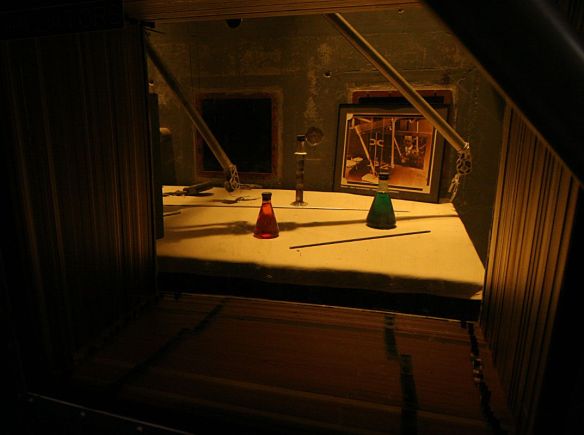
One of the interactive features of the place was the opportunity to try out the mechanical arms used to handle the fuel. The picture below is a view into the materials handling room. The arms visitors could try out were outside this, we wouldn’t want any amateurs knocking over the bottles of colored water. We’re looking through 34 layers of leaded glass.

IMG_3811s

I missed taking a picture of the fuel rods. They’re quite a bit smaller than I expected. Six pieces make up the rod assembly, each piece no thicker than a pencil. Around the corner from there is the rod farm where they stored the spent fuel rods.

IMG_3812sAnother exhibit I neglected to photograph was the recreation of the string of light bulbs that were illuminated when the thing was first turned on. They light four bulbs. The recreation has that early-50’s look to it, so I’m guessing it’s pretty accurate. The four bulbs combined were barely putting out enough light to read by. Nuclear power sure has come a long way.

Portland Trip: Day 1 – Denver to Boise

August 23, 2014

I packed the car last night. Everything went together just like in the dry run. But after I was in bed I thought of something I should bring that wasn’t on the list. Not just once but twice. Still, I managed not to think of taking a bagel out of the freezer for breakfast, but if that’s my biggest oversight I’ll be in good shape.

According to plan, I backed out of the garage promptly at 5:00am. Wanting to minimize my time on the Interstate, I got off I-25 at Ft. Collins and took US 287 to Laramie. The sun made its appearance about the same time I crossed the border into Wyoming. It was cloudy but not really overcast. The clouds were in layers, the lowest draping themselves over some of the hilltops.

I entered Laramie at about 7, looking for fuel and breakfast. I was pretty certain that if I went up the main drag I’d find somewhere to eat. There was nothing. I gassed up at the Safeway and ended up grabbing something at Wendy’s before getting on I-80. I sat at a window seat and watched people look at the car. She never fails to draw a crowd.

I’d have to say I’m pretty spoiled when it comes to scenic roads. So it should be understandable that I find the views along I-80 in Wyoming pretty boring. There’s really nothing interesting to look at until about Rock Springs where the geology changes a bit. To offset the boring scenery, or perhaps because of it, the speed limit is often 80. Typically, I’m happy going about 5 over the limit, so I ended up running most of the tank of gas at 85 or so. Instead of my expected 35mpg, I only got 28.

After fuel and restroom at mile 68, my route takes me off I-80 and onto US 30 at mile 66. Heading up US 30, there’s not a tree to be seen anywhere. The place is dense with oil production sites, all painted brown in an attempt to blend into the background. I’m amused that each has its own little solar panel. It’s a four lane highway much of the way through here. After a while, the oil production is gone, to be replaced by coal strip mines. They’re not really visible from the road, but a couple hillsides are nicely terraced, obviously reclaimed coal mines.

My next stop was in Cokeville for food. A couple miles out of town I saw a sign for a diner that looked promising. But when I came upon it, there were no cars in the parking lot. My first thought was “how good can they be if they don’t have any customers?” In retrospect that probably isn’t fair. Cokeville’s not a very big place. Instead, I grabbed a piece of pizza at the Pilot station. The pizza is from the convenience store – their restaurant is closed down. But it was actually a nice piece of pizza.

The weather had cleared up when I got on US 30, so I had some sun. But by here, the sky was filled with scattered clouds, some producing rain. I started going through these little squalls periodically. Never more than a few miles wide, they never caused me to turn the wipers on more than intermittent.

Before long, I was back on the super slab, northbound on I-15. The plan was to spend the night at Blackfoot for an early start with a quick stop at Craters of the Moon. This clearly would be suboptimal. I arrived in Blackfoot promptly at three. Way too early to bed down. So I fuelled up again, talked to three more guys about the car, and headed west on US 26.

In spite of the Snake River flowing through this valley, I find it very much like the San Luis valley. The native vegetation is much the same. It’s a bit denser here, and there is quite a bit more irrigated land than there.

I soon started seeing signs for the EBR-I Atomic Museum, a national heritage site. Miles from anywhere, I see a block shaped building a mile or so off the road. This is Experimental Breeder Reactor I. This was the first power plant in the world that produced usable electricity from atomic energy. This was Dec. 20, 1951. It was made a National Historic Landmark by LBJ in 1966.

The place was not at all what I expected, with the possible exception of the control room. Everything else was much smaller than I figured, although I can imagine the evolution from this early setup to something that would fit in a submarine. Very cool. And in spite of it being in the middle of nowhere, I was not the only visitor.

I spent about forty minutes there and when I returned to the car it was starting to rain again. By the time I got to Craters of the Moon, it was raining heavily. Perhaps I should have stopped at the visitor center anyway, but it was really coming down hard now and I had no idea how long it would last. So when a couple of bikers passed me, I let them get a bit ahead of me then matched their speed.

IMG_3815s

We had a nice little run, interrupted by some light traffic. They weren’t going that much faster than I’d have gone on my own but it was nice to pick up the pace a bit. Sometimes they went quite a bit faster than I expected, given the conditions. There was the occasional puddle of standing water. Again, the storm was fairly localized. Within twenty minutes we had gotten out from under it and the road was only damp.

This section of road around Craters of the Moon reminds me a lot of the area around Grants, New Mexico. The terrain, vegetation, and geology look quite similar to me. The lava here is blacker, perhaps, which makes me think it’s more recent.

US 20 and US 26 run the same route from Blackfoot past Craters of the Moon. Shortly after US 26 makes a right turn, the riders pulled over. I waved at them an continued. The weather had returned to the small, light squalls. I was back to my 5 mph over the limit. Traffic wasn’t heavy and slower cars were easy to pass.

Here I passed a red Honda. At least, I think it was a Honda. All identifying markings had been removed. It was red with black accents and darkly tinted windows. After I passed him, he matched my speed, following quite closely. Soon he downshifted and blazed by me at about 90, whereupon he slowed down again. I passed him a second time and he continued to follow me quite closely for quite a long time. He was being a bit of a butthead.

For the most part, both 20 and 26 were straight, flat roads. The valleys here are wide with flat bottoms. Sometimes the highway ran along the side thus twisting to and fro a bit. But long stretches were more centered in the valleys and the road has long straight stretches. Finally 26 started bending around the terrain, rising and falling. I ran into no traffic; my pleasure was uninterrupted. It was, however, short. I soon found myself at the junction with I-84.

Again the speed limit is 80, but here there is much more traffic than in Wyoming. The sky had cleared and I was feeling a bit warm for the first time today. I don’t think it was ever much over 60 all day, and often quite a bit cooler. But approaching Boise it was sunny and warm.

I pulled into the Kopper Kitchen at 7 for a Cobb salad and iced tea, found a cheap but clean motel and looking forward to a much easier day tomorrow than originally planned. I was happy to stop and see whatever sights I found along the way, which wasn’t much. With fuel and food breaks and a short museum visit, I was on the road 14 hours and covered 845 miles. Certainly more seat time than I planned, but it will allow for quite a bit of leisure tomorrow.

Much of today’s route was along segments of the Oregon Trail. I can only imagine the hardships involved in making this trek a century and a half ago. Pack up all your worldly belongings in a covered wagon, hitch up a team of oxen, and make your way through these inhospitable hundreds of miles taking a day to go as far as I go in ten or fifteen minutes.

Trip Preparation

My planned Portland trip is less than two weeks away. I first came up with this mad scheme back in January. Early on, I obsessed about it quite a bit. Now it’s getting close and I find myself back in obsession mode.

Here’s the quick rundown: spend two days driving to Maupin, OR. Take a three day trip down the Deschutes River. A track day at The Ridge Motorsports Park followed by a track day with Club Lotus Northwest at Portland International Raceway. Hike Mt. St. Helens. A third track day at Oregon Raceway Park. Hike Mt. Hood. Spend a few days in the office. One day on the road headed to either Yellowstone or the Grand Tetons. Hike there. Drive home.

That’s the plan.

Although there are some missing elements – I only know where I’m sleeping on eight of the fifteen nights – I’ve definitely moved from planning to preparation.

The car is nearly ready to go. I changed the oil today. I had the brakes flushed Friday, along with a couple minor repairs. I still need to clean the air filter.

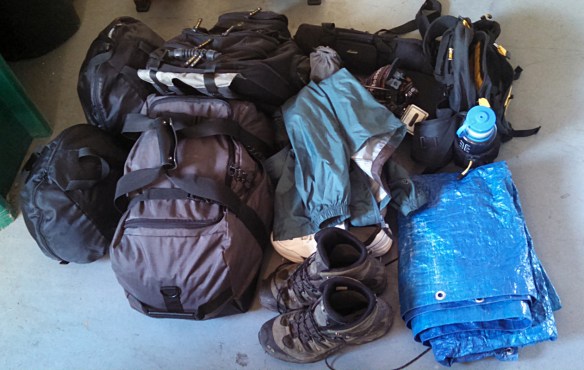
2014-08-10 18.22.54sI have a lot of kit to take. I feel a bit like Imelda Marcos, taking driving shoes, hiking boots, old shoes for the river trip, and a pair of sneakers. I have my fanny pack for hiking and my backpack full of work stuff and the laptop. I have helmets, driving suit and gloves, and tools for the track days. Cameras, tripods, connectors, chargers. Poncho, windbreaker, sunscreen. And, of course, clothes.

It’s a small car. I’ve been concerned it might not all fit. When I do track days, I have too much gear to take a passenger. But I’ll leave the five gallon gas can at home and won’t bring a lawn chair. Not as much gear when I hike, but still a non-trivial pile of stuff. Neither of those requires me to pack ten days of clothes and my work backpack. I wonder if I need a TARDIS to fit it all.

2014-08-10 18.32.30s

This evening Genae helped do a dry run.

2014-08-10 18.31.52sAmazingly, everything fit. Note that I had the top in the drivers seat. I’ll start with the top on and when it’s nice enough to go topless, it will have to ride in the passenger seat. And I’ll need to make sure some items are handy, but I’m pleasantly surprised with the results.

And I still have ten days or so to go over the lists. I wonder what necessity I’m forgetting…


US Hwy 36 Flood Damage

On my way up to the Park for my hike last Friday, I mounted the camera on the car and shot footage from Lyons to the trailhead. With other subject matter, I’d say I put together a highlight reel, but there aren’t really any highlights here so let’s just say I threw together a montage.

It weighs in at over twelve minutes, so if you’re not familiar with the road you probably won’t be interested. In any event, you should watch the video full-screen. With the camera’s very wide angle, everything looks very far away. Also, aside from debris on the right side of the road in the first sequence, all the damage is on the left side so you’ll want to focus there.

Finally, I added a soundtrack. The sound from the camera is mostly wind noise and is fairly annoying. If you feel music isn’t appropriate, just turn your speakers down.