Two Rivers Lake

Sunday, June 5

For the first hike of the year, my latest first hike in eight years, I headed toward Lake Helene. Either Helene or Two Rivers. I figured this would be an unremarkable hike. This is the third or fourth year in a row I’ve hiked this way at this time of year. Familiar territory and conditions.

It’s a short hike, probably the shortest I’ll take all year. That meant I could have a leisurely morning and didn’t need to arrive at the Bear Lake parking lot until about 9:30. I arrived pretty much on schedule to a nearly full lot. I parked in the third or fourth spot from the bottom of the lot. I was on the trail by 9:45.

My first encounter with other hikers was a bit of foreshadowing. Four young women were at the trail sign at the start of the Flattop/Odessa trail. Their discussion sounded a bit confused. I asked if they had things figured out. They didn’t. They were looking to go to Nymph Lake. I showed them Nymph on the map and told them how to get there, as that trail wasn’t on this map. They had no idea where they were and couldn’t make sense of the map.

Shortly after ten I arrived at the Flattop-Odessa trail junction. I stopped and put the spikes on. There was more snow here than any of the last few springs. About the only snowless patch from the junction on up is at a rock outcropping with a view of Bierstadt. Not far past that there’s a meadow. On winter hikes I’ve sometimes had trouble finding the route – the blowing snow erases most of the footprints. Plenty of steps to follow today, and here’s where we deviated from the summer route.

The summer trail crosses over to the flank of Joe Mills Mountain but the snow trail stayed on Flattop side. I soon caught up to three hikers: mom, college aged daughter, junior high son. Mom was in sneakers, none had spikes.

The daughter told me, “We’re going almost to Odessa. I was there yesterday and dropped something. We’re going to look for it.”

“You don’t have spikes? You made it to Odessa? I won’t go to Odessa this time of year even with spikes. Too steep.”

She confirmed that she’d been to Odessa.

A short while later I met a young couple coming down the trail. They didn’t have spikes and also said they made it to Odessa. The next hikers, two guys, said they wanted to go to Odessa but when they got to an overlook decided “no way.” They didn’t have spikes, either.

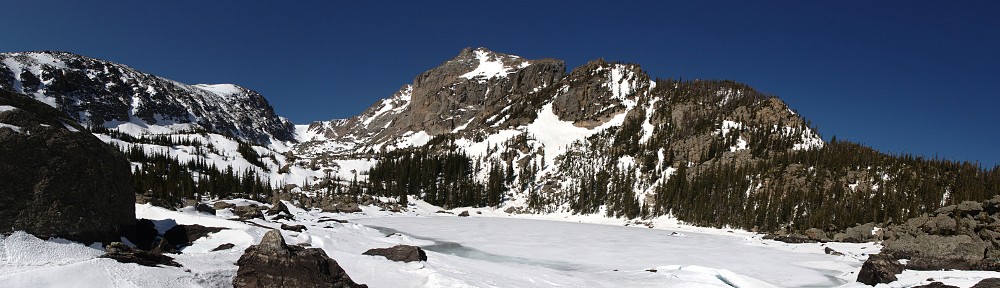
Continuing to follow the steps in the snow I soon arrived at the outlet of Two Rivers Lake. The trail stopped here in the rocks that will probably be under water in a matter of days. A few skiers had traversed the slope on the south side of the lake, and there were a couple sets of footprints, but this was the end of the line.

2016-06-05 11.30.56_stitch_resize

It finally clicked – all those people who said they went to Odessa had no idea that they’d only been to Two Rivers. No official trails go to Two Rivers or Helene; they’re not on any signs. The only lake on any of the signs they’d seen was Odessa. Of course they thought they were at Odessa. Only about a third of the people I’d met had the slightest idea where they really were.

I managed to take only a handful of photos with the SLR before the battery died. I was disappointed, but not surprised. It’s been a while since I used the camera. It was breakfast before I thought to charge the batteries. I only charged one battery for a short time. But it’s not like I don’t already have pictures of place, no big deal.

I found a nice log to sit on, got comfortable, tucked into lunch, and proceeded to watch the world go by. Before long, a small bird arrived on a branch very nearby. Small, gray with a white head and black collar. Black stripes on the eyes, not horizontal like a raccoon but vertical. I don’t know my birds; I think this was a White-throated Sparrow. She sat on this limb and fluffed and preened. Spread our her feathers, rearranged a few with her beak. Birds never pose that nicely for me when I have a working camera. She flew off after a while but did come back later. She spent a lot of time on the ground looking for food.

Also notable was the mated pair of ducks that were feeding in the shallows. They motored past me to the outlet where they ran their beaks back and forth under the surface and occasionally went deep, putting their butts up in the air. They were the only two ducks at the lake.They eventually worked their way back past me, occasionally bobbing their tails up.

I stayed at the lake for forty minutes, had the place all to myself. The weather was great, bright sunshine, scattered clouds, calm. As the clouds moved eastward they darkened a bit, incipient scattered showers.

When I started back, I found it easy to exactly retrace my steps. I saw no other hiker using spikes, so my prints were obvious. That lasted until I met a couple hiking up. They were “just going to the lake”, Odessa presumably. Between the two of them, they only obscured about a third of my footprints. Then I met the hikers who had spikes.

As expected, I crossed paths with more people as I progressed down the trail. At the clearing, where our route regained the path of summer trail, a group of snowshoers were just leaving the trail and beginning to head up the side of Flattop. Just before seeing them I passed a couple of women who were switching to hiking boots, one from skis the other from snowboard.

I stopped and enjoyed my plum at the Bierstadt overlook. The plum was nearly perfect – skin still crisp, the flesh at maximum juiciness. Sweet and flavorful.

A group of five young guys approached the Flattop trail junction from Bear Lake as I got there from Two Rivers. They turned to go up Flattop wearing flat soled canvas shoes. “You’ll be hiking on snow from here on, and you’re a long way from any kind of view!” But they were undeterred. I wonder how far they went before they turned around.

In the end, I didn’t get the expected “unremarkable” hike. It was another beautiful day in the park. Even though I’ve been through this area repeatedly, the snow cover and altered route breathed freshness into this visit. I found solitude after a short, easy hike and enjoyed watching the birds.

Santa Fe, Day 4

Tuesday, May 24

At dinner last night we discussed an 8:00am departure. I didn’t think anything of it at the time, but Mike’s tour guide called for an 8:30 exit. This caused a bit of confusion. We didn’t hit the road until more like 8:20 and still managed to abandon one car. Thinking we were seven cars, we were immediately split up at the first intersection. Four made it, three didn’t. We three quickly caught up.

After driving north on US 285 for a short while, we switched to a series of New Mexico state highways that make up the High Road to Taos: NM 503, NM 76, NM 75, and NM 518. The low road to Taos follows the busier routes along the rivers while the High Road goes through the hills and valleys of the southern end of the Sangre de Cristo mountains. It’s a much more circuitous route, pine-scented and cooler than river bottom desert path.

Through one small town, the road is quite narrow. Signs warn “No Center Stripe Next 1.5 Miles”. There is no center strip because the road is essentially a single lane. I’m not sure what we’d have done had we encountered oncoming traffic. A few towns later the road revealed dramatic views of what I believe is North Truchas Peak, its rocky summit still sporting a fair amount of snow. These peaks are not as dramatic as the northern Sangre de Cristos but may be the prettiest mountain views in New Mexico.

Some time before arriving at our pit stop in Taos our straggler caught up. At the pit stop we parted ways with the group. We had been over most of the roads on Mike’s route and elected to tread new ground and head east on US 64. The first section, from Taos to Angel Fire, is a nice twisty Lotus road without much weekday traffic.

The road crosses Palo Flechado Pass (“arrow-shaped trees”). A hundred years before the Louisiana Purchase, this area was the scene of some tensions between the Spanish and French over trade. In 1719 governor Valverde heard intelligence form the Spanish viceroy in Mexico City that six thousand French troops were moving up the Arkansas River. He sent a scouting party of forty-two soldiers, sixty Pueblo Indians, and a thousand horses to check the report. After battling snow, bears, and poison ivy, the group crossed the pass and made it as far as the site of current North Platte before meeting their end at the hands of the Commanche. The few stragglers that returned to Santa Fe admitted that there was no sign of six thousand Frenchmen.

Our crossing of the pass was much more comfortable; no snow, no bears, no poison ivy. At Angle Fire we enter a broad, windswept valley. There’s a Vietnam Veterans memorial here and today the road was lined with American flags for a few miles on either side. At Eagle Nest Lake the road climbs out of the valley. It’s twisty enough to have quite low speed limits; several miles of 35mph with a bit of 25mph as well. This is Cimarron Canyon State Park.

At the exit of the canyon, the land flattens to low, broad mesas and the road straightens passing through the burg of Cimarron. The road turns to the north east and runs past the NRA facility at Whittington before reaching its junction with I-25.

The remainder of our trip was on I-25 and thus deserves little discussion. We did see the remnants of our group stopped at the KFC/Taco Bell at Walsenberg. We weren’t ready for lunch yet and proceeded to Pueblo. While stopped there Genae got a Red Alert on her phone: we were about to get some very nasty weather… at home.

From the time we put wheels on I-25 until Colorado Springs we kept a steady speed a few miles an hour over the posted limit and were passed only twice. North of the Springs, driving the same speed, we were nearly the slowest car. Even travel trailers and semis passed us.

To avoid the potential of running into the weather that generated our warning we took C-470 and looped around the west side of town. This also had the benefit of missing most of the bad traffic through the center of Denver. We had no signs of bad weather until we got within a mile or so of the house. At the golf course, the fairways were covered with hail and rivers ran down the cart paths. The streets were littered with shredded leaves torn from the trees.

Michael had kindly shoveled the hail and leaves from half the driveway, clearing our path. The rain came down so hard and fast our little solar tube over the stairs leaked badly, soaking the carpet. Shredded leaves were everywhere, the raspberry bushes were transformed into denuded twigs, and the windshield of the Chrysler is cracked from top to bottom. We were quite happy to have not been caught in this in the Lotus.

2016-05-24 16.17.58sWe had a nice trip, enjoyed the company of good friends, and took pleasure in exploring a good portion of northern New Mexico.

Finally, a tip of the hat to Mike for all his effort in putting this trip together – scouting much of the route, inspecting the hotel, and ensuring that our visits to the various parks would be worthwhile.

Santa Fe, Day 3

Monday, May 23

Today is the optional day; about half the cars departed today by the route we’ll take tomorrow. Today’s route takes us southeast and east so we will have fairly fully explored Santa Fe’s environs, hitting all the major roads except I-25 south.

We got a more leisurely start today, on the road at 8:30. We enjoyed visiting with folks and tucked in to the potatoes again, and a strictly verboten (half) cinnamon roll. We hit the road on schedule with no drama and 10 cars: 5 Elises, a Europa, an M100, a Triumph, a Boxster, and an Evora.

First on the agenda was Sandia Crest, via NM 14. This is the route Jerry and I took when returning from the balloon fest back in October. Although we didn’t do the fourteen miles to the summit then, I had gone there the first time I attended the Balloon Fest. Today being a Monday, there wasn’t much traffic. There was, however, paving in progress near the summit. With only one lane open we had to wait for the escort truck. We were first in line both on our way up and on our way down, so we had open road in front of us.

2016-05-23 10.26.51sAlbuquerque is about a mile above sea level and Sandia rises about a mile above the city. There’s a spruce-fir forest on the top of the mountain, above roughly 9,200′. It’s an 800 acre island of forest surrounded by desert. The mountain gets as much as ten feet of snow in a season. There’s a ski area here which is accessible via the tram from the city side.

2016-05-23 10.14.04sThe Rio Grande side of the Sandia Mountains is 1.4 billion year old Sandia granite on top of a 1.7 billion year old metamorphic layer. The earth’s crust is separating along the Rio Grande Rift; the eastern side lifting and the western side dropping, the river filling the lower side with sediment.

We retraced our route nearly back to Santa Fe before heading east to Glorieta Pass and Pecos. We’ve driven I-25 many times without realizing it crosses the pass. There’s no marker, and this part of the road doesn’t appear any higher than any of several other parts. Glorieta means “hub”. In a Spanish town, the central square is called a glorieta. This is an apt name for the pass, as it served as a hub of trade and culture for nearly a thousand years.

The area was first settled at about the year 1100. By 1450 the pueblo here was a fortress five stories tall and housing two thousand people. This location commanded the trade path between the farmers of the Rio Grande valley and the hunters of the plains. Many goods passed through here – hides, flint, shells, pottery, textiles, crops, turquoise, and slaves. The inhabitants of Pecos grew rich from the trade, and their culture borrowed elements from both valley and plains.

In the autumn of 1540 the first Europeans crossed Glorieta pass. It was a party of twenty two Spanish men detached from Coronado’s army. Coronado sent his captain of artillery, Hernando de Alvarado with sixteen cavalrymen, four crossbowmen, and a chaplain to explore the area. In Pecos, de Alvarado met the “legendary Turk”, a Plains Indian held captive by the villagers. Turk told de Alvarado about a city called Quivira. Quivira, Turk said, was much richer than the Seven Cities of Cibola. This was misdirection: the Pecos people had the correct idea that the Spanish had come up from Mexico to rob them. The myth of gold in Quivira would lure them out into the Plains where they might get lost.

2016-05-23 14.01.45sThe Spanish searched, but didn’t get lost. They returned and, in the early 1600s, built a large mission complex. There was a revolt in 1680 that got rid of the Spaniards for twelve years, but they returned and rebuilt. The population declined until 1838 when the final inhabitants migrated to Jemez pueblo (near where we picnicked yesterday). Today, the Spanish mission is being restored amidst the ruins of the pueblo on the grounds of the Pecos National Historical Park.

2016-05-23 14.05.35s

Adobe blocks for restoration made on-site

We began our visit with today’s picnic lunch, then we watched a short video before embarking on the self guided tour. I thought it was somewhat less interesting than Bandelier. The emphasis here seems to be more on the Spanish history than that of the Pecos Indians. This was a much bigger, clearly more important, settlement than at Bandelier, but seems a much harsher place to live.

With nothing on the schedule until dinner tonight, we were left to make our own ways back to Santa Fe. As we were leaving I had a short chat with a fellow who asked about our club. He’s a member of the national Hudson car club. He told me they had their 2015 national meet in Colorado Springs (what a coincidence). They had over two hundred cars show up, and seated over four hundred people at their banquet.

Only a few miles from Pecos there’s a historical marker on the side of the highway. It was erected in 1961 and commemorates the Civil War battle of Glorieta Pass. The sign says the battle is often referred to as the “Gettysburg of the West.” I’ve never heard it called that, but I’m certainly no expert on the Civil War. Rebel troops from Texas captured Santa Fe in March of 1862. Colorado Volunteers met them here, burned their supply camp and slaughtered hundreds of their horses and mules. The Rebels fled New Mexico within two weeks.

We were back to the hotel by 3:15, with plenty of time to rest and clean up before dinner. Tonight we had reservations at The Shed. It was an excellent choice. I had the enchilada/taco plate. Blue corn tortillas, cheese and onion enchilada, green chili turkey sausage taco, served Christmas style (half red chili, half green). In my experience, the green chili is typically hotter than the red. I started with the red. A few bites into it I feared I might spontaneously combust. Here, red is definitely hotter than green. Instead of flour tortillas to sop up the extra sauce, they serve garlic bread. An unexpected but good choice.

During dinner Genae’s phone rang. Too loud in the room to hear, she let it go to voice mail. It was a call from Ann. They had suffered a flat tire after crossing Raton Pass, the group’s third mechanical incident of the trip. Luckily, it sounds like they quickly had a fix and were back on the road.

We rode the hotel’s shuttle to get to The Shed but decided to walk back in an attempt to burn off a few calories. We were back to the hotel before dark, and turned in early after another full day.

Santa Fe, Day 2

Sunday, May 22

Our first destination today is Bandelier National Monument. There’s very limited parking at the visitor center. If you don’t get there first thing you have to park at the White Rock visitor center and take a shuttle bus. Shuttle buses aren’t how we roll so we planned on an early start. We wanted to leave the hotel by 7:30. They don’t normally start breakfast service until 7:00 but Mike had arranged for them to set up a half hour early for us.

The breakfast buffet isn’t the greatest spread I’ve ever seen, but we did enjoy their potatoes – diced, with generous portions of red and green peppers, onion, and bacon. Scrambled eggs, fruit, cereal, juice, and coffee were available as well.

We hit the road on schedule. Today’s caravan included the same cars as yesterday, less one Elise but plus the Z06. We have to make two left turns to get onto US 285 from the hotel. We were immediately split into two groups at that first light, a couple hundred yards from the hotel parking lot. They didn’t catch up to us until we were parked at the visitor center; Mike’s fine directions got everybody where they needed to be.

We arrived at the entrance station before the park opened. There’s a kiosk there that we ignored. Three miles past the entrance we found ourselves at the visitor center. There is parking for only a couple dozen cars. By the time the second tranche of LoCos arrived we had pretty much filled the place up.

2016-05-22 08.59.24sThe visitor center is at the bottom of a small canyon. The rock looks like sandstone but is actually tuff – rock formed from volcanic ash. A stream runs through the canyon all year long. Based on its meager flow this time of year it must be really puny in the depths of summer. The canyon is situated in an ecotone – the transition between two biomes. This provides an abundance of flora and fauna, which was probably key to ancient peoples settling here.

2016-05-22 09.11.54sWe took the one hour self guided tour. There are only three miles of roads in the park but over seventy miles of trails. The self guided tour covers about a mile and a half but visits the largest of the ruins. On the floor of the canyon are the ruins of a circular pueblo that probably contained a couple hundred rooms. Additional structures were cliff dwellings. These weren’t high up the cliffs like the ones at Mesa Verde but were on the bottom of the canyon and used the cliffs as part of the structure.

Next on our agenda was a picnic lunch at the Walatowa Visitor Center, south of Jemez Springs on the Jemez Mountain Trail Scenic Byway. Jerry and I took this road all the way to San Ysidro back in October when we went to the Albuquerque Balloon Festival. The drive transitions from subalpine evergreen forest to red rock desert. We initially thought it was a shame to pass all that comfortable shade and end up in the desert but Walatowa turned out to be a pleasant place for a picnic. The only hiccup on this part of the drive was when Tim ran his TR-6 out of gas. Operator error, rather than a malfunction.

After lunch we retraced our route, back up NM 4. We were to stop at Battleship Rock for a group photo. The lead cars (we were 5th) didn’t stop. I don’t know that anybody behind us stopped, but given that it was midday on a beautiful Sunday it was likely there would be too many other cars there for us to get a decent group photo.

Next was a stop at the Valles Caldera National Preserve. The four cars ahead of us passed the entrance; we followed them until we saw Mike make the turn. We turned around and followed everybody down a somewhat bumpy two mile dirt road. Having skipped Battleship Rock we went about lining up the cars for a picture here. Unfortunately, Mike’s car wouldn’t start – our second mechanical issue of the trip.

Photo courtesy of Peter Monson

Photo courtesy of Peter Monson

Unfortunately, most of the vehicles with empty seats didn’t stop. Mike needed to call AAA for a tow and he and Lisa found themselves in the back seats of the two Evoras for the return to the hotel. We later learned that the problem was just a flat battery and he was able to source one at an auto parts store that was open until 10pm on a Sunday night. I’m not mechanically inclined, but it doesn’t make much sense that his battery was fine a half hour earlier when we left Walatowa but wouldn’t even take a jump here.

In any event, this pause allowed us an extended stay in the caldera. The caldera is 24 miles across and last erupted about 1.5 million years ago. This was the source of the ash that formed the tuff in Bandelier. No trees grow on the floor of the caldera – the soil isn’t that great and in winter there is often a thermocline that makes the air here much colder than up the slopes.

Before the place was a wildlife preserve the surrounding slopes were extensively logged. One slope to the north had conspicuous horizontal lines. These were the result of clear-cutting in the seventies. When logging ceased the forest grew back to maturity, only to be severely burned a few years ago.

The last activity planned for the day was a stop at the museum in Los Alamos. We elected to drive through town but not visit the museum. In Los Alamos we failed to make a turn and led the others astray. When we finally got through town we arrived at the junction at exactly the same time as the two Evoras, executing a perfect zipper merge.

We made it back to the hotel just after four. Most of the group had dinner reservations but Genae and I were on our own. We drove downtown to the plaza and wandered around looking for anything interesting. There was a low-rider car show there earlier; all had gone except for two or three stragglers. We finally made our way to a pizza place and nano brewery – they brewed their beer in single barrel batches. Tasty pizza, refreshing beer. We were back to the hotel by eight, tired after a full day.

Santa Fe, Day 1

Saturday, May 21

It’s time for another long weekend trip with LoCo. We used to call these trips The Colorado Good, a riff on The Colorado Grand. This one’s entirely in New Mexico, except for the to and from. The participant list detailed twenty cars and thirty-five people. Mike organized the whole affair and sent out a nice Tour Guide with turn-by-turn directions and snippets of history for many of the places we’d be seeing.

On the way down, the first official way point was in Johnson Village. The Denver folks would meet up with the Springs people there. The Denver contingent planned to gather at The Fort and caravan to the rendezvous. However, we elected to proceed solo and were headed up the canyon on US 285 when the rest were scheduled to start their engines. We were allowing for a potty stop; we’d have been separated from the group anyway.

Going up Kenosha Pass I was collected by a short line of traffic. When I finally got a chance to pass them, a glance in the mirror revealed a string of skittles rolling down into South Park – the other Denver cars. Mike’s notes indicated we wouldn’t be going more than five to seven miles an hour over the limit. In South Park this is fiction. The first few cars in line flew past us at a great rate of speed.

Pete stopped at the junction with US 24 and we all stopped with him. Several people got out and inspected the bottom of his car. With things well in hand, we elected to continue to the rendezvous. Moments after we left, the Colorado Springs cars arrived at the junction. We couldn’t have gotten the timing any better if we’d tried. (Later, we learned Pete’s issue was a loose diffuser.)

Approaching the summit of Trout Creek Pass a prairie dog darted out in front of me. He never had a chance; I don’t think my tires ever made contact with him, but no matter. In the hundreds of thousands of miles I’ve driven in cars and trucks before the Elise I’ve never killed any animals. I hit a deer in my Arrow but didn’t even knock her off her feet. But in the Elise I’ve now gotten four birds and a prairie dog. How does that work, exactly? When we stopped, I checked out the car. No blood, not even hair, and no damage to the car.

When we finally hit the road as a full group, departing Johnson Village, we were four Elises, two Exiges, two Evoras, two M100s, a Europa, a Birkin, a Focus ST, a TR-6, a Boxster, and a Miata. (In Santa Fe we added another Elise and a Z06 Corvette.)

We had a picnic lunch in Alamosa. The road through the San Luis Valley to Alamosa is one of the straightest roads I’ve ever driven on. Not exactly a Lotus road, but it gets a pass because I never get tired of looking at the Sangre de Christo mountains. We didn’t have a picnic lunch so we made a detour to Arby’s. Afterwards we refueled. Genae bought a candy bar. The cashier told her they were two for one so we decided to split one and save the other for tomorrow.

The drive from Alamosa to Antonito lacks the drama of the northern end of the valley. Ranch land instead of scrub, but centered in the wide valley and without a view. Unremarkable, except for the parallel railroad track. It’s a single line and for ten or twelve miles it’s an almost unbroken string of idle rolling stock. At the northern end it was all brand new tank cars. After the new cars it alternated stretches of hoppers, covered hoppers, and tank cars. An almost unbroken string, I say: gaps only at side roads and driveways. How many rail cars fit in ten miles? How many millions of dollars of capital equipment is that?

Leaving Antonito we finally embark on a road that is new to me. Rather than turn left to stay on US 285 in the Rio Grande valley we continue straight, the road now designated CO 17, following the Conejos River. This road takes us over La Manga (Spanish for “sleeve”) and Cumbres (“crests”) passes. The Cumbres crosses the divide of the Chama and Los Pinos rivers, both tributaries of the Rio Grande.

More than a century ago, Ernest Ingersoll described part of Cumbres Pass thus:

In the most secluded nook of the mountains we come upon Phantom Curve, with its company of isolated rocks, tall, grotesque, sunburned. They fill the eye, and in their fantastic resemblance to human shapes, seem to us crumbled images of the days when there were giants, and men of Titanic mold set up mementoes of their brawny heroes.

Much of the path parallels the Cubres-Toltec narrow gauge railroad. The road crosses the rails near the top; on the descent the rails are often visible, curling along the hillside below. The railroad turns are surprisingly tight. We didn’t see any trains running, but in Chama there were a number of sidings holding quite a few cars.

After we gassed up in Chama we were leading the group. I thought I might collect another bird when we came upon a murder of crows feasting on dead deer in middle of road. The birds were reluctant to leave their meal, not taking flight until after staring me down for a moment, making me slow down.

Our position in the lead didn’t last long. Lacking electronic counter measures we stuck to the 5-7mph rule. A few miles after the crows some faster cars passed us and we picked up the pace. The first car to pass did so just as an antelope was crossing the road ahead. There was only one; I don’t think the passing driver saw it. This section of road between US 84/US 64 junction and Tres Piedras is very nice. It features long sweeping turns on hillsides of piรฑon forest. There was one particularly nice view of granite mountain that resembled Half Dome.

We were near the front of the pack and our group of cars separated from the rest. We didn’t see some of the folks until well after we had checked in at hotel. This was when we learned of Jeremy’s problem: a blown oil line. He shut the motor down immediately and was fortunate to have a handy place to pull off the road. This is by far the worst mechanical issue we’ve had on any of these trips.

Happy hour was scheduled at six, which gave us time to get provisioned for tomorrow’s picnic. We made a quick run to the grocery store and picked up sandwich fixings and some fruit.

We had adult beverages and chips and dip, cheese, and shrimp; a much better spread than we were anticipating. It was a long day’s drive, and many of us were happy to move the conversation to the next room and eat at the hotel restaurant.

Scuderia Rampante

Saturday, May 7

Scuderia Rampante is a Ferrari restoration and repair shop in Erie, Colorado. They’ve been in business for something like forty years. Skip arranged a shop tour for the Miata and Lotus clubs. It turned out to be not so much a tour of the facility as the opportunity to wander freely about the place.

Life sized Matchbox collection

Life sized Matchbox collection

It’s loaded with interesting sights. In addition to all sorts of exotic Ferrari automobiles, there were cars of other marques, a helicopter and a half and two stuffed bears. Some of the cars are there in storage but most seemed to be undergoing some repair or other.

I seem to gravitate to the unusual. Certainly it could be said that wandering around a world class Ferrari shop is unusual in itself. For the most part, though, I’ve seen these cars on the road; out in the wild so to speak. But there were a couple of notable “which of these is not like the others” cars.

In the small show-room like entryway was a Ferrari I’d not only never seen before, but had never heard of. In the first couple years of the fifties, Ferrari produced eighty two copies of the 212 Inter. Powered by a three carburetor V-12 that pumped out as much as 165 HP it was capable of hitting 116 mph and going from 0 to 60 in just 10.5 seconds. My how automotive technology has advanced. Someone there told Michael this car is worth $18 million, but a quick search indicates it’s more likely in the $2 to $3 million range.

Ferrari 212 Inter

Ferrari 212 Inter

The 212 isn’t unusual because it’s a Ferrari, it’s unusual because of its vintage and rarity. There was at least one other unusual car of the same vintage, if not the same rarity. In the rack I couldn’t help but notice the Wolseley 16/60 with the Bahamas license plate. This is another car I’ve never even heard of. It’s not out of place here, though. Although the car was made by BMC it was styled by Pininfarina. About 63,000 of these were made.

Wolseley 16/60

Wolseley 16/60

Scattered throughout the shop floor were various Ferrari drivetrains under repair. Some where just the engine, others were both engine and transmission. I was quite interested in the flat 12. There was a red Testarossa in the giant car rack with a license plate “FLAT 12” but this engine probably belonged to the black Testarossa on the floor.

Flat 12

Flat 12

Scuderia Rampante wasn’t the only place we went on Saturday. We started at cars and coffee in Louisville and ended at a show put on my Hagarty’s and Auto Archives. Several weeks ago I had the pleasure of seeing a Porsche 918 on US-36 where I managed to get a crappy cell-phone picture. The same car was at Louisville. I hadn’t seen it there before.

We were planning on having hot dogs at the Hagarty event. By the time we got there the weather had deteriorated quite a bit. No longer just chilly and overcast, it was now raining lightly. We elected not to stand in line in the rain for hot dogs. After a quick tour of the new home of Auto Archives we made our way home. It turned out to be excellent timing, as we were hit by an intense hail storm. Most of the hail was BB sized or pea sized but some stones were more like marbles.

Porsche 918 Spyder

Porsche 918 Spyder

Emich Track Day

Sunday, April 10

The forecast was for a high in the low sixties with a chance of rain in late afternoon. They hit it pretty much spot on.

They limited the day to 120 entries and we had perhaps a few more than half in the experienced session.

We got started a bit late. Emich had a Z06 there to give people rides. Brand new, $95,000 price tag on the window. At the end of the first novice session one of the Emich guys put it into the wall between one and two. Deployed both airbags; they had to flatbed it off the track.

My fastest lap was in the first session, a 2:12.5. This is the first time I’ve gotten my fastest lap in the first session. I ran six sessions, sort of. One time I didn’t get on the track until the session was half over; another session was ended early due to an incident I’ll describe shortly. The tow truck was deployed two other times.

The track now has lights at every corner station; a nice upgrade. Usually they man about half the corner stations. There are several cameras that are monitored in race control, but with only half the stations manned, any yellow flag conditions might last three turns. With lights on all corners, there’s twice as much information available to us drivers. The same number of corners are manned, but they don’t use flags (except the meatball). Flashing yellow, steady yellow, red (stop), or “police lights”: flashing blue and red (exit the track).

I’ve often said that the race track is the safest place to drive your car. Everybody’s going the same direction, there are no potholes, nobody’s on their phone, all the cars are in good working order, and people wave flags at you if something unexpected has happened in front of you.

I’m going to have to add a condition to that: it’s a club day rather than open lapping. Unfortunately, as has been all too obvious these last two track days, there are people who can’t be relied upon to pay attention and to follow the few simple rules.

There was a white BMW with a giant black wing. A race car. He was fast; a few seconds a lap faster than me. He came up behind me in turn two. When I went to apex turn three I glanced in the mirror to find him missing. He was passing me, taking my apex. If I’d have stayed on my line, his left front would have hit my right rear.

Multiple times in the drivers meeting it was stressed that the slower car stays on the racing line. It’s the responsibility of the overtaking car to go around the slower car. This jackhole in the BMW, running at least twice my horsepower, couldn’t wait three seconds to pass me on the straight.

Back in the paddock I went looking for him. He was clear across the paddock from me. I asked several drivers if they knew where the white BMW with the giant black wing was. More than one said he’d passed them unexpectedly in turns. When I found him I was still pretty pissed. My cutting wit sometimes gets me in trouble, but today words failed me. I was unable to articulate exactly what he did wrong.

I just kept telling him to watch where he’s going and to think about what he was doing. I’m sure he still thinks he did nothing wrong because I failed to be articulate. He said “I thought you saw me” and “no hard feelings.” Yes, I saw him. Just because I’m paying attention doesn’t mean he can have my line. And, yes, there are hard feelings. I reported him to the assistant track manager and told other drivers to keep an eye out for him. Later, one guy told me the idiot passed him in turn three, same place he did it to me.

Now the story of the shortened afternoon session. I was running in proximity to a Subaru, blue and black with gold wheels. I passed him early on, but the next lap he seemed to be faster than me. He was clearly faster on the straights. I didn’t want to hold him up, so I waved him by. As soon as he got around me, my windshield took a light misting of fluid from his car. It was just that one shot, just as he passed me. I didn’t follow him too closely.

After another lap it was obvious I was quicker. I figured I’d get in his mirrors enough to get him to let me by on one of the straights. Coming out of the corkscrew he blew a big cloud of blue smoke out and jerked to the left. I stayed well right and went through another shower of fluid much heavier than before. He went in an arc across the track exit, spinning, kicking up clouds of dust and dumping a wide swath of oil across both the track and the pit lane. The police lights were on by the time I got to turn 3.


Broncos Victory Parade

Tuesday, February 9

It’s a bit odd, as a fan, to say “we won the Super Bowl!” Of course, as fans we contributed very little. We didn’t go to any games; the team couldn’t hear us cheering them on. But we were carried along with the team on their emotional roller coaster: happy when the team won, not so happy when they didn’t.

Timing is everything. My gig in San Francisco ended just as the city was getting ready for the big party. I was gone before they had everything set up at the end of Market Street. Being there for the preparations was a bit of a vicarious thrill. Okay, thrill overstates it a bit. But I did have a sense of being included in something big. Being there before the game, watching them put up the giant Lombardi Trophy on the building across the street, got me more excited for the game.

Every winning team gets a big parade when they get back home. When the Broncos won their first Super Bowl we were in Phoenix so we missed out on everything. They say 650,000 fans turned out for the parade after Super Bowl XXXII and half a million came out for the one the next year. For this year’s parade, they were expecting similar sized crowds. Genae and I decided we’d join in the fun.

I’m not a huge fan of large crowds. As large crowds go, Broncos games themselves aren’t bad. For most of the people at any given game it’s not their first time there. They know where to park, how to get in and out of the stadium. Things are pretty orderly. Concert crowds generally aren’t as good. Ingress and egress are often in the dark, more people have navigational problems.

A parade crowd of half a million people is the equivalent of four Broncos games and ten arena concerts at the same time. The largest mass of people would be in Civic Center Park. A bus to Union Station was our best option. There was no possible chance of parking anywhere near downtown, and we don’t have a convenient train. We felt our best strategy was to walk to the Park N Ride, take the Flatirons Flyer to Union Station, and stay as close to there as possible.

The weather couldn’t have been better – bright and sunny, not a cloud in the sky, calm. We left the house earlier than our original plan, which turned out to be a good decision. There were about a hundred people lined up there before us. The Flatiron Flyer runs about every fifteen minutes.

The first FF1 arrived a couple of minutes late and took on only about a dozen passengers; standing room only. It’s a nice bus, a coach. The driver closes the door, tells the guy still on the stairs to move behind the yellow line. Everything in order, he starts to pull away from the curb. Unfortunately, an alarm is sounding: beep, beep, beep. He stops, opens the doors, closes the doors, tries again. Beep, beep, beep. Pushes some buttons. Gets on the phone. No, not a cell phone: a handset like from an old pay phone. The pear-shaped driver gets out, opens a couple of access doors, fiddles with this and that. Gets back in. Beep beep, beep.

Before long a supervisor showed up and the bus was quickly on its way. By now, some people had given up on waiting. Others ventured on to local buses to get down to Colfax. Through attrition, we’d moved up and were perhaps sixtieth in line. At a dozen per bus, we’d be here quite a while. We discussed our options. Maybe Michael could take us down and drop us off. We could get an Uber – one was seven minutes away. Or we could wait.

We waited, and our patience paid off. The supervisor announced that he had four empty buses on their way here. The next bus was, indeed, empty. When we boarded, the driver kept his hand over the money slot. We’re getting a free ride – that saves us nine bucks. A nice coach, appointed almost like an airliner: overhead bins, cloth seats, fan and light (but no tray). We were underway without any drama, fifty-six people dressed up in orange and blue.

Genae likes the navigator app on her phone almost as much as she likes checking the weather radar when it’s stormy. She shows me the map: a red spider-web. Everything going downtown is congested. Even so, it didn’t take too long to get to Union Station. I had never been there before. They recently finished the big underground bus station, but it was all new to me.

This is a bigger bus station than I expected, a concourse with at least ten gates on each side. We follow the crowd up the escalator and out onto the plaza. Amtrack and light rail lines terminate here from the north. The crowd flows south toward 16th Street. Normally, you can catch the Mall Ride here but today the Mall Ride is out of service. All their buses are lined up two by two, filling the concrete apron.

People are pushing strollers, pulling wagons, carrying children. The flow of people, a moment ago organized and directed in the bus station, like blood pulsing in a vein, is now more random. We went to the front of Union Station. People were lined up ten deep here so we went back to 16th and down a couple blocks to Larimer. Here it was only about six deep. We weren’t going to find anything better anywhere else.

We were in the second rank on the sidewalk, with three or four more between the curb and the barricade. The people in front of us had kids; the father wearing the daughter’s tiara on his baseball cap. There were strollers parked along the curb, and there were a lot of kids. There’s a stream of people behind us.

A guy comes up from behind me, says “Excuse me”, wanting me to move out of his way so he can get to the front. I ask him where he wants me to go and he has no answer. I turn my back on him. A few moment later he shoves me then steps in front of me. He now sees the strollers and kids blocking his way.

I said, “I know how you can get in the front row. Get here early.” He gives me a blank stare. “Oh, that’s right. You didn’t get here early. Too late for you.”

No more blank stare. “I’ll kick your ass!”

I chuckled. “Really? You’re going to kick my ass in front of all these people?”

“You could have just gotten out of my way.”

You could have just not been a dick.

Undeterred, he worked his way to the front. The guy next to me, not tiara guy, is with his wife and young daughter. “Good thing for him my daughter is here.”

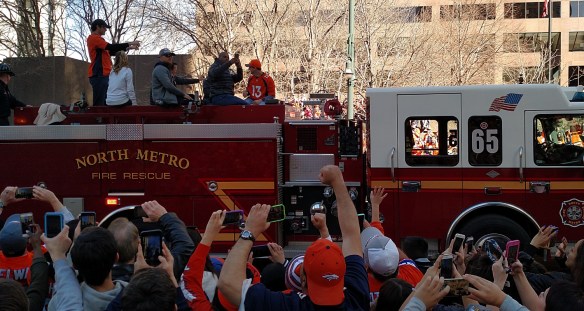
Every now and then, a couple of police motorcycles would pass slowly, lights flashing. The crowd would get excited then realize it was nothing. There was something going on across 17th from us. A few minutes later some paramedics wheeled out a guy on a gurney. Finally, at about 12:15 we could see the first fire truck over the heads of the crowds. The parade was under way!

2016-02-09 12.23.27s

How do you get the job cleaning up after Thunder?

2016-02-09 12.23.55s

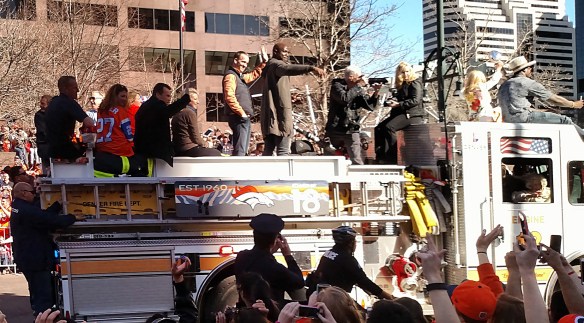
Engine 18 – Kubiak, Manning, Ware, Mrs B (with trophy), Miller

2016-02-09 12.24.00s

The receivers

2016-02-09 12.26.15s

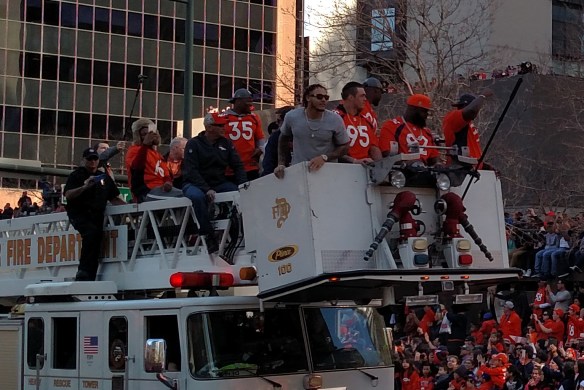
Defense!

2016-02-09 12.28.02s

How many people in this picture don’t have phones?

2016-02-09 12.32.42s

Eng77ine – Karl Mecklenburg

2016-02-09 12.33.43s

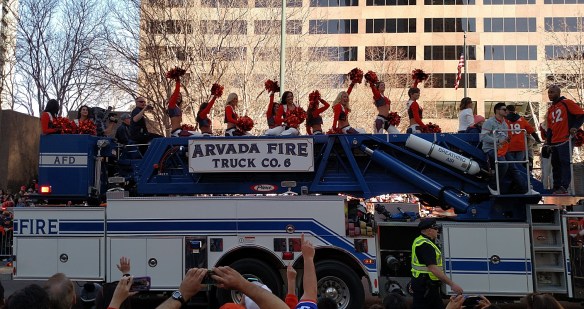
My Arvada tax dollars at work! We got a better deal than Littleton!

After the last truck went by, we spilled past the barricades. The general flow was to follow the parade. We swam upstream, back to Union Station in search of lunch. We stood in line for fifteen minutes at Acme Burger. After placing our order, Genae went off in search of a place to sit while I waited for the food. I waited so long she thought I’d wandered off. I kept thinking our order would be up soon, then I realized how many orders they had lined up. And more kept spilling off the printer.

It was easy to spot our order come up. We ordered onion rings, which turned out to be unique. After the rings, the cook put up a burger, told the guy assembling the orders what it was – “original, no onions, no sauce”. So that’s our rings and Genae’s burger. But the burger ends up in someone else’s order, and my buzzer hasn’t buzzed. Another burger gets put up: “Western burger.” That’s mine. My buzzer buzzes. They’ve messed up. My burger and our rings are in the bag with an order of fries.

I tell the clerk it’s wrong, he looks at the ticket, calls out “I need an original, no onions, no sauce.” The cook responds, “I already gave you one.” “Give me another.” So we get a bonus order of fries. It took us a half hour to get served. I heard quite a few people ask for their money back. But what can you expect when there are a half a million people nearby?

Back at the bus station we found ourselves queued up for the FF1 behind about a hundred and fifty people. We considered jumping to the end of the Longmont bus queue when they were boarding but we remained patient and were again rewarded. “I have two buses for FF1!” One was a regular local bus, the other was a coach. We got on the coach. Again they weren’t taking any fares. When we rolled out the driver announced that today was a free day until 8pm.

Watching the news reports, I couldn’t believe how many people showed up. Initial reports had the number at a million. Now they’re saying it’s more like 780,000. Either number is mind-boggling. There are only about five million people in the entire state.

What NOT to do

I finally got around to going through the in-car footage from the free track day at HPR a couple weeks ago.

I feel there’s an argument to be made that driving a car on a race track is the safest place you can do it. Nobody is on the phone or texting; everybody is going in the same direction; people wave colored flags at you if anything unexpected has happened in front of you; there’s no debris on the road; even if you go off the track there’s nothing to hit, and so on. Mind you, I’m talking about a track day, not a race. We all understand there’s nothing we’ll do during a track day that will make our cars more valuable and there are no F1 scouts looking for the next Lewis Hamilton.

Every track day I’ve participated in has begun with a drivers meeting. At each meeting we’re told the same things we’ve been told at all the other drivers meetings we’ve attended. “This is a yellow flag. When you see a yellow flag, slow down. No passing until the next manned corner station.”

Still, it seems some folks get on the track and get a bit too excited. These words appear to fall on deaf ears. When watching the video, keep in mind that the camera has quite a wide angle – the yellow flag is much more obvious in person than on the GoPro.

One of the drivers in the video is a student. I can only assume there is no instructor in the car, as I’d expect the instructor to notice the yellow flag. I understand that this car, this student, was involved in car to car contact during the session. I’ve never known of any contact at any other track day I’ve attended.

I see the case of the red Porsche as even less forgivable. The yellow flag has been out here for at least two laps. Did he not see the stricken Corvette two minutes earlier? Had he already forgotten? Even worse is that he passed me in that turn. The normal line is to begin way on the outside, then cut sharply to the apex. Had I not seen him, I’d have followed my line and we’d have occupied the same space. If I had any way to positively identify this guy, I’d make my case to track management that he is in need of remedial action. At every drivers meeting he’s attended, I’m sure, he’s been reminded that the car being passed gets to keep his line – it’s the responsibility of the passing driver to go around him.

San Francisco

I just finished an engagement that had me in San Francisco twelve weeks since last October. It was like visiting an old friend. My first consulting job, starting at the end of 2006, was there. Then, it was something like sixty four weeks over an eighteen month span.

22nd floor, Parc 55 Hotel

22nd floor, Parc 55 Hotel

When I returned back in October, my first impression was that the place had changed quite a bit. The structure of the place hadn’t changed, all the buildings and streets were familiar, but many of the restaurants – familiar haunts – were gone, replaced by strangers. After a couple of weeks, though, that sensation went away. Lori’s Diner and the burrito place were still there, just at different addresses.

2016-01-26 07.24.29sI stayed in various Union Square hotels both times. This time I worked in the financial district and last time was City Hall. Then, we ate lunch at dozens of little places in the Tenderloin, Little Saigon, and Hayes Valley. This time the client had catered lunches every day. I only went out to eat a handful of times and gained about a pound a week during my stay.

2015-12-16 19.01.41sBefore starting that first gig San Francisco eight years ago I would say I had a fairly limited experience when it comes to food. At the end of my first day of work my colleagues and I discussed where we’d eat: Thai or Indian, they asked. I’d never had either and was out of my comfort zone. Now I’m much more open to variety. I ate at some nice Thai, Indian, Chinese, Italian, and even American restaurants. I also managed to take in some live jazz a couple of nights and went to see the Golden State Warriors beat the Dallas Mavericks.

2016-01-13 14.24.17s

California Street

Although I didn’t have to leave the office to get a good lunch, I tried to get out for a walk a couple of times a week. I did a little loop that took me through the southern end of Chinatown. From the office on Market, I went up Bush Street past Dragon’s Gate to Stockton. To the right, Stockton climbs steeply. I generally took Pine back down but sometimes strolled past the Ritz Carlton to California. Here you’re high enough to see Coit Tower to the north and one of the towers of the bay bridge to the east through the canyon of California Street.

It would have been nice to stay another week. The city is getting all dressed up for the Super Bowl. The Pro Football Hall of Fame has had exhibits on display in the airport the whole season. Although the game is something like fifty miles from downtown, this week they started hanging banners from the streetlights and placing interactive kiosks on the sidewalk of Market Street. “Enter a code, watch highlights of past games!” The kiosk in front of the office had three of the Broncos blow-out losses. No thanks, no need to watch those highlights!

2016-01-27 14.44.12sMy second or third week there I took the GoPro and tried to get some time lapse action. I got nothing worthwhile and never bothered to try again. I missed a fine opportunity this week when they spent a day and a half plastering a giant likeness of the Vince Lombardi trophy on the building across the street from my office.

I flew into SFO on eleven Mondays and a Tuesday. It was raining every one of those Monday mornings. It felt like it was about 52 degrees the whole time: day, night, sunshine, or rain.

There are homeless everywhere – more now, I think, than seven years ago. There are also quite a few street buskers. One fellow stood below our fourth floor window, day after day, and played is sitar through a little amplifier. He had a limited repertoire. We joked that somebody should go downstairs and give him twenty bucks to move a block down the street. I will admit that he was less annoying than the trumpet player we had outside City Hall. He was louder, not as good at his craft, and because it was summer at the time we had to have the windows open.

Although I never got together with any Golden Gate Lotus Club members, I did learn they’re going to have a few track days this year. One of those will be at Laguna Seca (near Monterey) on July 18. I’ve penciled that in on my calendar and we’ll see what sort of trip I can put together around it. Perhaps I can do some hiking in Yosemite along the way.