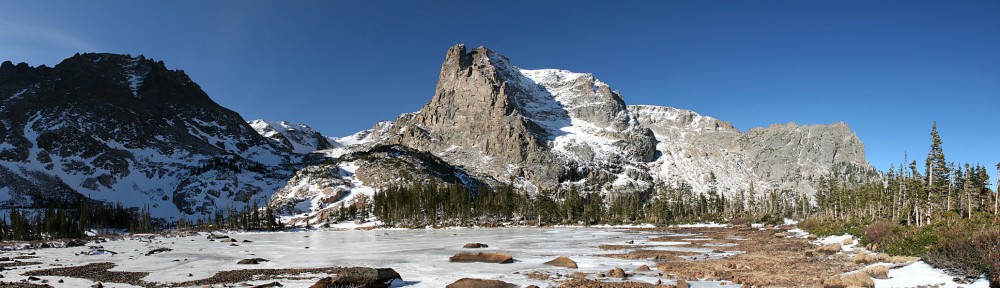
Jasper Creek drains the valley east of the Continental Divide, bounded by Mount Jasper on the north and Skyscraper Peak on the south. In this valley are found Jasper Lake, Devil’s Thumb Lake, Storm Lake, and Upper Storm Lake, as well as half a dozen or so unnamed lakes and ponds. Upper Storm Lake sits at 11,946′ above sea level, about a furlong from the Divide, and is the only named lake here that I haven’t visited yet. No, I won’t make you look that up: it’s an eighth of a mile.
Chad and I hiked to Storm Lake a couple of years ago, when I managed to lose one of my GoPro cameras. Before that trip, I thought it might be possible to reach the upper lake on a day hike, but once I got a good look at the terrain, I decided I’d need to spend a night camping at Jasper Lake in order to have a chance.
Sunday, July 26
As is usual, I struggled with how early we needed to get to the trailhead. There is limited parking at the trailhead. On weekends, this isn’t a big problem as they run a shuttle bus from Nederland High School to the Hessie trailhead. Since we won’t be back at the trailhead until Monday, the shuttle isn’t an option for us.
So it was a bad sign when we rolled up to the high school at seven to see the parking lot nearly full and a sign saying parking at both Hessie and Fourth of July trailheads is full. I told the volunteer we have a backcountry pass, and he got on the radio to a colleague. We were in luck: they had saved one parking spot at Hessie. Does that mean our timing was perfect?
It’s about five miles from the trailhead to Jasper Lake, but we were parked another quarter mile down the road. We arrived at our campsite just after eleven, so I was pretty slow. Carrying the backpack really slows me down. There are seven campsites at the lake. We camped on the west side, so I don’t know if any of the sites on the other side were occupied. One on the west had a tent on it when we got there, but it was gone by evening.
After setting up camp and eating lunch, we set forth for Upper Storm Lake. The climb up Jasper Creek is spectacular. You pass a series of cascades and falls surrounded by an abundance of wildflowers. We’re not above treeline yet, but the views are open. The trail peters out now and then, but navigation is fairly obvious until you get very close to Storm Lake and encounter some willow and krumholz.
Standing near the outlet of Storm Lake, the view of the terrain ahead is a bit discouraging. The north shore looks to be impassable due to a surplus of willow, and the south shore has a large rock outcropping we would have to go above. It looked like we’d have to climb a couple hundred feet to find a clear path.
Once above the south shore, things didn’t look much better. We’re standing in front of a large bowl. The two obvious routes are to head northwest and descend to the bottom of the bowl, and from there climb to Upper Storm Lake’s eastern shore. Alternatively, we could circle the bowl, heading west and curving north, climbing slightly the whole way. Neither looked particularly appealing. The lower route would mean dealing with vast fields of willow, while the upper meant crossing quite a bit of talus. We were hoping to find some grassy ramps to cross, but these were in short supply. We opted for the upper route.
Gordon led the way. He’s a faster hiker than me, and he has a knack for finding the easy path. Initially, he found some game trails to follow, but these disappeared fairly quickly. Our route, in the end, was about a mile long, with most of that being talus. It took us about two hours to reach Upper Storm Lake.
It started raining fifteen or twenty minutes before we reached the upper lake. Gordon put his raincoat on first. I was hoping he had the magic raincoat – the one that, as soon as you put it on, makes the rain stop. His coat was not magic. My coat did the trick last week, but I must have used all the magic, as today the rain continued. Oh well.
Any lake at or above 12,000′ is going to be stark. Upper Storm Lake is no exception. Dark, rain-laden clouds are coming over the Divide from the west, but the rain that falls is blowing in from the east. At the Divide, I’m accustomed to seeing layers of clouds that move in different directions. Now, the clouds all move in one direction, but the raindrops are going the wrong way. How does this work? The clouds aren’t very far above us; it didn’t seem possible for this to be happening. Just another of the wonders of weather along the Continental Divide.
We didn’t linger very long. The clouds grew more threatening every minute. Two things in particular were on my mind. First, the possibility of lightning. Above treeline, there’s nowhere to hide. Second, the rocks tend to get slippery when wet, and we had to cross the better part of a mile of talus. I mentioned the second to Gordon, but neither of us wanted to mention lightning for fear of tempting the godz. I never did see any lightning, but we did hear one peal of thunder.
The route down is typically easier to find than the route up. I often find an easier route. After surveying the options, we chose to return the way we came. Better the devil you know – the big patches of willow didn’t look any better from here. Gordon did a great job of route finding, minimizing the talus and maximizing the few grassy ramps. His balance amazes me; never a false step, never had to use his hands. I, on the other hand, managed to slip on wet rocks twice, landing unceremoniously on my ass. No harm, no foul.
Falls and Flowers
Jasper Lake
What’s with the orange needles?
Mossy
Storm Lake
Upper Storm Lake
Threatening clouds at Upper Storm Lake
Parry’s Primrose
Descending to Storm Lake
I made it back to camp a bit after five. I didn’t see anybody else at the lake, which surprised me. I was expecting all the campsites to be taken, but it very much looked like we were the only campers here.
The skies never did clear up. We had light rain off and on all night.
Monday, July 27
In the morning, I spent some time investigating the shoreline of Lake Jasper. It’s a reservoir, and with the drought conditions we’re having, the lake is at perhaps its lowest level, maybe twelve feet below its full capacity. It’s hard for me to judge when the water level went down. Some of this liminal space between the current shoreline and the usual one is dried and cracked, while in other areas it’s still muddy. Some plants are just starting to grow here, perhaps not more than a week old. Moose tracks are all over the place.
Years ago, I seldom saw moose. When I did see them, it was only on the western slope. Now, east or west of the Divide, I see moose on almost every hike. While exploring, I heard a distant splash. It took me a few minutes to spot him. He was swimming across the lake about a hundred yards away. When he got to the opposite shore, he shook himself like a dog, then began to frolic: jumping back and forth, splashing in the water. He was too far away to get a decent picture. We ran into him later, on the trail when we were hiking out.
It took me a bit longer to hike out than it did to get in. You’d think I’d have an easier time going downhill, but that’s seldom the case for me. Today I struggled. I think my age is catching up to me. I do just fine on day hikes, but the 35lb backpack kicks my ass. I have a permit for next month, but I’m wondering whether I’ll cancel it or not.
Moose frolic
Who are you looking at?
Despite my growing reluctance to carry a heavy backpack, the poor weather, and the difficult hike from Storm Lake to Upper Storm Lake, I had a good time. My irrational desire to always “bag” new lakes compels me to visit places that may not be worth the trip. I can’t recommend that hikers go to Upper Storm Lake, as “the juice isn’t worth the squeeze”, but I gained a warm sense of accomplishment by going there.
Pawnee Lake sits a stone’s throw west of the Continental Divide, in the heart of Indian Peaks Wilderness, surrounded by Blackfoot, Paiute Peak, Mount Toll, Pawnee Peak, and Shoshoni Peak. It can be reached from trailheads at Brainard Lake, east of the Divide. Taking that seven-mile route involves a 2000′ climb to Pawnee Pass, followed by a sketchy 1700′ descent to the lake, making for a total of 3700′ of climbing for the round trip.
Not being a big fan of sketchy steep descents and going uphill both ways to school, I chose to get there from the Monarch Lake trailhead. It’s eight miles and climbs about 2500′. The only negative to this option for me is the extra hour’s drive each way.
Friday, July 17
The hike to Pawnee Lake shares much of the route to Crater Lake. Instead of hiking the last mile to Crater Lake, make a left turn on the Pawnee Pass trail and hike about 1.7 miles to Pawnee Lake. On my trip to Crater Lake, I wasn’t sure about my park pass. I later learned that if you have an annual pass or lifetime pass, just leave it visible on the dash of your car.
The trail to Crater Lake gets a fair amount of traffic. Crater Lake is gorgeous, and there are a few nice falls and cascades along the trail. If the hike to Crater Lake was shorter, I think there’d be many more visitors. I encountered quite a few backpackers hiking out from a night or two at Crater Lake, but I didn’t meet anybody who had been to Pawnee Lake.
Shortly after passing the Buchanan Pass trail, I met a couple of moose. Some hikers I’d passed a few minutes before warned me they were up ahead. Still, I came up on them abruptly. As I came around a corner, one was on the trail about fifteen feet in front of me. I was expecting to see him, but he wasn’t expecting to see me. He took a couple of steps toward me before he left the trail. I took a few more steps before I saw the second guy. He, too, was startled, and his first steps were in my direction. Moose have a reputation for being unpredictable, but in my dozens of encounters with them, this is the first time I thought I might have to put a tree between us.
After hiking 6.3 miles of trail that’s shared with Crater Lake, there’s a final trail junction. Go to the left and hike a further 1.7 miles to Pawnee Lake, climbing about 800′. The trail affords some nice views of steep and jagged terrain of Cherokee, Lone Eagle Peak, and Mount George.
Not long after diverging from the Crater Lake trail, I met two women backpacking out. They had come over the Divide from Long Lake. I asked them about the descent from Pawnee Pass. They both shook their heads. They didn’t like it. I’m sure it’s easier with a day pack than a full backpack, but their few words supported my decision to avoid crossing the pass.
I sat by the lake for nearly an hour, and for half of that, it rained lightly, just enough to warrant the rain jacket. Before I left the lake, the clouds were breaking up, and I could see my shadow more often than not. By mid-afternoon, a quick, cool shower would have been welcomed.
On my hike out, at one of the falls that has a nice pool, I ran into four backpackers from Minnesota. They had just cooled off with a dip in the pool and suggested I do the same. They were doing a big loop: Brainard Lake north to Buchanan Pass trail, then on to Pawnee Lake and Pawnee Pass and back to Brainard Lake. The research they’d done recommended this counter-clockwise route rather than clockwise, as it’s better to go up the west side of Pawnee Pass than to go down it. More confirmation that I made the correct choice.
One other hiker I encountered deserves mention. We had a rather long conversation. He had a bit of an accent, but just a bit. Parting, I asked if he was Australian. He laughed and said I was one of the few who noticed. I said I wasn’t sure, as I can’t really discern the difference between Aussie and Kiwi accents. He told me he’s been in the US for more than a decade and spent some time in Britain. Then he gave me a perfect demonstration of the differences between Aussie, Kiwi, and South African accents.
I have no time-lapse video today. Even if I hadn’t forgotten the camera at home, the weather would have made for a boring video.
Our reservations were for 10:30, and we expected it to take about an hour to get there, so we left at about 9:00. The Metro was packed with morning rush-hour traffic. Our route had us change from the Metro to the RER at Invalides station. At that station, there are gates on the platform such that both the train’s doors and the platform gates have to open. Unfortunately, the platform gates at our door were out of order, so we couldn’t debark, and the train wasn’t stopped long enough for us to push our way to a different door. So we had to go one stop further, then backtrack.
Our next task was to find our way to the RER train. We must have looked confused, as very quickly a young Parisienne asked if we needed help. More support for my belief that the French get a bad rap in the rudeness department.
Naturally, the RER train (a double-decker much like one I rode in Chicago) was packed, with almost all passengers staying on until the end of the line at Versailles. From the train to the palace, navigation was trivial – just follow the crowd.
Even being half an hour early, the line for 10:30 entry was quite long. We have to wait on a cobblestone plaza with no shade. We were still a few hours before the hottest time of day, but it was already getting uncomfortable. There are three lines here: one for the 10:00, our 10:30 line, and one for 11:00. You really must want to be at the head of the line if you’re willing to stand in the sun for an hour.
Once we were let inside, it was simply a matter of following the tide of the sea of humanity. But that’s the wrong metaphor. It’s more a river than a sea. We are swept along from room to room, covering more than half a mile, by my guess. After touring only a small part of the interior of the Palace, we went out into the gardens. The scale of the place is difficult to grasp.
I was somewhat prepared for what I saw. When I was in high school, I went on a trip to the Soviet Union with my Russian language teacher. There, we visited the Hermitage Museum, which is the second-largest art museum behind the Louvre. The Hermitage used to be the Tsar’s Winter Palace and was patterned after Versailles. We were told that if we looked at a work of art for 30 seconds, it would take 117 years to make it through. It may not have been 30 seconds or 117 years, but those numbers are close enough to give the scale.
One of the first rooms we visited was the Chapel. The King worshipped there every day he was in residence. The organ is still used today for special events and masses. I didn’t know until we left that there’s also a church on the site. It’s not as big as Notre Dame or the other medieval churches I’ve visited, but I guess when you’re King, having both a chapel and a church at your house is de rigueur.
The most famous room in the palace is the Gallery of Mirrors. It may be the most famous room in any palace. It’s not quite the length of a football field, but it’s narrower. The ceiling is decorated with thirty large panels depicting the important events in the Sun King’s reign. It is perhaps also best known for a few important political events. The Armistice of Versailles was signed here, ending the Franco-Prussian War of 1871. This document should not be confused with the Treaty of Versailles, which ended World War I. That wasn’t signed in the Gallery of Mirrors, but in a rail car, the Compiègne Wagon. What might Hitler have done to the Gallery of Mirrors had the treaty been signed there?
I can’t say if the Palace of Versailles has as much art in it as the Hermitage, but from what I can tell, the Hermitage is slightly larger. So, if you could access the entire palace and view each piece of art for a few seconds, you’d be done sometime around the start of the next century.
Royal Chapel ceiling
Royal Chapel altar and organ
Modern benefactors
Art isn’t just painting and sculpture. It’s furniture and floors, too.
The Hall of Mercury
Entering the Mirror Gallery
Mirror Gallery
The Queen’s Bedroom
“Siege of Yorktown” in the Gallery of Battles. Note that Washington isn’t the center of attention.
The best word I can think of to describe the place is “obscene”. This place, the building and the grounds, are built on the slavery of an entire nation. Each room is a work of art, filled with dozens of works of art. The ceilings are murals, the walls covered with paintings, the spaces filled with statues and ornate furnishings. Each object of art is the result of hundreds or thousands of hours of effort. It is mind-boggling. What sort of ego would one have to have to employ an entire nation to build, furnish, and maintain his house? Keep in mind, this wasn’t his only palace. The Louvre was one of his homes – it’s bigger than the Winter Palace, bigger than Versailles – and he had at least half a dozen others. Clearly, it’s good to be King.
The gardens are quite lovely, but we didn’t get to see them at their best. I don’t know if it has to do with the heat or if there are water conservation measures in effect, but none of the fountains were operating, and there weren’t many flowers in bloom. There was an abundance of gardeners at work, and the Chestnut Grove is undergoing restoration.
We ate lunch at one of the restaurants in the garden. We were a captive audience and paid prices worthy of an F1 race or an NFL game.
The Orangery
Note the palm trees
Fountain of the Fight of the Animals
Saturn Fountain (no, he’s not wearing a wrist watch – it’s a light)
Apollo’s Grotto
We left the grounds a bit before 2:00 and were back on the crowded RER train, followed by the crowded Metro. When I say “crowded”, I find it hard to avoid the cliché of “packed in like sardines”. It was bad enough that Genae said, “Never again!” and so we’ll be taking a taxi to the airport tomorrow rather than taking another ride on the RER, dragging our luggage.
Back at the hotel, I took a nap before we ventured out for dinner. At the restaurant we chose, our waiter had only a few words of English, but he was friendly and cheerful, and we had little difficulty communicating. Is this an advantage or disadvantage to picking a hotel that’s not in tourist central?
As I was writing my notes of the day, it was 10:00 pm and not yet sunset. We still haven’t gotten accustomed to climbing into bed before dark. We’re both ready to go home. It’s been a long trip, with most of our days packed with activities. I’d say we’re looking forward to some well-deserved relaxation, but Genae is already anticipating several loads of laundry and some grocery shopping because we have no produce in the house.
In any event, we’re off to the airport in the morning for a long airplane ride home.
Wednesday, July 8
Everything on the return trip went according to plan. The taxi, although much more expensive than mass transit, was quick and comfortable. We bought some sandwiches and snacks for the flight, anticipating we’d have service much like our flight over. They darken the cabin, even though it’s a daylight flight the entire way, and I don’t want to be “that guy” who has his reading light on, disturbing the other passengers, so I watched three movies (one good one, one bad one that was funny, and one that was just bad).
I wasn’t sure whether I’d like the guided tour of Normandy. If we hadn’t used our “free day” to go back to the invasion beaches, I would have been disappointed. But I enjoyed the places we visited that I’d never have come up with. We both enjoyed it enough that we’re considering going on another one in a year or two. Perhaps one that is more focused on scenic beauty than on churches and museums.
As to our self-guided visit to Paris, I enjoyed it, too. Having no (or few) specific plans and making it up as you go may not be the best way to see the world, but it works for me. There’s no direct correlation between this and hiking off trail, but I think both stimulate the same part of my brain. I seem to enjoy answering the questions “Where do I want to go next?” and “How do I get there?”
So, how thorough a job of seeing France did we do? Of the 20 most visited attractions (according to tripsavvy.com) in France, we managed to hit 5 of them:
Anyone who has made it this far into our trip to France may be able to guess what is on today’s agenda. If you’re tempted to skip to the next entry – wait. I’m going to bore you with so much more than just another church and another museum. Lots of photos this time.
Our day wasn’t planned, other than wanting to visit Notre Dame. Otherwise, we made it up as we went.
Although planned, our visit to Notre Dame wasn’t well planned. You can go online and make reservations to visit Notre Dame, so that’s what we did. However, they were all sold out. They allow as many as 15,000 reservations a day, yet between 30 and 35,000 people pass through the doors every day. Since less than half the visitors have reservations, we figured we’d get in, but expected we might have to wait in a long queue.
Every large city these days has a homeless population. Small towns and villages may also have unhoused people, but I haven’t noticed any in any of the places we visited in Normandy. No doubt, residents of Denver know where the homeless tend to congregate, and if tourists don’t travel through those areas, they’d be invisible. The same, I’m sure, is true of all other cities. On our walk from the Metro station to Notre Dame, we walked through one of those areas. It struck me as a bit incongruous to find what looked like semi-permanent accommodations for the unhoused just a block away from Notre Dame in one direction and a few blocks from the Louvre in another. I didn’t expect it.
Anyway, we walked up to Notre Dame at 8:15 to find no line at all.
We could only wander through a small part of the church. We’re not sure if that was because that’s as much as can be visited now, or if it was because we got there during a service. If this had been my first visit to a Gothic cathedral, I’d probably have been disappointed. Having been inside a few now, perhaps I’m getting jaded. It’s a beautiful building and an impressive feat of engineering for its time. But is its fame due to it being above the rest, or is it just because it’s famous? I wonder if I was more impressed with the St Michael & St Gudula Cathedral in Brussels because it’s more impressive, or because I saw it first.
Even though Notre Dame is open, it is still being renovated after the fire. There is still quite a bit of scaffolding on its south side, a crane hovers over it, and there are shipping containers stacked up next to it. When we first walked in, I thought I caught a strong, momentary whiff of smoke, but that may be my imagination.
Fifteen minutes after walking in, we walked out.
The Metro
Notre Dame exterior
Notre Dame interior
From this pulpit, created in 1868, preachers would traditionally address the faithful.
Charlemagne, just outside Notre Dame
We hadn’t eaten breakfast yet, so finding a boulangerie was next. This is not a difficult task. What’s difficult is choosing exactly how to bust the diet. I picked a deadly-looking pastry covered with raspberries. I had these in Brussels last year, but today’s had more raspberries. If it’s covered in raspberries, it’s gotta be healthy, right? Right?
Now we had to settle on our next tourist destination. Genae was in France for a few weeks in high school and had already been to the Eiffel Tower. Initially, she wasn’t too keen on going again, but it didn’t take much effort on my part to get her to go, so we hopped back on the Metro.
We were thinking that, because we hadn’t planned and thus hadn’t bought tickets, we wouldn’t be able to ride the elevator up. Genae certainly wasn’t going to take the stairs. Again, we were pleasantly surprised that planning wasn’t required. We took the elevator up, wandered around a bit, took in the views, and wondered repeatedly, “What building is that?” before taking the stairs down to the next level. It’s theoretically possible to climb to the summit, but it’s closed. I don’t know if that’s temporary or not. The lower level is full of trinket shops and restaurants.
On our trip down the stairs, we spotted a group of engineers with hard hats and binoculars inspecting the structure. I also noticed that the stairs going up are more worn than the stairs going down (walking on the right side, that is). I’d have guessed it would be the other way around. Don’t more visitors walk down than up?
Breakfast!
The Eiffel Tower, viewed from Champ de Mars
The Trocadéro
Spot the Arc de Triomphe
Descending the stairs
Back on terra firma at 11:15, it was again time to figure out our next stop. While up in the tower, we saw the cruise boats on the Seine. Why don’t we take a cruise? Google Maps has some unexpected behavior. When we asked it to direct us to a cruise company, it said we could go 4.2 miles to find one. When I searched “night cruise”, it said one was a bit over a mile away. Instead, we crossed the street west of the tower and bought tickets for the boats right at the foot of the tower. With departures every thirty minutes, and, again, with no pre-purchased reservations, we walked up, bought tickets, and after a five-minute wait, boarded a boat.
The boat goes up the river, turns around above the Île de la Cité, then turns around to go back down the river on the other side of the two islands. The kids’ thing with moving the hands up and down, palms up, and saying “six seven” is still big here, it seems, as somebody did it on every bridge we sailed under. I still don’t get it.
There are 37 bridges over the Seine in Paris. All have names that are somewhat more poetic or informative than, say, “23rd Street Bridge”. I snapped pics of all that we sailed beneath, but two in particular caught my attention. The first was Pont Alexandre III, completed in 1900. It is named after the Russian tsar, and his son, Nicholas II, laid the foundation stone. The bridge is widely regarded as the most ornate, extravagant bridge in the city and has been classified as a French monument historique since 1975.
The other one that caught my eye was the Pont Neuf. That means “new bridge”. It’s an ironic name, though, as it’s the oldest standing bridge in the city. Construction was completed in 1607. When we passed under it, I wasn’t sure which bridge it is. It’s currently wrapped with part of a large art installation. The temporary inflatable piece, known as La Caverne du Pont Neuf, was initially due to open in June, but the vast trompe l’oeil canvas was torn during a recent storm.
As I have lived most of my life in Colorado, where we have no navigable waterways, I was a bit surprised to see cargo barges on the Seine. When I think of river cargo, I think of the Mississippi, or Missouri, or Ohio Rivers and the giant barges. The Seine isn’t very big compared to those rivers, and it has all these old, ornate, low bridges. Nonetheless, there’s a fair amount of barge traffic on the Seine, including container ships and bulk cargo. Cities were built on rivers because of transportation. Why shouldn’t that still be true, Dave?
I had a short conversation with the guy seated next to me. He’s visiting from Melbourne. More precisely, he’s visiting London. He and his family were here in Paris for the day – they woke up in London and will go back to sleep in London. That makes for a short visit to Paris. Talk about a whirlwind tour.
One of the nymph reliefs on Pont Alexandre III
Seine view of Notre Dame
Pont Neuf with partial art installation
Assemblée Nationale
Seine view of the Eiffel Tower
Cargo barge on the Seine
Now that it’s one o’clock, it’s time for lunch. We decided to grab some ham and cheese baguettes and eat in the park at the foot of the tower.
While noshing on our tasty sandwiches, we asked ourselves two questions. First, facetiously, could we see all the sights in Paris in one day, and, second, seriously, what’s next on the hit parade?
How did tourists do the tourist thing before the internet? Okay, sure, they planned ahead, unlike me. A few minutes of searching resulted in some interesting possibilities. Unfortunately, the first two that we selected, the Catacombs and the Musée d’Orsay, were no-goes as it’s Monday and they’re closed. I couldn’t ver well subject Genae to another military museum, so I let her decide. The heat of the day had set in (Paris is undergoing another heat wave), so someplace air-conditioned was required. She quickly decided we should check out the Muséum national d’histoire naturelle.
So, after another trip on the Metro and a short walk, we found ourselves at the front door. The first thing we noticed is that the line for people without tickets is closed. Uh oh. Did our lack of planning send us on a wasted trip? When we asked, we were told to buy tickets online. This took about two minutes, and two minutes more got us into the air-conditioning.
I was quite impressed. The grand gallery is essentially a giant atrium. The floor of the atrium is filled with all the animals one would find in the African savannah. The walkways on each floor that go around the atrium had exhibits covering a variety of topics includig moths, moose, and what Paris looked like before it was Paris. The exhibits are cleverly done, and even though this museum didn’t have English text on any of the descriptive signs, we didn’t feel short-changed. A couple of times while we were there, the lights flashed and thunder boomed, simulating a storm (without precipitation, of course).
Done with the museum, we were pretty much running on empty. The temperature was 94 and my Fitbit said I’d walked over 16,000 steps already. So we headed back to the hotel.
By now we’d become fairly competent at getting around on the Metro. We’d ridden on half a dozen different lines and used nearly twice as many stations. We’d ridden on three distinct wintages of trains: one where you had to open the doors by flicking a handle, one by pusing a button, and one where the doors opened automatically. We’d been in ancient stations and (seemingly) grand new ones. The last thing we learned was how to add fares to your Navigo cards. A friendly young Parisienne gave us a lesson. That stereotype about the French being snotty to tourists? Not at all true in our experience. Everyone had been friendly.
We grabbed some carry-out for dinner and ate in our room. We also managed a minimal amount of planning: we stopped at a boulangerie and bought tomorrow’s breakfast. Somehow, then, we have defininte plans for tomorrow. We’re going to the Palace of Versailles and already have tickets.
Muséum national d’histoire naturelle grand gallery
See the family resemblance?
Why is my first sight of these statues always the horse’s ass?
The portion of our vacation with AHI Travel came to a close with the drive back to Paris. They dropped us off at CDG airport, where Rainer made sure we got on the correct train to get to our hotel. We’re staying in St. Denis, rather than downtown. I probably could have picked a better location, but this one met my two requirements: I could pay part of the cost with reward points, and it’s close to a Metro station.
Google said that when we got off the train, we should catch a bus. Rainer suggested we catch a taxi instead. Unfortunately, no taxis were to be found. And, through a lack of preparation, I didn’t have the Uber app installed on my phone. So we legged it. The weather wasn’t too hot, and we didn’t have to drag our suitcases very far, so it wasn’t bad.
After an early check-in at the hotel, we went in search of food. Google let us down again – we picked a place to eat a couple of blocks away, but when we got there, we saw it was under renovation. A few doors down, we spotted a little neighborhood pizza place where nobody spoke English. Pizza is a universal language, or close enough that we can manage without difficulty.
We were hoping to be able to find a place to relax and watch the F1 race. Last year in Brussels, I had no difficulty finding a sports bar that had the race on multiple screens. F1 is big in Europe, so how hard can it be? We couldn’t get it in our hotel room – F1 is on a premium channel, which we didn’t get. And the hotel bar wasn’t open yet. So much for Plan A. After a few minutes of thought, Genae suggested we visit the Basilica of the Sacred Heart of Montmartre.
We headed off on our adventure – the first task was to figure out how the Metro works. We were too stupid to figure out how to recharge the Navigo cards we used on the train from the airport. Luckily, the agent at the service desk spoke enough English to do the task for us. That was nice, but it meant we still didn’t grasp how to do this on the kiosk. Yes, you can change the language on the kiosk to English, but there’s one little thing I couldn’t figure out without seeing it done. Navigating the subway itself wasn’t any different than BART or the DC Metro, except it’s all in French.
The Basilica sits atop the summit of the butte of Montmartre. It is the second most popular attraction in Paris behind the Eiffel Tower, so getting there was just a matter of following the giant crowd. Admission is free, but there was a long queue, surprise, surprise. I had a bit of a flashback to my Brussels trip last year. I was expecting to visit an ancient building, but it’s only about a century old, like the Basilica of the Sacred Heart there. Construction for the Paris one began about twenty years prior to the Brussels one, and they were both consecrated between the World Wars.
After touring the church, I spotted signs directing visitors to see the panoramic view from the dome. The one in Brussels had an elevator, so I told Genae they probably had one here. We bought our tickets to the top only to quickly discover that instead of an elevator, we’d be climbing a series of spiral staircases totaling 292 stairs. I could imagine Genae later telling the French gendarmes, “Honestly, officer, he slipped.” She was a good sport, though, and (I think) we both enjoyed the view.
Anyone who knows me well knows I’m a collector. I collect alpine lakes and race tracks, coins and currency, books and music. Having now visited two Basilicas of the Sacred Heart, one might wonder if I’ve just started another collection. There are, it seems, about twenty churches in the world called the Basilica of the Sacred Heart. Surprisingly, six of them are in the US. But, no, as beautiful and interesting as these buildings are, I don’t think I need to collect them all.
Back in St. Denis for dinner, Genae spotted a Chinese restaurant that looked good to her. It’s called Le Panda Express. No, not the American fast food chain. When she was in Paris as a teenager, she ate Chinese, so it was natural that we maintain that tradition. Who doesn’t eat Chinese food in Paris?
Today is a “free day.” That is, we had no planned group activities. We’d have the whole day to explore Honfleur. Genae and I had very few ideas of how to spend the time. So far, the only thing we’d come up with was to take a boat tour that would get us a good look at the Pont du Normandie. That would take us an hour.
As it turned out, though, we weren’t the only couple who felt rushed or short-changed on our visit to the invasion beaches on Tuesday. Someone requested a car and driver to take them back there on our free day. Word spread, and in the end thirteen of us split the cost of a small bus with a driver for a return trip there. The plan was to mount our own invasion of Utah Beach with a return to Omaha to visit the museum there.
The weather was fine, scattered clouds in blue skies. We arrived at Utah fairly quickly, using the highway that runs a few miles inland rather than the narrow roads and streets right adjacent to the beach, as we did earlier at Juno, Sword, and Gold beaches.
I don’t know for sure that it was low tide, but the water was a few hundred yards out from the dry sands. I walked as far out as I could without getting into the puddles about halfway between the sea and the dry sand. Here we encountered some harness racers. That is, trotting horses pulling 2-wheeled carts called “sulkies”. Most of them were running over the damp sand, but one was out in the water almost to the horse’s belly.
The museum here concentrates, as one might guess, on Utah Beach. There are a couple of landing craft on display, and one of only six surviving B-26 Marauders (the only one outside of America, on loan from the Bourget Air & Space Museum). There’s an exhibit dedicated to Easy Company’s attack on the German artillery position at Brecourt Manor, depicted in the second episode of Band of Brothers.
Utah Beach, facing south, lowish tide
Higgins Boat Monument
German MG 42 machine gun, called “Hitler’s chainsaw” by Allied troops
LVT-2 “Alligator” tracked landing vehicle
B-26 Marauder, one of six remaining in the world
Higgins Boat. Made of plywood, carries 36 men to the beach
Done at Utah Beach, it was getting on lunchtime. Rather than trying to find a restaurant that could seat and feed us in a reasonable time, we stopped at a boulangerie, and Rainer bought their supply of ready-made sandwiches. We had a choice of four different kinds, each made of a baguette with meat and cheese. I had the camembert with ham. The bread was delicious. And each sandwich was less than 4€, a bargain. We munched lunch on the bus on the way to Omaha.
Our tour coordinator, Rainer, who accompanied us on our “free day” trip and speaks six languages, for some reason struggles to say “Omaha”. It comes out “ohama”. After three or four attempts, he gets it. It is a source of amusement, not ridicule. A few folks kept saying, “Peyton Manning!” C’mon, people. Why would Europeans know who Peyton Manning is, or why he says “Omaha” so much?
At Omaha Beach, we visited the memorial on the beach before going to the Omaha Museum. “The Brave” was dedicated on June 6, 2004. People like to stand right next to it for photos, even though there’s a sign there saying to stay 3 meters away. I didn’t get any closer than that, but I can understand that most folks didn’t see the sign. I didn’t until Genae pointed it out to me.
Onward: up the beach exit road to the Omaha Beach Memorial Museum. I can hear you asking, “C’mon, Dave, another museum? How many D-Day museums are necessary?” That’s a fair question. The museums in the area are focused on events that happened in the immediate area, rather than covering the whole conflict. Aside from the historical differences at the beaches, each museum has a unique way of presenting things. The Omaha museum has a number of large dioramas demonstrating the equipment used by both sides. In addition, Omaha has a vast quantity of artifacts found in the area, both excavated from the land and found in the sea.
Every town in the area seems to have a Sherman tank parked in the town square or in the center of a traffic circle. There’s one in the parking lot of the Omaha museum. Both of today’s museums also had examples of German side arms, rifles, machine guns, and light artillery. No German tanks, though – no doubt they were all destroyed in combat. The Shermans are everywhere, though. We made nearly 50,000 of that single tank model, which is about the same as all German tank models combined.
Our second day at the beaches made up for the disappointment of Tuesday. We enjoyed our visit to the chateau and the apple farm and the rest, but our prime reason for going on this trip was to see the invasion beaches. This second day there made up for the shortfall. It was a good day.
We finished the day with the whole group over drinks, then our last group meal. Rainer was thoughtful enough to ask the restaurant if Genae could have a chicken dinner instead of the salmon. After dinner, Genae and I went in search of ice cream. We found some. My doctor won’t be happy with my next A1C results, I’m guessing.
“The Brave”, dedicated on the 60th anniversary of the landings
Lost on Omaha Beach?
Dodge WC 56 Command Car
Gun emplacement diorama. Didn’t these guys get ear protection?
We were back on the bus at eight this morning for our day’s travels.
First on the itinerary was the Caen Peace Memorial. As the name suggests, it’s located in the town of Caen. The town was extensively damaged during the Normandy campaign. About 35% was destroyed in combat (and more damaged), but some guidebooks give the figure as 70%. Having your city destroyed is a golden opportunity for urban renewal, so many damaged buildings were destroyed rather than repaired, and some undamaged buildings were torn down, as well.
I have issues with the rest of the name, Caen Peace Memorial. It’s a war museum. It’s a very nice war museum, which presents its material clearly and effectively. Exhibits are multimedia- artifacts, text, and videos. The exhibits are on the floor below the entry, reached on a wide spiral. As we descend, we are shown Hitler’s rise. The wall starts white, but as you descend, it turns light gray, then dark gray, and the texture goes from smooth to rough. Dark, rough times are ahead, no doubt. For the most part, it’s about the Normandy campaign. One large room is dedicated to the Holocaust. Another room covers the Pacific.
The museum is built on top of a large command bunker built by the Germans. General Wilhelm Richter’s headquarters staff (716th Infantry Division) directed operations from here during the campaign, occupying the bunker from June 5 to June 23. I was a bit disappointed – there’s very little of the bunker visible. Visitors navigate through what was a central corridor, but the passage is modern and comfortable, with several exhibits but no feeling that we’re in a bunker.
British Typhoon fighter
Socialist Party poster, Federal election of July 1932: “The worker under the swastika state!”
Tell me he’s not checking his phone!
Fiat 500 Topolino (“little mouse”). This inspired Hitler to ask Ferdinand Porsche to design the Volkswagen
Our next stop was Les Vergers de Ducy. The estate is a large apple orchard that produces organic apple juice, hard ciders, pommeau, and calvados. After we learned a bit about how these products are made (and what they all are), we had a nice buffet-style lunch of chicken, potato salad, beets, carrots, a variety of local cheeses, with a tasty rice pudding for dessert. We also sampled all their products as well as a couple of jellies.
From there, we headed to Bayeux for a visit to the cathedral. Our guide was a wealth of information about the place – too much to retain it all. It’s of the same era as the cathedral I visited in Brussels. It was nice to have somebody telling me what I was looking at.
Construction began in the 11th century by William the Conqueror’s brother, who was made bishop at the age of 15. In the following centuries, it was expanded. Our guide explained many of the frescoes and friezes and stained glass. Each tells a story to the illiterate congregation, including the Last Supper to the resurrection in one fresco, to the assassination of Beckett in another. She kept calling them “comic strips”, which gets the point across, but there’s not a lot of comic content in these stories. Also, if you try to read them left-to-right, top-to-bottom, you’ll get the story backwards: most are read from the bottom up and alternate between left-right and right-left.
I think our visit there would have included a look at the Bayeux Tapestry if it had been on-site. It’s currently making its way to London for display in the British Museum. Our guide told us its story as well, while noting that it’s an embroidery, not a tapestry. Some wags, knowing the history of the British Museum, suggested the French might want to verify that the original was returned and not a copy.
Before returning to Honfleur, we had some time to wander through Bayeux. It’s a bit congested right now, as the town is hosting its annual Medieval Festival. We managed to find a patisserie, where we indulged in a treat called a Mont Blanc. It was decadent. If I lived in France, I’d balloon up to 400 pounds and die of diabetes. I find these little gems almost irresistible.
Learning about cider, pommeau, and calvados
Bayeux Cathedral
You can’t not look up
Decadent Mont Blanc
Always on the lookout for cars. This is a Citroen Burton.
Today, we went to Mont-Saint-Michel. We left the hotel at 7:30 am and didn’t return until 6:00 pm, which gave us four hours there. This is the farthest we’ll go from Honfleur on this tour. I noticed today that the Prime Meridian is about 30km west of Honfleur. Crossing the Prime Meridian just doesn’t have the same cachet as crossing the equator.
Mont-Saint-Michel is a bit overwhelming. Our guide did an excellent job of giving us the history of the place, but it’s like drinking from a firehose. I’ve retained only a small percentage of it. Trying to pay attention to her while looking at everything, trying to see as much as I can, is a recipe for overload.
The place is so widely known, I think everyone has a mental picture of it. It’s on a small, rocky island just offshore. The tide here is extreme. Our guide said nine meters; Wikipedia says fourteen. For most of a thousand years, you needed a boat to reach it at high tide but could walk there over the mud flats at low tide. Beware the quicksand, though! People are not allowed out on the mudflats without a guide, and children are taught how to spot quicksand.
All the stone for all the structures on the island came from other islands. Imagine, a thousand years ago, quarrying rock on that island, loading it on a boat, then carrying it to the top of this island to build the abbey. There are similar islands nearby, but I wonder if there was once one more island than there is today.
For a while, Mont-Saint-Michel was accessible by a causeway. That was recently removed and replaced by a bridge. The causeway interfered with the flow of water and was creating problems. We arrived not much after high tide, and by the time we left, the water was quite distant from the island. I would have loved to be able to walk on the mud flats.
Our guide told us France is the most visited nation in the world and that the Eiffel Tower is the most visited attraction in France and that Mont-Saint-Michel is the second most. [She was close. France is the most visited nation, but Disneyland Paris is the most visited attraction. The Eiffel Tower is 3rd, and Mont-Saint-Michel is 17th.] We had a long wait for a shuttle bus to take us from the parking lot to the island. Once there, we were swept through the place by the enormous crowd, ascending ramps and climbing stairs, past restaurants and gift shops as you climb.
Once in the abbey, you follow a single route through the enormous, labyrinthine structure, finally exiting through the gift shop (of course!). I can’t even come up with an estimate of how many people were there. I’m generally annoyed by big crowds. The whole island was crawling with people, but you could never see very many of them at the same time.
The place is an architectural and engineering marvel. Begun in the tenth century, before f=ma was a thing, before calculus was dreamt up, when Material Studies wasn’t a science but just trial and error applied over centuries. The oldest structure is at the top: it’s built from the top down!
It has the third-oldest Gothic arch in existence. Luckily, it was spared destruction in World War II. It was a tourist attraction for German soldiers, but off-limits to Allied soldiers except for a handful of American officers. Hemingway was here in 1944 and is said to have drunk all the alcohol in the place.
After the tour, we had time to visit the shops and grab a bite to eat. I had a crepe with egg, cheese, and “chorizo”. This is one of those many cultural differences, much like my experience with “BBQ burgers” in Belgium last year. The chorizo turned out to be more like pepperoni. The cheese was something like Swiss, the egg was sunny-side up, and the crepe wasn’t rolled up but had the edges folded over, making it square. I accompanied this with a (Belgian) beer. It was quite tasty.
Side note here. We looked for snacks at a small grocery store a couple of days ago. I spotted a jar of “BBQ sauce,” which looked to be the same stuff I experienced in Belgium. At Omaha Beach, I saw a place that claimed to have “authentic BBQ”. I was tempted to go inside to get the true story, but we didn’t have time. I’d be surprised to find anything like authentic BBQ sauce on this continent. No worries: I didn’t come here to have BBQ.
Approaching Mont-Saint-Michel
A surveillance camera in the arrow slit
At the summit
The cloister. Lines and lights are for an art installation.
Cloister architectural details. Every arch is unique.
The refectory (dining room).
The treadmill crane. Typically, two convicts would walk inside the wheel to lift up to 3 tons
Another early day, today we boarded our bus at 8:00 for a trip to the village of Entretat, which lies about 50km north of Honfleur. This is a drive through rural France, avoiding the A roads (similar to US interstates). We begin, though, with a trip across the Pont du Normandie, which was the longest cable-stayed bridge in the world when it was constructed. It spans the Seine River near its mouth in the Atlantic.
Entretat is a scenic little village situated in a crease in the cliffs and bluffs that overlook the coast. Much like Arromanches, which we visited yesterday, it was largely untouched by the war. That doesn’t mean the buildings there are ancient – it has been subjected to large floods over the years. Still, many structures are a couple of centuries old. Some of them, though, are called “true fakes”. This describes some of the oldest buildings, which were built elsewhere, dismantled, shipped to Entretat, and reassembled here. They are truly old, but are fake because they’re not original to Entretat.
At the edge of the town, we disembarked from the bus and climbed onto a wheeled train that took us up to the heights to the east. We are here to see the view, a monument, and a church, but there are dairy cows here, and somebody started asking the guide questions about them. So we all walked up to the fence and learned about Normandy dairy cows. The guide said it was the first time anybody paid so much attention to the cows.
A few yards away from the cows, we find the Monument “L’Oiseau Blanc” – Nungesser et Coli. Charles Nungesser and François Coli were French World War I aces. In 1927, they attempted to be the first to fly non-stop from Paris to New York City. They disappeared not long after crossing the coast here. The monument consists of a concrete platform in the shape of an airplane, along with a triangular spire reaching westward.
Alongside the monument is the Cappelle Notre-Dame-de-la-Garde. This church is closed except for one day a year. It has a few interesting architectural details, including fish-head-shaped ornaments on the roof rafters. Both of these overlook the village and the limestone cliffs to the west. There’s a footpath from here down to the beach, which I’d have loved to take, but it was not on the cards.
After the train ride back down the hill, we walked through the streets to the waterfront. The buildings fronting the beach are all new since the Second World War. When the occupation began, the Germans demolished all the buildings along the beach and built fortifications, which are still in existence, including machine gun bunkers and anti-tank walls. France’s northern coast is lined with derelict bunkers and gun emplacements and anti-tank walls. They have no utility. They’re ugly. And they’re too big to economically demolish.
Naturally, I had to walk on the beach. It was blustery, not exactly beach weather. I was happy we brought our jackets. A guy in surfing pants and a hi-vis t-shirt went out into the water. Brrr.
The beach here is stone, inch or inch-and-a-half. This is what Omaha Beach was on D-Day. Today, Omaha Beach is sand, not a stone to be found. In the weeks after D-Day, the Allies used all the stone on Omaha Beach to make roads. If your military is going to fundamentally change the landscape, I think it’s better to use their beaches to build roads than to build indestructible, ugly, brutalist sculpture.
Approaching Pont du Normandie
Monument “L’Oiseau Blanc” – Nungesser et Coli
Cappelle Notre-Dame-de-la-Garde
Entretat
Stone beach
Limestone cliffs
We retraced our steps through Entretat and embarked on the bus for our next stop: Chateau du Bec. I found the place fascinating. A fellow named Jeremy purchased it only three weeks ago. He had worked with the previous owner for several months, so he was quite familiar with the buildings, grounds, and operations.
The 10th-century chateau is, unusually, situated in a valley rather than on top of a hill. Tactically, it is critical to hold the high ground. But sometimes, other factors prevail. In this case, the chateau is on the site of some significant springs, the source of the local river.
Normandy has a lot of Viking history. Norman is “north men”. When the chateau was first built, it was fortified. This was a strategic location in the conflict between the King of France and the Vikings. A deal was struck such that the Vikings could have the area as long as they didn’t sail up the Seine and attack Paris.
The chateau was defortified centuries ago and has undergone a series of enhancements and extensions. The stone that made up the walls was used to add on to the main house as well as the outbuildings.
Before we went inside, Jeremy gave us a tour of the immediate grounds – the springs and a couple of the ponds. The grounds are kept wild, other than an area of lawn around the ponds where a few sculptures stand, including a five-foot-tall mouse looking with some trepidation at a similarly large mousetrap.
Inside, we were fed and entertained. Jeremy introduced us to Jerome, who gave us a demonstration of a pottery wheel and a lecture on porcelain, earthenware, and pottery. In the room where we mainly congregated, Patrick, a Senegalese musician, played his kora and sang. I declined the opportunity to throw a bowl on the wheel, but Patrick let me pick a couple of notes on his kora. It’s a home-made traditional African instrument, but with pickups for his amplifier.
The food was delightful. We had about a dozen different sorts of hors d’oeuvres. Jeremy described each one. One was a miniature hot dog, reimagined by a French chef. Another was in a little bowl made of hash brows. I liked some better than others, but I’d have any of them again. Delicious. We also had wine and champagne. The next course was cheese, 8 or 10 varieties, mostly local, with some bread and jams. Finally came the little desserts – one rum-flavored, one lemon, and a few chocolate. Again, I had one of each and will testify to their tastiness.
Jeremy was quite personable. I managed to chat with him a few times during the nearly four hours we were there. I asked some general questions about the upkeep involved in maintaining such a structure. He chuckled, said he didn’t really know much about repointing stone and rendering the exterior walls, and concluded with, “It’s a little scary, but that’s how you know you’re alive!” His face lit up.
Jeremy’s final treat for us was some home-made limoncello. The woman he bought the chateau from lives in Sicily and has a lemon orchard. She sent him 75 kilos of lemons, and he used some of them to make a batch of this digestif. I’m a simple man – generally, beer is my only alcoholic treat. Here, on restaurant menus, I see apéritifs and digestifs. An apéritif is an alcoholic beverage usually served before a meal to stimulate the appetite, while a digestif is served after a meal, traditionally believed to aid digestion. Limoncello is a digestif.
Chateau du Bec
Chateau du Bec sculpture
Delicious little concoctions
These desserts didn’t last long
I admit I was disappointed yesterday with not getting enough time on the D-Day beaches. If I had planned the trip myself, I’d have been sure to spend more time there. On the other hand, I’d never have been able to come up with today’s activities. Today was quite enjoyable and is a big offset for yesterday’s disappointment.
Back in Honfleur, we were on our own for dinner. We went to a place that one of the other couples in the group recommended. Genae had a chicken dish while I had beef carpaccio. I didn’t really know what I was ordering, and that’s part of the appeal. I thought it was a dinner salad; the menu said arugula, beef, and shaved parmesan. It turns out it’s typically an appetizer, and I didn’t realize the beef would be raw. Adventures in dining! Afterward, we wandered through the old part of town until we found some ice cream for dessert.
One little side note. I love seeing all the cars we don’t have here. I’m not a fan of giant SUVs and pickup trucks, so I enjoy seeing the smaller cars. One I kept seeing is a little two-seater. I saw a few of them, all in a sort of primer gray. Walking down the sidewalk, we came across three teenagers getting out of one. I didn’t see how they were all in it, but it must have been a tight (and unlawful?) fit. I asked them if it’s electric. They didn’t speak any English, so one got his phone out and typed into a translator app. It took him a few tries to craft his answer, which was, “It runs on sperm.” It is, indeed, an electric vehicle, a Citroën Ami. I asked Rainer if, perhaps, the kid had made a typo, but he shook his head and smiled. They were having some fun with me.