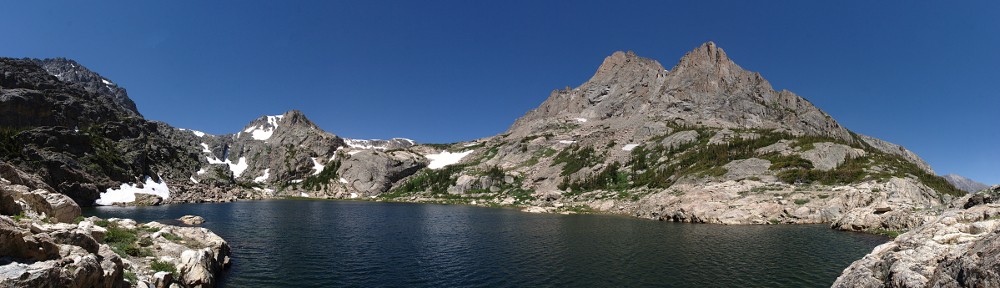
After a ship gets a major overhaul or a crew change, it goes on a “shakedown cruise” to simulate working conditions and insure that all the ship’s systems are functional. Today I went with a small group of fellow LoCos on a pleasant little drive south and west of Denver to give the Elise a little shakedown.
The highlight of the drive was Tarryall Road. The club has driven this road several times recently but somehow I’ve never gone with them until now. Tarryall Road runs about thirty miles, from the little town of Jefferson on US 285 at the foot of Kenosha Pass to a junction with US 24 at Lake George. It’s a nice Lotus road – curvy rather than straight, featuring beautiful scenery and little traffic.
I very nearly described the town of Jefferson as “not much more than a wide spot in the road.” That would be incorrect. The word “town” is an overstatement. It’s one of those places on US 285 that is best described as “blink and you miss it.” It was founded in 1879 and in its heyday had a population of 55 and even had a hotel. Today, I conjecture that the only people who go to Jefferson on purpose, people who aren’t just blasting through on the highway, are hikers on the nearby Colorado Trail who come here to get provisions.
I understand the name “Tarryall” was coined by a group who discovered gold in the area. They thought there was enough for everyone and called their camp “Tarry-all”. I saw no sign of gold mining. In other streams around South Park there was extensive dredging in placer mines, but none here. And there were no tailings piles from hard rock mining. In the end it appears there wasn’t that much gold here after all.
Jefferson was founded by ranchers, and serves ranchers today. Driving the thirty miles of Tarryall Road we pass by dozens of ranches. Some are obviously thriving operations today, others are rustic to the point of near total decay.
Our lunch stop for the day was the Iron Tree Restaurant and Funky Town Brewery. The menu we ordered from was the brunch menu, featuring a number of variations on Eggs Benedict. I had their “Country” version: English muffin, sausage, poached egg, hollandaise sauce, with country potatoes. Quite tasty. None of us was daring enough to order beer with brunch.
Europa, Elan, 3 Elises. Not pictured: Esprit and Triumph TR 6
Okay, so what about the shakedown?
This was my first real drive with the car after our extensive repairs. I’d taken it around the block a couple of times and down to Ferrari of Denver for Ryan to do an alignment. But that was all city driving and not typical of how I drive it.
In my trips around the block, my first impression of the new motor mounts was mostly negative. The shifting is much improved, but the vibration of the engine isn’t absorbed by the motor mounts at all. It all goes into the car. My first joke was that it wouldn’t be long before the fillings got vibrated out of my teeth. I was sure Genae would never want to ride in the car again.
The trip across town did show me that it’s not as bad as I first thought. Once you get it above about 3500 rpm it gets, well, not exactly civilized, but certainly much quieter. When I first bought the car I had to train myself to keep the revs up over 3000 as it doesn’t do well at low revs. Now I have incentive to keep the revs above 3500.
Below 3500, you see, the car plays a symphony of rattles and buzzes. Every part of the car vibrates, and everything within it. All engine speeds between idle and 3500 set various bits going; as you run the speed up some rattles go away and other vibrations start. Think of it like an orchestra. Before the symphony begins, all the players tune their instruments; an unpleasant cacophony. But when the orchestra is in full song, it’s marvelous. Above 3500 rpm, to be sure, the car isn’t quiet, but it’s in full song – the players have stopped tuning and the music starts. I can’t wait to get it onto the track.
The other major work was the clutch. I will admit that I was somewhat concerned that I’d end up with a much stiffer pedal. But my worries were baseless. The new clutch feels pretty much the same as the original equipment. I’m quite happy with it.
So I’d say the shakedown cruise was a success. The car works wonderfully (if a bit of a rattletrap at low rpms) and I had a pleasant drive on some beautiful Colorado roads and had a nice meal with friends.
Technically, I may be premature in saying “Part Last”. We still have a few items on the punch list, but I’m happy to say that my level of distress is no longer at maximum: the car is put back together, sits on her four wheels, and has even been around the block. She both goes and stops.
Michael and Daniel spent quite a bit of time over the last week, most of it without my presence in the garage. Not surprisingly, things went much quicker. I’d like to chalk it up to my absence. At the grocery store, no matter which line I choose to stand in, it will be the slowest moving. In traffic, the lane I’m in is slowest and changing to a different lane won’t help: the slowness property follows me. So I say they could work faster without me in the room, but they tell me that things went faster because all the hard work was already done and all they had left was the easy bits.
A few days ago I had to go buy the fluid for the gearbox. Google told me it was available any number of places, but calling around the first place that actually had what I wanted was Peak Eurosport. So I headed down and picked it up. While there, I had a brief chat with Ernie. He had recently replaced the clutch in an Elise. He said it was hard enough with the car on a lift and couldn’t imagine having to do it on the floor. He told me the car he worked on had relatively few miles, only 20,000 or so, but it was a track-only car. He also said the clutch he replaced was in worse shape than mine was. I find that hard to believe, but Ernie’s a straight shooter.
So here’s a recap of what we’ve done since about the end of November:
Replaced the motor mounts
Replaced the clutch
New ball joints on the rear lower control arms
New hub carrier plinth bolts
Although maximum distress is over, we still have some work to do:
Fabricate an improved battery tie-down
Replace the wheel studs, all four wheels
Get an alignment
I’ll take the car to the track at the end of April for an afternoon of lapping. Need to get refamiliarized with her at speed before I hit the road for points east in May.
She’s back on terra firma!
Shortly after this picture was taken, I went around the block a couple of times for a quick test. When idling, the vibration from the solid mounts is… extreme. But once you’re moving it’s not nearly as bad as my first impression was last time I took it around the block. I don’t know if it’s because it’s been so long since I’ve driven it that I can’t make a proper comparison, or that it actually is better with all four new mounts than with just the fore and aft mounts. It also seems that the clutch feel isn’t noticeably different than the stock clutch (which is good) and that the gear shift is much improved (also good).
My crack team of mechanics has already identified a list of additional work we’ll need to do after the summer driving season. We’re thinking stainless steel brake lines and new rear rotors.
The only niggling item at this point is the one extra bolt we have left. The three of us looked the car over for about half an hour and can’t find anything amiss. In the end I found a cover for one of the motor mounts that we neglected to put back in. We’re thinking the bolt is for that. But I’m thinking we should have two bolts for that, not just one. Hmmm.
This month’s Lotus Colorado meeting was held in Erie at Scuderia Rampante, a high-end Ferrari restoration shop. Calling the place a high-end Ferrari restoration shop is a bit redundant, I guess, but I think I can get away with it. If you had a Ferrari and wanted some work done on it, how far would you be willing to send it? They’re working on a car that, when they’re done, will go back to Hong Kong. I’m not sure there is anywhere farther from Hong Kong than Erie, Colorado.
They called the event a “shop tour”. That probably overstates it. To me, a tour implies some sort of guide telling us what we’re seeing: what’s important or interesting. Nothing like that today, we just wandered around the place. Several employees were there to answer questions, so we weren’t completely on our own.
This was not our first visit. We were here a few years ago. Not much has changed, and for somebody not very interested in cars it might be fair to ask what there is to see a second time. For those of us quite interested in cars, there’s always something to see. I’m not particularly a Ferrari fan – I’ll never own one and probably never drive one – but I think they’re fascinating examples of engineering and technology.
And it’s not just Ferraris. There are a variety of other cars there as well. Most are stored in a giant rack but a number are in various states of disassembly. To do engine work on most of the Ferraris, they simply remove the entire engine, transmission, and rear suspension and put that assembly on a table or rack.
As I said, I’m not that into Ferraris. For the most part, I can’t look at one and say, “That one is a 430 and that one is a California.” I don’t know what any of them is worth (other than more than I’ll ever spend on a car) or how much it might cost to have one worked on. On many of them, I’d guess a clutch service would go for perhaps as much as I paid for the Elise. So I won’t go into any detail on any of the cars I saw.
F40 and F50
On prominent display were an F40 and an F50 side by side. The F40 is the red one, the F50 is the black one. The F40 was built between 1987 and 1992. I have no idea how many of these they made. A quick look on the internet tells me if you want one today, you can expect to spend about $1.6 million. The F50 dates from 1995-1997. You’d need to sell two F-40’s and kick in an extra few hundred thousand dollars beside to pick one up. I’m guessing you don’t get to see these cars side by side very often.
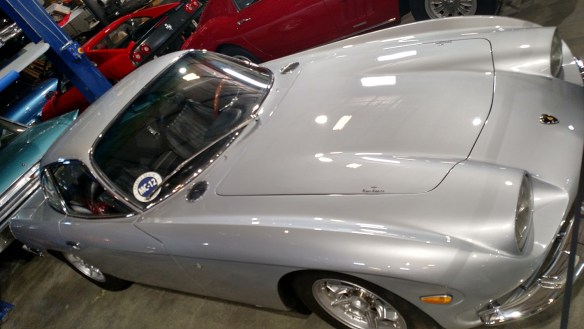
Lamborghini 350GT
I know even less about Lamborghinis than I do Ferraris. This one is an example of the first Lamborghini model made. It’s a 350GT. They hadn’t yet started naming their cars after bulls. There was a 350GT and a 400GT. If I understood correctly, this car was an interim car – a 350GT with the motor from a 400GT, which makes it quite rare. Even so, it probably could be had (were you to find one for sale) for somewhere in the neighborhood of a million.
Cadillac Fleetwood
I thought the Fleetwood was interesting. I don’t know what year it was, but it was a giant. I believe this one is a 1952 Fleetwood Seventy Five limousine. It’s about a mile long and has more chrome on one car than on all Cadillacs built in the last decade. Looking at it, I couldn’t help but wonder what the thing weighed. I was guessing it might be 6,000 pounds. That was way off. In fact, these cars were closer to 4,700. For comparison, my 1967 Imperial was 4,900. The Imperial had a giant 440cid engine, while this Fleetwood was motivated by an eight cylinder 331cid motor that cranked out 190hp. Again, for comparison, my Elise generates 190hp.
They don’t just work on cars here, they store them as well. I didn’t count them, but they can probably stack something like forty cars in this giant rack. I’m sure it’s quite the operation to get one off the top: move the bottom one out of the way, rotate the stack down, take the next one out, repeat. Every car in there looked to be hooked up to a battery tender, so you could just jump right in and drive them off, once you managed to get to the one that belongs to you. Not all of them are super-exotics. In this photo, the car on the other side of the Testarossa is a modern Ford Mustang. And there were a few examples of Detroit iron from the same era as the Fleetwood above.
Engine test
Here’s one of the engines they had taken out of the car. It’s the engine, transmission, and suspension. This one was hooked up to a device that lets them run the thing. I wasn’t in the room when they fired it up, but it was much quieter than I expected. I guess you’ll get that, given the size of the muffler hanging off the back.
It wasn’t just cars. In the back corner they had a little sitting area with a couple of stuffed bears (including a polar bear smoking a cigar and holding a pool cue), a couple of cabinets filled with knick-knacks, and some vintage race posters on the walls. This portrait of Steve McQueen caught my eye. It’s made up of articles, photos, and advertisements from magazines.
Here we are, four weeks into a planned two week operation, and still plenty of work yet to come. I think I can safely say that “maximum distress” now relates more to Fripp’s sense of the term (Murphy’s Law) than my own distress at seeing my car in parts on the floor of the garage. It could be that I’m just becoming used to it in that state, or it could be that we’re finally making some progress at putting the thing back together.
Today we actually accomplished a few things. The transmission is married to the motor, the starter and master cylinder are installed, and although the car is still on jack stands, the motor and trans are supported by (half) the motor mounts instead of floor jacks.
Engine and transmission, not supported by jacks
It took a bit of jockeying to get the transmission attached to the motor. We had one floor jack supporting the motor and used two smaller ones to levitate the transmission into place. This was a bit of a challenge, given the cramped quarters. But when we finally managed to apply the correct roll, yaw, and pitch and got things lined up there was much rejoicing!
Michael announced that we’d just completed the hardest part of the operation. Then we went to work on installing the starter. We used various English swear words (English, not American) on the previous step but now upped our game. A quick search of the internet got us the proper Japanese swear words and we were able to compose an incantation that did the trick on the starter.
Both Michael and Daniel think we can get the rest of the work done in one more day, but I’ll believe it when I see it. We still have a fair amount of work to do, and what makes them think we’ll be any more efficient at reassembly next weekend than we’ve been the last two? We still need to replace the passenger side motor mount and install the trans studs for the fore and aft motor mounts. And we need to borrow the use of a press to remove and replace two ball joints before we can reassemble the suspension. When that’s all done, we can replace the wheel studs.
I’m happy that positive things are happening, however slowly. Distress is being replaced by anticipation.
Just a quick update to the clutch job. We spent about four hours but made very little progress. We officially began putting things back together today, which is a milestone. The clutch assembly went into the car, and we replaced the driver’s side motor mount (three down, one to go).
The stumbling block today was mating the transmission to the engine. Because the car is so low to the ground, there’s no room to manoeuver. If we put the transmission on a jack, it’s too tall to get under the frame. If we try to put the tranny on a jack while it’s under the car, we can’t get enough leverage to lift it up. And it’s all too low to the ground for somebody to put his body under the thing to lift it up. We will reconvene next week for another go, adding another jack to the mix.
New clutch, installed.
At one point today, I expressed my amusement that even the internals of my car are green and yellow. The axles are green, and the new clutch is yellow.
Things did not go as planned last weekend with the clutch replacement. By now, we had hoped to be able to take the driveshafts to a shop to have them reconditioned and to take the flywheel to a machine shop to have it resurfaced. Neither of these things has happened. We were unable to disconnect the driver’s side driveshaft from the transmission, which was proving much more difficult than expected. Getting to the flywheel would be easier; we just ran out of steam.
Yesterday Michael and I tried to pry the driveshaft out of the transmission without success. Last weekend we tried to do this when the transmission was still on the car using a slide hammer but had no luck. Doing this with the transmission off the car adds somewhat to the degree of difficulty because it’s hard to keep it from moving.
So our first task today was to remove the clutch assembly from the car. The friction disk looks okay. Compared to the new part, the old one appears to have about half its life left. The flywheel also looks to be in good shape. In fact, it’s good enough that we don’t see the need to have it machined. Both these observations fit with my self-assessment that I’m kind to the equipment.
Friction disk
The pressure plate is another matter. The plate itself is okay. It’s just that it was tearing itself apart in an apparent effort to divorce itself from its neighbors.
One bolt hole was completely off, two more were seriously cracked
I will probably never know exactly what happened as a result of the spin. Perhaps this part was already failing. I do know that I didn’t have any abnormal noises before the spin, but did hear something I didn’t like when driving the car around the paddock afterwards. The noise was gone by the time I got on the highway. I’m pretty sure that noise was the debris inside the bell housing.
Inside of the bell housing scored by debris
The diaphragm spring has also seen better days. Looks like the throwout bearing was grinding it away. The throwout bearing is why we embarked on this repair. It’s visually intact but when you spin it, it makes an obvious noise. I hate to think of how this would have turned out if that little sucker wasn’t crying out to be replaced.
Diaphragm spring wear
We finally did manage to get the driveshaft out of the transmission. We oriented it so the bell housing was on the floor (well, on boards actually) with the driveshaft pointing up. Both Michael and I had to stand on it to keep it from moving while Daniel went at it with a big pry bar. Our first few attempts fell short, but we finally overcame friction and got it removed. High fives all around and break out the beer.
We still need to use a press to get the driveshafts disassembled to the point where we can take them to get reconditioned. Michael has that lined up for later in the week. We’re finally nearly almost close to half way done.
I’m a big King Crimson fan. On one of their live albums they have a track called “The Law of Maximum Distress”. I learned this week that that is Robert Fripp’s name for Murphy’s Law. I don’t want to exaggerate. It’s not like Murphy’s Law is a constant companion for me. But Murphy does show up fairly regularly. By titling this post “Maximum Distress” I’m not suggesting that everything is going wrong.
Distress is defined as “anxiety, sorrow, or pain” or “to give simulated marks of age or wear.” In psychology it is “unpleasant feelings or emotions that impact your level of functioning.”
So why am I talking about Murphy’s Law and anxiety or marks of age or wear? Well, this weekend we embarked on a program of winter maintenance for the Elise. Perhaps “embarked on” isn’t exactly true. She’s been parked for a few months now. When last we discussed the car, we had replaced two of the motor mounts. Timing is everything: when test driving the car, we couldn’t help but notice that the clutch’s throwout bearing was making noise. If we’d have noticed this before our work we’d have combined the jobs and saved some effort.
In any event, it’s time to do some major work on the car. It’s not just replacing the clutch. In addition, we’ll take the passenger side driveshaft to a local specialty shop for refurbishment (the CV joint boot is weeping), we’ll replace the two remaining motor mounts, and we’ll replace all the wheel studs. For good measure, when we reassemble the rear suspension we’ll take the preventive action of replacing the hub carrier bolts.
The reader may recall that the motor mount broke when I spun the car at my last track day. I was running on slicks and made a slight error that resulted in the most violent spin I’ve ever encountered. Actually, it’s the only time I’ve spun the car except when I had a mechanical failure. That’s happened twice, both times a sheared hub carrier bolt.
I don’t know one way or another whether this spin caused any of the other damage we’re addressing, or whether it’s just wear and tear. I’d say “normal wear and tear”, but because I’ve done on the order of forty track days (and the previous owner did quite a bit of autocross) I don’t think it falls under the “normal” category. And although I’ve only run slicks a few times, running on slicks radically increases the forces on the car.
And so it begins…
The original plan was to take a day one weekend to dismantle the car to get to the clutch. One day the next weekend we’d replace the clutch and put everything back together. In between, we’d take the driveshaft in for servicing. (We could do that work ourselves, but parts alone from Lotus cost more than having somebody else do it.) Some online research led us to a nice writeup with plenty of photos. This guy indicates the clutch job will take twelve hours for first-timers.
Now, of course, anybody who knows me knows that I’m not doing this myself, no matter how good the instructions are. I’m software, not hardware. I will mostly stand around trying not to get in the way while Michael and his friends do all the work. I’ll run to the store if we find we need something, and I’ll supply the pizza and beer.
Suspension disassembled
So when we got started yesterday, we planned to have everything taken
apart by the end of the day. It was Michael and Daniel doing the work,
and our good friend Murphy showing up a few times to lend a hand. At the
end of the day we were still quite a way away from our goal. This is
where Maximum Distress comes in for me. I’ve watched everything get
taken apart. Car parts are everywhere. We’ve used every known size of
wrench and socket known to man, even had to go out and buy one we didn’t
already have. It would be a slight exaggeration to say it looks like a
bomb went off in the garage.
Motor dropped
We worked seven hours yesterday, and Daniel came over again today and we spent another five. The fellow who wrote up our instructions said the whole job would take twelve; we’ve got twelve hours into it and we’re not quite at the halfway point.
Transmission
I have every faith that Michel and Daniel can put it all together. There really isn’t any doubt in my mind. But it’s all too much for my pea brain. Given an infinite amount of time and a patient mentor and I could probably do it. I’d undoubtedly have a few extra parts left over, and I’d have had to do many of the tasks two or three times because I put something together upside down or backwards. It would by my hell, my Maximum Distress.
Finally, the clutch!
I’ve now adjusted my expectations. I’m thinking it’ll be two more weekends before we’re done. We managed to leave enough room for Genae to park her car, so at least she’s not relegated to the driveway. But the bad news is that Michael put a bit too much effort into this given his recent back surgery. He’s now in a solely supervisory role.
On my last visit to the track I ran on slicks. I was able to navigate turn 7 at between ten and fifteen miles an hour faster than on the street tires. Unfortunately, late in the day I apexed a bit early and had the choice of going off the track or lifting off the throttle. I chose the latter and for the first time in thirty-five or so track days spun the car. It was a particularly violent spin that dislodged the battery (again!) and broke a motor mount. A couple of weeks ago, the new set of motor mounts arrived.
The new parts
I was surprised to see that the inserts are black. They’re supposed to be red. The reds measure a 60 A on the durometer scale. (Hopefully I’m using the term correctly.) The blacks are 75 A, which is harder. I called the vendor and asked about it and was told that Innovative is no longer selling the 60 A for use in the Elise. I’m not sure I’m buying that. It could be that they just shipped the wrong ones. But there’s quite a bit of discussion on the web about which ones to use, so I decided I’ll install these. In theory, I could buy red inserts and replace them.
Today it’s time to install them.
Saturday, November 3
There are four mounts in the car: fore, aft, driver side, and passenger side. In addition to the various discussions I found on the web concerning the hardness, there is also quite a few opinions as to whether to replace all the mounts or not. It is not uncommon for people to just replace the fore and aft mounts, leaving left and right as stock. The original plan was to do them all, but if we run out of time I’m happy just to do the fore and aft.
The idea was that Michael and I would do it. He has a sore back, though, so he invited one of his friends to help. But Michael quickly found out that he was able to do some of the work after all, so I ended up watching and fetching tools as required. There really isn’t room under there for three people.
The guys at work
I’m sure this operation is a lot easier if the car is on a lift, but we don’t have a lift so we just put the back of the car on the ramps. It’s a little cramped, but workable. We did the rear first. It came off pretty easily
The old aft mount
The stock mounts aren’t solid and the new ones are. When we first inspected the mounts, that wasn’t clear to me. The only one we got a good look at was the rear one. I was thinking it was broken worse than it actually is. But it’s pretty broken. It’s not exactly X-shaped, but close enough. The photo doesn’t show it very well but three of the four legs of the X are cracked all the way through.
Forward mounts, new and old
The front mount was a bit tougher to replace. The bushing is pretty stout and we had to persuade it a bit to get it into place. Then there was much finagling required to get the holes to line up for the bolts.
While they were working under the car, I decided to finally “upgrade” the camera mount on the nose of the car. I didn’t give much thought to where the camera should be mounted back when I originally installed it. There are two problems with it. First, I have to take the tow ring off the car to run the camera. That’s not ideal if I have a problem on track and need to get towed. Second, because it’s sideways I need to use two little arms, one of which is essentially a 90 degree elbow. It’s not an elbow, but serves the same purpose. And because of the two arms the camera is farther from the mount itself and more subject to vibration.
Old camera mount (above, horizontal), new camera mount (below, vertical)
With the camera mount in the new location, the camera won’t move around so much and it’ll be even closer to the ground, making it look like I’m going faster! Sadly, the picture shows how beat up the front of the car has gotten. Michael and I have talked about what it will take to effect some fiberglass repairs, so I’m thinking the current beat-up state of the nose is only temporary. (The picture also shows both mounts. The old one is no longer there.)
We finished the job in about three hours. That’s just the fore and aft mounts. We haven’t put the undertray back on the car but I did take her out for a spin around the block. It’s going to take a while to get used to it. There’s a lot more vibration in the cabin. Before the test drive I was joking that it’ll be like a bunch of buzzing hornets. It’s worse than that. She really vibrates quite harshly now. I don’t think it’s enough to loosen the fillings in my teeth, but it’s quite different. On the other hand, there’s a noticeable difference in the feel when shifting gears. I never got past third and literally only went around the block, but I think it’s much improved.
In addition to only doing half the mounts, we haven’t done the trans studs yet. We probably are going about this the hard way, but so it goes. Oh, and it sounds like there’s an issue with the clutch. Michael thinks it’s the throw out bearing. Neither of us heard this noise at the track after the spin, and I haven’t driven the car since getting it home. When it rains, it pours.
No, this is not the story of how Indiana was settled.
Several months ago I found a set of “gently used” Hoosier A7 slicks for sale on Lotus Talk. The seller was in Fountain Hills, Arizona, which added a bit to the degree of difficulty in obtaining them, but only a bit. Michael was in school in Phoenix so he could fetch them for me if I managed to strike a deal. We knew we’d be bringing a load of his stuff back to Denver at the end of the summer anyway, so why not add a set of tires to the mix?
I contacted the seller, who wanted two hundred dollars. I told him they weren’t worth that much to me and asked if he’d take forty. After a long pause he countered with sixty and we had a deal. Michael went to his house to collect them, and when Michael graduated I went down to Phoenix and helped him move his stuff home, along with my set of slicks.
Here it is the end of September, and finally time to put the rubber to the road, so to speak. I’ve been thinking about the difference between the Hoosiers and the Dunlops for quite a while now. The anticipation was exquisite. How much faster can I go over the course of a lap? Specifically, I wondered if I could average two miles per hour over the whole lap. If I exited turn 3 two miles an hour faster, could I carry that two miles per hour down the length of the highway straight? How much faster could I go in the sweeping uphill right handers of turns 7 and 11? I was pretty sure I could take turn 3 flat. I was pretty sure I could take 7 in fourth gear instead of third. Certainly I could average two miles per hour better. Then I did the math. Two miles per hour works out to about four seconds per lap. Two miles per hour doesn’t sound like much, but four seconds per lap sounds huge.
Sunday, September 23
The thing about track wheels and tires for an Elise that is driven to the track rather than trailered is that a support vehicle is necessary. My last set of track tires were street legal – I could mount them on the car at home and drive to and from the track – but slicks definitely are not. I sure wouldn’t want to get stuck in even the lightest rain in slicks. Also, I’d basically use the tires up completely driving them the 140 miles or so for the round trip. So I can’t run the slicks unless somebody goes with me. Michael kindly volunteered, even with the proviso that there’d be at least one session where I wouldn’t want a passenger so I could try to set a fast lap. (I figure the weight of a passenger costs me something like two seconds per lap.)
This was an Emich sponsored event and they offer full day, morning only, and afternoon only sessions. I signed up for only the afternoon session, with (I thought) the drivers meeting starting at noon. They’d break us into two groups, fast and slow, and we’d get four half-hour runs. My experience with these things is that most of the full day runners give up by mid-afternoon and that I’d have the most traffic in the first run and least in the last one.
Michael and I met up with Scott at the park and ride and we caravanned to Byers where we filled up with fuel. Michael and I abandoned Scott at the gas station so we could get a head start on setting up our stuff. We brought not only my track wheels but some chairs and a “gazebo”. That’s what it says on the box, but I’d call it more like a canopy. It provides shade, anyway, if the wind doesn’t carry it off. This was a risk, as we didn’t have any bungees to allow us to use the street wheels as ballast. We weren’t expecting wind, but you never know.
Turns out I was wrong on the meeting time, which was actually 12:30. That’s not a bad thing, as we didn’t have to hurry with anything. We got the canopy deployed and I went to work swapping the wheels. Here I will interject that I was poking around the internet the night before trying to decide how often I need to replace the wheel studs. So I use the breaker bar to get the lug nuts started all the way around, then start at the left front wheel with the impact wrench. Wouldn’t you know, the very first lug comes off bringing the stud with it.
I showed it to Michael and said, “Well, I’m done for the day!” I was pretty crestfallen. I lost a stud several years ago at an Eiskhana event and tried to drive it home slowly. Before I got home another stud failed. I ended up getting towed that time.
Luckily, Mark happened to be there. I met Mark through Dennis. Dennis owned the car I drove in the ChumpCar race at Road America a few years back. Dennis ran his car in three different race series so he had to have a pretty long list of drivers available. Mark was one of those drivers. He was here today running his Miata.
Mark says, “I’ve got some blue Loctite.” So we put that sucker back in and had an hour or so to cure before I took it out. I was still pretty concerned during my first session, paying close attention for any unusual vibrations. But all is well, and at the end of the day when we swapped back to the street wheels the stud stayed in place. In any event, even though I don’t have an answer to “how often do I need to replace the studs” I do know that I’ll be replacing them in the next few weeks.
I went out for the first session without Michael in the passenger seat. I was a bit uncertain how the slicks would work. They’re autocross tires, designed to heat up very quickly. So they’re not necessarily suited to running a half-hour track session. I’ve been told they’ll get greasy pretty quickly. One experienced racer told me I might only get one good lap on them. And, as I said, I was concerned about the stud.
But the biggest problem in that first session was the traffic. It was a bit like rush hour. Scott wanted to follow me around for the first lap, so I took it pretty easy. By the end of our out lap we were catching up to people. Going in to turn 4 I was seventh in line. The fast group is open passing, meaning we didn’t need the slower car to point us by. And everybody in front of me had a horsepower advantage. Nobody was pointing anybody by, but nobody was able to execute a pass. I got by two BMW’s and next time into turn 4 I was still seventh in line. At the end of the lap two cars went into the pits and on the pit straight I passed two more and got another in turn 1. It was the fourth lap before I got a clean run. That lap ended up being the day’s best. It was the only lap of the session where I had no traffic.
That best lap beat by previous best by two seconds and my best on the Dunlops by nearly five seconds. So I managed to get my two miles per hour. It was a little like driving a different car. Because of the greater cornering speed, I didn’t have to resort to my unusual line through 2, 6, and 11. I took 3 flat once or twice and was easily on cam in fourth gear through turn 7. I was six miles per hour faster in the pit straight, ten miles per hour faster through turn 4 and six miles per hour faster through turn 7. And yet I was slower on the highway straight. It was exhilarating. And I felt I could beat that time by another two seconds if I had a few clean laps.
The next two sessions I took Michael as a passenger. I’m thinking a passenger costs me about two seconds per lap. The first session with him I managed a 2:10, which isn’t much slower than that two seconds. The second session with Michael I had two laps in the 2:07’s, just a fraction slower than my best lap of that first session. If my two second guesstimate for the passenger is correct, my goal of doing a 2:05 is within reach. My lap timer confirmed that: it says my optimal lap in my first session was a 2:05.53. (That optimal lap is comprised of my best times in each of the three sectors put together as a theoretical lap.)
My last session started at 4:30. By now most people had left. I should be able to run eight or nine laps without any traffic. The tires still felt great, never felt greasy once. I was feeling good. I was psyched.
In my first timed lap (according to the data) I entered turn 7 two miles an hour faster than I had all day. Going up the hill I was in fourth gear and on cam. At the time, I’d have said I was doing it just as I’d done two dozen times already. But the data shows that I got off the throttle a little earlier than I had before. With the extra entry speed, I must have felt I was running wide at the exit, so I got off the throttle a little early.
I lost the back of the car, went into a spin, dropped the rear off the track. After 180 degrees was momentarily rolling backwards up the track before the car spun another 180 degrees. The car stalled and the oil light was illuminated for a second or two. I was going again right away. I never went more than a few inches off the track. But it was a violent spin. I’ve been sideways many times and always caught it. The only two times I spun the car before this was when I had the hub carrier bolts shear.
At the end of the lap I reported to the black flag station. Glen was already there talking to another driver. When it was my turn he asked what happened. I told him I lost it, that I spun all the way around. But I said maybe it was 180 one direction then 180 back the other way. “You don’t know how many times you spun?” I was there, I did it, but my eyewitness testimony was unreliable.
Everything felt okay, and Glen looked the car over and let me rejoin the session. On the next lap, as I was nearing turn 4 a car lost it between 4 and 5, first going off the left side, then crossing the track and going off the right side. He kicked up an enormous dust cloud and the lights in the turn 5 bunker were flashing yellow. I went pretty slow through the cloud of dust, not really sure where that car ended up.
Next time around, when I entered turn 4 I tried to downshift from fifth to fourth. But I couldn’t find fourth. I eventually got it back into fifth, but something was wrong. I continued slowly, trying to find a gear other than fifth. I eventually got one, but things were not good. I exited the track and going slowly through the paddock I heard a new noise. The noise went away when I engaged the clutch, came back when I released it.
With the car stopped I was able to select any gear. Michael jumped in and we drove slowly through the paddock. Gear selection was working again, but the noise was still there. We looked things over to the best of our ability when we remounted the street wheels. Nothing looked amiss with the suspension. Michael suggested that I’d broken a transmission mount. That would fit the symptoms. After a short discussion we decided I could drive the car home, taking it easy. So we packed everything up and hit the road.
Monday, September 24
At lunch today we put the car up on the ramps, took off the access panel under the engine and had a good look around. The rear engine mount is clearly broken, but the other three look intact. None of the bolts or studs appear to be damaged and everything else looks good.
I spent a fair amount of time looking at the video of the incident. I’m going to have to go with driver error. I shouldn’t have lifted until I had the car straightened out. For years I’ve heard that LOTUS stands for “Lift Off Throttle U Spin”, but I’ve never experienced it. That was quite the introduction.
Next on the agenda is ordering a set of motor mounts. I’m going to go with an upgrade from OEM. I’ve done a fair amount of research and will go with the Innovative mounts. I expect to feel a fair amount of additional vibration in the cabin, but these mounts will be better suited to the track and will likely improve shifter feel.
I’ll also order a new set of wheel studs.
I’ve been happy running track days on my street tires. I don’t feel the need to run on slicks all the time, and I really don’t want to spend a bunch of money on tires. The last set of track tires cost me about $800 and lasted four days. I got these Hoosiers because they were a bargain. I will continue to use these tires until they’re used up, whenever I can get somebody to cart them out to the track for me. But I know running slicks greatly increases wear and tear on the car. I do want to run better tires at the track, but ideally I could drive them to and from; ideally they’d last ten or twelve track days. I’ll keep looking.
But there’s no denying the thrill I got from these tires. Until the end there.
It has been a busy week and I’m a little behind on getting the blog updated. So I’ll post things a bit out of sequence. I’m still putting together two or three videos of my drive home from Snowmass over Independence and Loveland passes. That work was slowed down by an evening at the Great American Beer Festival and a trip today down to Ferrari of Denver for a little car show which they called “Holy Horsepower.”
Saturday, September 22
Hours on the flyer stated 10am to 2pm, but their parking lot is small so I figured it was better to be early than late. As it was, I didn’t arrive until a few minutes after ten and by then they were pretty well full. They directed me to a nice spot that could hold two small cars. “We can probably fit another Lotus in there.” I wandered off for a bit and when I got back it wasn’t a Lotus in the spot next to me but a Tesla Roadster. Close enough!
I quickly spotted Kent’s 2017 Ford GT. It took me a while to track him down. When I did, I asked if he remembered me telling him that, even though I like all his cars, the only one I would ask to drive was his 2005 GT. I said I’d renege on that now that he has the new one. That got a smile out of him. I told him to expect an email from me.
As is usual in these things, if they were to give out an award for the dirtiest car I’d win. I haven’t had a chance to wash it since the Snowmass trip, so it’s all covered with bugs, dust, and track grime.
As expected, there was no shortage of fancy machinery. I neglected to get photos of the Morris Mini and the yellow Pantera. Actually, there were quite a few cars I didn’t get pictures of. But my photographic skills aren’t that great, so I figure I’ll go easy on everybody.
This was my best look at the Tesla and Elise side-by-side. I’d heard that they share only something like 7% of parts, and it looks like most of those are on the interior. The Tesla is several hundred pounds heavier but uses the same brakes. I was surprised by that, but it makes use of regenerative braking, so the brakes don’t need to work so hard.
I took a few shots of a pretty orange Aventador. It was one of the few cars with the engine compartment open. I was somewhat amused that they have a plaque with the engine firing order on it. I don’t recall seeing that before.
Quite a few people left by noon, but a few cars kept arriving throughout the time I was there. The one that drew the biggest crowd was a pearl white Ferrari LaFerrari Aptera 70th Anniversary car. I heard somebody say it was worth $6 million. I don’t know my Ferraris. I didn’t know it was a LaFerrari until I looked it up at home. Sure enough, it looks like that $6 million figure could be correct. Wow. Pictures don’t do the paint job justice.
When I found Ryan I told him I was interested in getting an ECU dump for my car. He said it was pretty easy and offered to do it. He brought out his scan tool and laptop and in a couple minutes I had the data. He did this last year when he rebuilt the top half of my motor, but I didn’t get a copy. I was most interested in time spent at various engine speeds. In adding these up and counting the amount of track time I have, I’m a bit surprised I’m not above 5700rpm even more than is shown. The time by car speed maps out to my expectations pretty well, so I don’t doubt the data.