February 17
We left Consejo Shores early on our way to the Excalibur Adventure Park to enjoy the Via Ferrata and zip lines. We had 11:00 am reservations and didn’t want to get there late. It’s a bit southwest of Belize City, so we left some extra time.
As we got closer to our destination, the landscape transformed a bit, with small, steep mountains jutting above the otherwise pancake-flat terrain. This was a good sign: I was having trouble imagining zip lines without mountains.
I said earlier that the road signs look just like the ones at home. That isn’t entirely true – the signs warning drivers about the speed bumps were like none I’ve seen anywhere before. Today, we started seeing some new signs. They’re the usual amber diamond signs you’d see to warn you of deer crossing, but they weren’t for deer. Instead, we were warned to watch out for tapir and jaguar crossing the road.
It was only 10 o’clock when we pulled into the parking lot at Excalibur. It looked like we had an hour to kill, but they said we could start our adventure whenever we were ready. We pretty much had the whole place to ourselves.
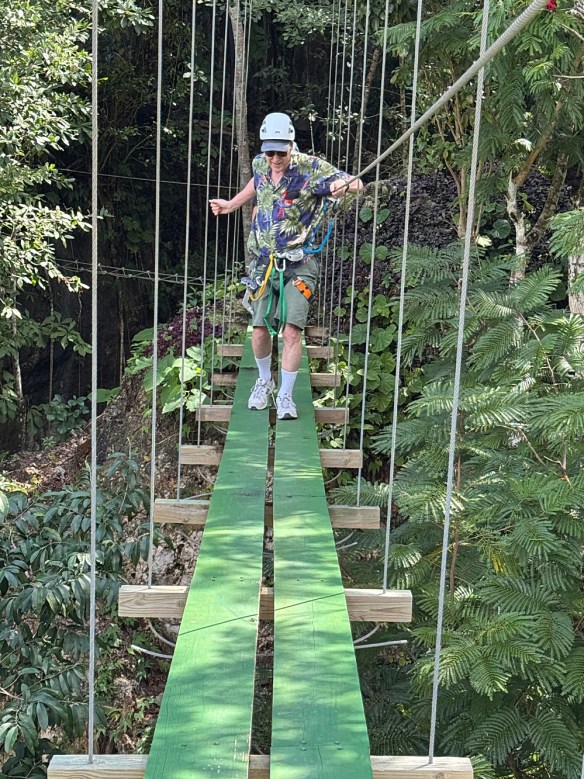
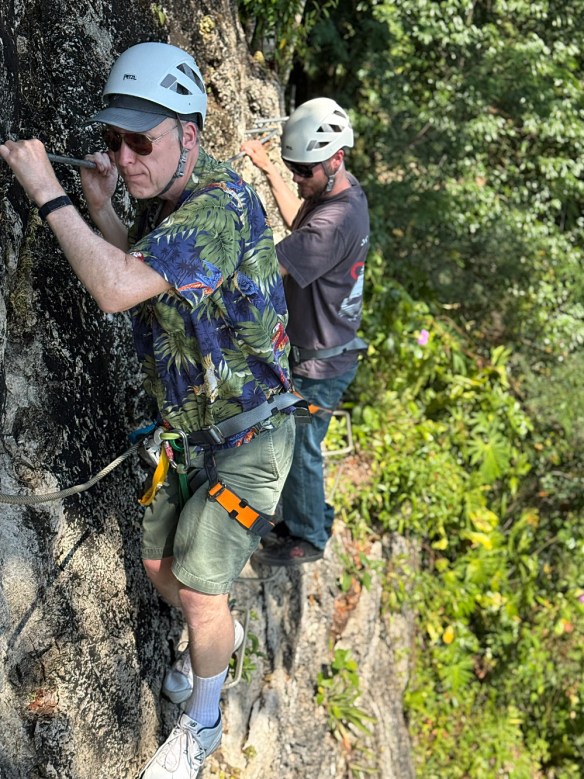
A via ferrata (“iron path”) is a protected climbing route over mountainous terrain. By “protected,” I mean strapped onto a heavy cable with a carabiner and a device called a “cookie”. The cookie is a squared C-shaped one, with the opening of the C smaller than the cable’s diameter. There’s no way to get the cookie off the cable except at the ends. The carabiner, on the other hand, can be removed from the cable at any time. The cable is attached to the rocks or bridges with a sort of plate. Orient the cookie such that the opening of the C can traverse the plate. At these connecting plates, we have to disconnect the carabiner and reconnect it on the other side. This system makes it impossible to come off the cable, which is reassuring for those of us who have problems with heights.
The original via ferrata was built by units of the Italian army during the First World War and was used to get men and supplies over difficult terrain. They’re now sprouting up all over the place.
This is my first time on one, and I didn’t really know what to expect. On this one, there are five bridges. Some thought went into the design. One bridge tends to bounce up and down when you cross it. Another bridge sways left and right, and another moves backward and forward. Yet another is simply a series of cables criss-crossed, and you need to step where the cables cross. Without the safety gear, I think I could have crossed these bridges, but it would have taken me much longer!
No photography is allowed on either the via ferrata or the zip line. Our guide, Sergio, was kind enough to take some photos. Along the way, he also pointed out some of the interesting plants in the area. One was the gumbo limbo, commonly called the “tourist tree”. The bark has a reddish tinge to it, and it peels off, much like the skin of sunburned tourists. It’s always near a black poisonwood tree. The bark of the gumbo limbo can be used to counteract the effects of the black poisonwood tree. Greg warned us of the poisonwood tree as he had a bad time with it in the jungles around his house. The effect is worse than poison ivy.
When we were putting on our harnesses, before starting off on the via ferrata, Sergio pointed out a coatimundi. The little guy moved too fast for me to get a picture. Oh, well. I’m sure we’ll get another chance to see one tomorrow at the zoo.
The start of the zip line is at the end of the via ferrata. Genae didn’t do the via ferrata with Michael and me, so she joined us here. The first platform is 275′ above sea level (and thus nearly that distance above the ground below). In all, there are five different zip lines that circle through the property, passing over the via ferrata and garden paths below, before ending not far from the start of the via ferrata. It was quite fun.
We ate at the restaurant there, delicious burgers and sandwiches (with buns branded with Excalibur’s logo), fries, and beer.
We didn’t originally sign up for any other activities, but Sergio told us a little about the caves they have there. One is a wet cave that you ride through on innertubes. The other is a short dry cave. We didn’t have our swimsuits with us, so we decided to take the tour through the dry cave.
Sergio told us all about the various formations in the cave – stalagmites, stalactites – and how water comes into the cave during the rainy season. I pointed out the bats that live there, and we even spotted a scorpion spider stalking a cricket. In the middle of the cave, Sergio asked us if we wanted to see total darkness. We turned off our headlamps for a short while. In our modern world, we rarely encounter total darkness. We literally couldn’t see our hands in front of our faces.
There are two short sections of the cave where you have to crawl on hands and knees, and one where you have to slither on your belly. I couldn’t help but wonder how they could politely tell your basic “Walmart shopper” they were too fat to make it through these sections.
Sergio was the first Belizean I’d had any sort of conversation with, more than a simple transaction at the store, anyway. I was expecting his English to be accented much like any other native Spanish speaker I’ve spoken to. But his accent had a bit of a Jamaican lilt to it. I noticed this accent when speaking to other Belizeans. I think I’ll change how I think of this accent – for me, now, it’s not so much a Jamaican accent as a Caribbean one.




Done with our great time at Excalibur, we hit the road and headed to Belize City. Tomorrow we’re heading to the zoo, and rather than drive all the way back to Consejo, then all the way back here (the zoo isn’t far from Excalibur), we traded a night in a motel for all the driving.
The Ramada Inn, where we stayed, was right on the water. I was guessing half the rooms would have an ocean view, and half would have a “city” view, but all the rooms had ocean views. We didn’t want to tour the city after dark, so we had dinner in the hotel restaurant.