Breakfast at the hotel was much like you’d expect breakfast to be at any Ramada Inn stateside, but with a slightly different selection of fruit. The sausage was different – instead of patties or links, it looked like sliced-up hot dogs. I sampled it; it wasn’t hot dogs, but I can’t say for sure exactly what it was.
Genae found out that the Museum of Belize was nearby. We didn’t know if it was open yet, so we asked the hotel’s concierge. She said it was open and that we could get there on foot or by taxi. Instead, we drove. Yes, we could have walked it, but the roads are narrow and not particularly well set up for pedestrians.
The building the museum is in was built more than a century and a half ago by the British colonial government as a prison. The prison was shut down not long after independence, and in about 2002 was made into a museum chronicling about 3,000 years of history. It hosts a rich assembly of Mayan ceremonial objects, carvings, paintings, and other cultural artifacts. The story of slavery is told – loggers who braved malarial swamps and often tried to find freedom in Guatemala – and emancipation 15 years before our Civil War.
There are exhibits of the region’s animals. Each stuffed animal is accompanied by a sign telling visitors how the animal came to be here: killed by a vehicle, or died of old age. Animals aren’t represented only through taxidermy; there are some beautiful paintings and photographs. One exhibit tells about the destruction caused by Hurricane Hattie, which struck Belize in 1961. It was this hurricane that caused the capital to be moved inland to Belmopan.
Ex-prison
Mayan numbering – they had a zero!
Not Toucan Sam (Froot-Loops)
Our museum craving satisfied, we hit the road and headed to the zoo.
I’ll admit that I’m not the biggest fan of zoos. They always feel a bit wrong to me. Yes, it’s nice to be able to see these creatures, but they’re in jail! The Belize Zoo is a not-for-profit organization founded by Sharon Matola in 1983, who was caring for a handful of wild animals that had been part of a natural history documentary. When filming was completed, she was left with these animals and decided to start a zoo. The animals here are rescued, confiscated from the illegal wildlife trade, or transferred from other rehab facilities. Most of the exhibits have signs telling visitors how they came to be here.
When we were looking at the spider monkeys, a tour guide came up onto the platform leading a small group. Once the monkeys spotted her, they came running up to the fence. She tossed them bits of food, at first on their side of the fence, then on our side of the fence, which they could grab with their prehensile tails.
The howler monkeys were all asleep at the top of their tree. A sign said. “Please don’t howl at us, it causes us stress.” I don’t know if they’re nocturnal, but it was fairly hot out, and even many of the diurnal animals were sleeping in the shade.
Tapir
Spider Monkey
Harpy Eagle
American Crocodile
Iguana – a visitor, not a resident
Today’s beer
We had lunch at the restaurant at the zoo, bought some T-shirts, and then headed back to Corozal.
We left Consejo Shores early on our way to the Excalibur Adventure Park to enjoy the Via Ferrata and zip lines. We had 11:00 am reservations and didn’t want to get there late. It’s a bit southwest of Belize City, so we left some extra time.
As we got closer to our destination, the landscape transformed a bit, with small, steep mountains jutting above the otherwise pancake-flat terrain. This was a good sign: I was having trouble imagining zip lines without mountains.
I said earlier that the road signs look just like the ones at home. That isn’t entirely true – the signs warning drivers about the speed bumps were like none I’ve seen anywhere before. Today, we started seeing some new signs. They’re the usual amber diamond signs you’d see to warn you of deer crossing, but they weren’t for deer. Instead, we were warned to watch out for tapir and jaguar crossing the road.
It was only 10 o’clock when we pulled into the parking lot at Excalibur. It looked like we had an hour to kill, but they said we could start our adventure whenever we were ready. We pretty much had the whole place to ourselves.
A via ferrata (“iron path”) is a protected climbing route over mountainous terrain. By “protected,” I mean strapped onto a heavy cable with a carabiner and a device called a “cookie”. The cookie is a squared C-shaped one, with the opening of the C smaller than the cable’s diameter. There’s no way to get the cookie off the cable except at the ends. The carabiner, on the other hand, can be removed from the cable at any time. The cable is attached to the rocks or bridges with a sort of plate. Orient the cookie such that the opening of the C can traverse the plate. At these connecting plates, we have to disconnect the carabiner and reconnect it on the other side. This system makes it impossible to come off the cable, which is reassuring for those of us who have problems with heights.
The original via ferrata was built by units of the Italian army during the First World War and was used to get men and supplies over difficult terrain. They’re now sprouting up all over the place.
This is my first time on one, and I didn’t really know what to expect. On this one, there are five bridges. Some thought went into the design. One bridge tends to bounce up and down when you cross it. Another bridge sways left and right, and another moves backward and forward. Yet another is simply a series of cables criss-crossed, and you need to step where the cables cross. Without the safety gear, I think I could have crossed these bridges, but it would have taken me much longer!
No photography is allowed on either the via ferrata or the zip line. Our guide, Sergio, was kind enough to take some photos. Along the way, he also pointed out some of the interesting plants in the area. One was the gumbo limbo, commonly called the “tourist tree”. The bark has a reddish tinge to it, and it peels off, much like the skin of sunburned tourists. It’s always near a black poisonwood tree. The bark of the gumbo limbo can be used to counteract the effects of the black poisonwood tree. Greg warned us of the poisonwood tree as he had a bad time with it in the jungles around his house. The effect is worse than poison ivy.
When we were putting on our harnesses, before starting off on the via ferrata, Sergio pointed out a coatimundi. The little guy moved too fast for me to get a picture. Oh, well. I’m sure we’ll get another chance to see one tomorrow at the zoo.
The start of the zip line is at the end of the via ferrata. Genae didn’t do the via ferrata with Michael and me, so she joined us here. The first platform is 275′ above sea level (and thus nearly that distance above the ground below). In all, there are five different zip lines that circle through the property, passing over the via ferrata and garden paths below, before ending not far from the start of the via ferrata. It was quite fun.
We ate at the restaurant there, delicious burgers and sandwiches (with buns branded with Excalibur’s logo), fries, and beer.
We didn’t originally sign up for any other activities, but Sergio told us a little about the caves they have there. One is a wet cave that you ride through on innertubes. The other is a short dry cave. We didn’t have our swimsuits with us, so we decided to take the tour through the dry cave.
Sergio told us all about the various formations in the cave – stalagmites, stalactites – and how water comes into the cave during the rainy season. I pointed out the bats that live there, and we even spotted a scorpion spider stalking a cricket. In the middle of the cave, Sergio asked us if we wanted to see total darkness. We turned off our headlamps for a short while. In our modern world, we rarely encounter total darkness. We literally couldn’t see our hands in front of our faces.
There are two short sections of the cave where you have to crawl on hands and knees, and one where you have to slither on your belly. I couldn’t help but wonder how they could politely tell your basic “Walmart shopper” they were too fat to make it through these sections.
Sergio was the first Belizean I’d had any sort of conversation with, more than a simple transaction at the store, anyway. I was expecting his English to be accented much like any other native Spanish speaker I’ve spoken to. But his accent had a bit of a Jamaican lilt to it. I noticed this accent when speaking to other Belizeans. I think I’ll change how I think of this accent – for me, now, it’s not so much a Jamaican accent as a Caribbean one.
Tapir crossing
Jaguar crossing
I can’t draw the sword from the stone…
Via Ferrara bridge
Hanging on the Via Ferrata
The view at the top, ready to zip!
Today’s beer
Bats in the cave
Done with our great time at Excalibur, we hit the road and headed to Belize City. Tomorrow we’re heading to the zoo, and rather than drive all the way back to Consejo, then all the way back here (the zoo isn’t far from Excalibur), we traded a night in a motel for all the driving.
The Ramada Inn, where we stayed, was right on the water. I was guessing half the rooms would have an ocean view, and half would have a “city” view, but all the rooms had ocean views. We didn’t want to tour the city after dark, so we had dinner in the hotel restaurant.
Today we toured the town of Corozal. In the weeks before the trip, when I told people I was going to Belize, everybody asked where we’d be staying. Nobody I talked to had ever heard of Corozal, and gave me blank stares when I told them it was close to Mexico. Undoubtedly, this reaction is natural. Corozal is not at all a tourist mecca.
We’re in Consejo Shores, not Corozal town itself. Consejo is an enclave of Canadian and US expats. It’s about 11 km of bad road northeast of Corozal and only a bit over a mile as the vulture flies from Chetumal, Mexico. Chetumal and Corozal are on the shores of the Caribbean (or Corozal Bay). A peninsula and islands to the east protect the shore from the worst effects of hurricanes and tropical storms, and the water here is too shallow for anything like a cruise ship. The closest tourist attraction is Ambergris Caye. All of Belize’s tourist attractions lie to the south of Belize City, which is a 2.5-hour drive south of Corozal.
Between Belize City and Corozal, the land is pancake flat, planted with sugar cane, palm trees for palm oil, and fruit orchards.
I was surprised to learn of the large presence of Taiwanese. Most of the stores and markets in the area are owned and operated by Taiwanese. Chinese names abound – Deng Shen, for example.
The official language of Belize is English. (The place was called British Honduras until 1981.) Spanish is common, and there’s quite a lot of pidgin English/Spanish – billboards with messages such as “Di Sun Serious!” abound.
There are hundreds of Mayan ruins in the region. I struggle to convey this properly. There are hundreds of sites, with each site ranging from a single structure still overgrown by the jungle to sites spread across hundreds of acres containing dozens of structures that are active archaeological projects.
Greg knew where one of these sites is in the middle of Corozal town. It took us a couple of attempts to find it, missing it by a block this way at first, then by a block that way. When we finally stopped to ask for directions, we were just a couple of hundred feet away, on the other side of a building.
The Santa Rita Archaeological Site is not much larger than a football field. It was first settled some time around 1200 BCE by about 150 people, eventually growing to about 6,800 people and controlling trade along the Rio Hondo river (which today separates Belize from Mexico). People here traded as far south as South America.
My inner 8-year-old couldn’t resist the urge to climb to the top of the pyramid.
We finished the day at a local pizza place. Rather than have another Belikin, I opted for a Landshark, brewed by Margaritaville Caribbean Brewing Company, based in Jacksonville, Florida. It was launched in 2006 by singer-songwriter Jimmy Buffett to compete against Grupo Modelo’s Corona. So, yeah, I went to a foreign country to drink a beer from Florida.
We left the house at 7:00 am for our 9:45 flight to Belize City. The fun began when we tried to check our bags. We’re all traveling on the same confirmation number. To begin the process, you need to let the kiosk know who you are. I’m using the Southwest app. You can scan the QR code, supposedly, but that didn’t work. After four or five tries, I gave up and just inserted the credit card I used to buy the tickets. Strike one against the app.
It has been a while since I flew out of concourse C. I was sort of looking forward to a bagel at Einstein Bagels, but they’re no longer there. Plan B was a breakfast burrito. Next, we headed to the gate. It was here that I discovered that the Southwest app wouldn’t bring up Michael’s boarding pass. When I went to get his boarding pass printed, I could no longer display either my or Genae’s boarding pass. Paper passes for all, then. I’m less than impressed with the Southwest app.
The flight was uneventful (as all good flights are). We didn’t notice until after beverage service was over that, it being Valentine’s Day, they were giving passengers free beer. An opportunity missed.
At the Belize City airport, they don’t have jetways – it’s old school. They drive the Arrested Development stair cars to the plane and we walk down to the tarmac. They did this at both the front and back of the plane, so deboarding was fairly quick. That was the last quick thing for the day.
A United Airlines flight from Denver landed just ahead of us. By the time we got in line for passport control, we were at the end of a line about a hundred yards long and about four people wide. After passport control, we go to customs. The guard let a bunch of people go without being queried about customs declarations, but no shortcut for us. We were asked where we were staying (“a private residence”) and who we were staying with. I gave them Greg’s name, but not an address or even the city he lives in. Just his name was good enough.
We were allowed to pass without being searched.
On to the car rental agency. I was third in line. It took about 45 minutes to complete the transaction. Basically, they were out of cars. One guy was told that his SUV had just been returned, but was having overheating problems. The next guy’s car needed to be washed – “It’ll only take 10 minutes. 10 Belizean minutes!” Our car wasn’t available either. Could we take a smaller car? Needing a car, I assented. “We’ll lower the price since it’s a smaller car.” The price given to me was $25 more than my original quote. That took another few minutes to fix.
We piled into our VW Nivus and headed out. To get out of the rental car parking lot, we had to pay $2 American (or $4 Belizean). I’ve never had to pay to get out of a rental car parking lot before.
Much of our 2.5-hour drive to Corozal would be in the dark on one of Belize’s best roads. (There’s a town called Corozal, in the district called Corozal. We’re headed to Corozal town.) This road is a two-lane highway, signed and striped just like roads here in the USA. The speed limit outside of the towns is 55 mph. But there are speed bumps on this highway. I’ve never seen speed bumps on a highway before. Most of them have warning signs. Most. I hit one of them moving at triple-digit speed. (The VW’s dashboard is set to metric.) Yes, we were going over 100 kph when I spotted the bump. I braked hard, but hit the speed bump harder. We did not catch air, but I was concerned I might have damaged the car. Good thing I got the insurance.
By now, it was getting dark. I got a dashboard warning telling me to turn on the headlights. Seems to me the car should be able to turn the headlights on automatically. It’s not new technology – I had it in a car manufactured last century. I couldn’t find the light switch while going 100 kph and keeping a watch out for speed bumps. Michael even did a quick (and fruitless) web search. I had to pull off the road to figure it out.
Back on the road, we began seeing trucks loaded with sugar cane heading the other way. The trucks were piled high with cane – far too tall to go under any US overpass or traffic signals. They all looked fairly precarious. Canes littered the road at each speed bump. The speed bumps, by the way, are called “sleeping policemen” by the locals.
The air was sometimes thick with smoke. When the cane is harvested, the fields are set afire. At one point, the horizon in front of us was orange with flame. A few minutes later, we saw the field that was burning – it came right up to the road.
Entering Corozal, we still had a bit of a journey ahead of us to get to Consejo Shores. It’s only about 7 miles, but it’s 7 miles of bad dirt road. It’s fairly heavily travelled, but punctuated by potholes small, medium, and large. I managed to miss most of the biggest holes while maintaining a more-or-less 35 kph pace: faster than perhaps I should have been driving, but too slow not to get passed.
We arrived at Greg’s a bit before 8 pm, which was earlier than Greg expected. I had a Belikin beer. This is perhaps the most popular beer in Belize, advertised at just about every cantina and restaurant between Belize City and Corozal. Compared to Colorado craft beers, it’s not great, but it was welcome after this drive. (The name “Belikin” is an amalgamation of several Mayan words meaning either “road to the east” or “road to the burning sun”.)
February 15
A lazy day today. For breakfast, Greg offered up some fresh fruit – guava, melon, pineapple, avocado – and banana bread.
In the early afternoon, it was off to the “beach” for volleyball. I didn’t play, but got into the water to float or sit on the bottom. There’s no beach here, and they play ball in the shallow water. The net is fifty feet or so from the shore, but today (even though some regulars said it was “deep” today), the water was about waist-deep. I ventured a bit farther from the shore, but never found deep water.
For dinner, Greg cooked up some sea bass and Spanish rice. We played games and chatted until after Greg’s bedtime.
Regular readers may recall that, since my transmission swap about a year ago, I’ve had issues shifting after about twenty minutes driving on the track. It never happens on the street, but after several laps, I’d find myself wanting to downshift from 4th to 3rd, but once I’m out of 4th, I can’t get into any other gear until I slow down almost to a stop. Maybe I could go another lap before it happens again, but it keeps happening until I’ve stopped and let the car cool down. Then I’m good for another twenty minutes or so.
Nobody I’ve talked to has had a similar issue. I did eventually come across one recommended solution: remove the stock clutch push rod and replace it with a longer one. It seems this upgrade is often used for people who replaced the stock clutch with an ACT clutch. I did replace the clutch when we swapped the transmission, but I switched to the ACT clutch the first time I swapped transmissions a few years ago. I never had any problems with that setup, so I’m not sure this is really the answer.
Thankfully, swapping out this part is a fairly easy task. For someone who knows their way around transmissions, that is, which excludes me. The sales material says, “A slightly longer shaft puts the slave cylinder piston further back in its bore, thus allowing a longer stroke and more disengagement. Installation is simple and does not require bleeding the clutch.”
The new part was only $19. Shipping almost doubled the cost, but compared to, say, replacing the transmission (again), it’s almost free. In my ignorance, I assumed that doing anything with the clutch would involve removing the transmission, which is not anything like “almost free”. Fortunately, I asked the proper stupid question on one of the Lotus forums and was given some simple instructions that even I should be able to follow. I asked Michael if he’d help me, and he kindly agreed. So, back in early October, Michael and I installed the new part.
New extended slave rod (left) and original rod (right)
I signed up for the afternoon session for the track day the following weekend to see whether this was, indeed, the answer to my problems.
My sessions are thirty minutes long. I made it through the first session without any shifting issues. Getting ready to go out for my second session, I had a moment of panic: I couldn’t get into any gear. The car had cooled down; the engine was running but I was parked. I shut everything off, took a deep breath, and worked the gear shift and clutch. I was able to get into each and every gear without problem. What the heck?
The second session went as well as the first, and the problem of getting a gear when parked didn’t come back. I’ll chalk that oddity up to “shit happens”. I don’t know what went wrong and can’t even make up a story that explains the facts. If it doesn’t come back, I’m good.
“And hast thou slain the Jabberwock? Come to my arms, my beamish boy! O frabjous day! Callooh! Callay!” He chortled in his joy. — from Jabberwocky, by Lewis Carroll
I went out for my third session, feeling pretty good about things.
Then things went sideways.
My track tires aren’t the correct size. The rears are good, but the fronts are too narrow. I like the “soft” compound – treadwear rating of 190 rather than the 460 of my street tires – but I need to make some adjustments to my speed in some of the turns.
I normally shift into 5th gear near the end of the Highway straight, the fastest part of the track. I’m only in 5th for a few seconds before braking for turn 4 and downshifting back into 4th. During this session, I was staying in 4th here. That saves me two gearshifts, but I can’t keep the throttle wide-open all the way to my braking point. I never want to rev so high as to bounce off the rev limiter, so I let off the throttle slightly to keep the RPMs closer to 8000 (my limiter is set at 8200).
This had been going well on previous laps, but this time, between turns 4 and 5, off-throttle and about to downshift to 3rd for turn 5, the car started sounding, as the Brits say, “like a bag of spanners.”
I should have parked the car right there, but all the gauges looked good (except for the check engine light that was now illuminated), there was no bang, no cloud of smoke, no loss of oil or coolant. I gingerly drove back to the paddock and parked the car.
I talked to Glen, the track manager, about leaving the car there. He said there were events planned all week, so I’d be able to collect the car any time that week. Chad gave me a ride home and I started plotting my next move.
I’d have to take a day off work, whether I had it towed by a towing company or I went there myself to get it. I asked around and decided to borrow a truck and trailer and do it myself. So I imposed myself on friends: Ryan for his trailer, and Michael’s friend Dan for his truck. They both instantly agreed. Dan had never towed a trailer before, and is considering getting a trailer to transport his cars, so it would be a good learning experience for him. Michael went with us.
We arrived at Ryan’s place a bit after 9 am and immediately discovered that the hitch we had bought had the wrong-sized ball on it. This was easily remedied with a trip to Harbor Freight. Back at Ryan’s, we hooked up and hit the road.
When I was a kid, we went all over the country in a travel trailer. I can’t tell you how many times I helped my dad hook up the trailer. It was old hat. In this case, really old hat, as I haven’t done it more than a couple of times since I was a kid. It’s not that hard. Also, Michael is a DOT-certified technician. Safety is a big part of his job.
On the final approach to the track, the highway crests a hill. We had just started going down the hill when we heard a really bad noise. The trailer had come off the hitch, and the trailer’s tongue was grinding on the ground. We stopped as quickly and as safely as we could. We weren’t entirely off the road, but there wasn’t much we could do as the only connection now between the truck and the trailer was the safety chains.
When hooking up, one of the steps is connecting the breakaway. The idea is, if the trailer comes unhitched from the tow vehicle, the safety chains keep the trailer attached, but the breakaway cable disconnects. When that happens, the trailer’s brakes are supposed to engage. The breakaway did break away, but the trailer’s brakes never engaged. Rather than the trailer stopping itself, the truck stopped the trailer by rear-ending the truck. The rearmost part of the truck is the trailer hitch. Which punched through the front of Ryan’s trailer.
Part of the trailer damage
So, here we are, in view of the track, not quite entirely off the highway, just over the crest, where any big-rig rolling along at 65mph wouldn’t see us until nearly on top of us. We didn’t dilly-dally very long before heading to the track to see if we could borrow a jack from somebody. The only people at the track were doing a photo shoot, but we did manage to borrow a jack.
We got the trailer hooked back to the truck, got it to the track, and loaded the car into the trailer. But we didn’t know what went wrong, so there wasn’t a lot of confidence that the trailer wouldn’t decide to unhook itself, this time with my car in it. It was bad enough empty, but with my car in there, I wanted to do whatever we could to make sure it didn’t repeat. We slowly drove back to Byers, where we picked up a ratchet strap from the general store. It was at about this time that Ryan texted me: “How’s the recovery trip going?”
I didn’t think it was a good idea to tell him about his trailer via text message, so I just told him we’d picked it up and were on our way to my place. I wanted to tell him in person. So I put it off.
Ratchet strap hitch lock
After a tense and nervous and, thankfully, uneventful hour drive back to my place, we unloaded the car and hit the road back to Ryan’s to return his (now mangled) trailer. I texted him with an ETA at his place. He told me he wouldn’t be home until much later, so I had him give me a call. I told him the story. He was very calm and collected. I was mortified.
Once we unloaded the car, we needed to do something to the trailer. When it dragged on the road behind the truck, even though we stopped quickly, the tongue jack was ground down a couple of inches, with some of that material curled up on the backside of the jack. We had to take an angle grinder to it to remove the excess material so we could mount the foot back onto the jack.
After dropping the trailer off, it was getting to be dinner time. We hadn’t stopped for lunch, and breakfast was a distant memory. I did a quick search for a brew pub where I could buy Dan and Michael a beer and some food. We went to Two22 Brewing. They don’t have a kitchen, but there was a food truck there. Michael and Dan weren’t interested in what the truck had, but I dove into a plate of tacos. Yummy. And the beer was delicious.
With the car safely back home, I turned my attention to what may have caused my engine problem. It is my habit to always run video cameras on the car. Also, the lap timer app I run on the phone connects to the OBD-II port on the car, which gives me RPM and throttle position data.
Unfortunately, I replaced my phone a few months ago. I only use the lap timer app a few times a year, and this was the first time since replacing the phone. (Not entirely true, but close enough.) Sadly, after replacing the phone, I should have verified that the phone and the OBD dongle were still talking to each other. They weren’t. So I don’t have any data to support my assertion that I kept the revs around 8000 and not on the limiter.
You can hear that I wasn’t on the limiter, but you can’t really “hear” whether I’m at 8000 or 7800 or 8200. So we’re down to my word that I was at 8000. As I often said during my years of computer tech support: “The user is an unreliable witness.”
To recap:
My transmission problem seems to be fixed!
My engine is horribly broken, but we haven’t opened it up yet, so we don’t know how broken
Due to operator error, I don’t have any data from the car confirming or refuting my innocence
I wrecked Ryan’s trailer
I maintain (because, of course I do) that I didn’t do anything to cause whatever went wrong with my engine. I also maintain that we didn’t do anything wrong hooking up Ryan’s trailer to Dan’s truck. I don’t like mysteries. If either of these were due to my error, I’d like to know. I’d hate to repeat either of them.
The common refrain people give me is, “It could have been worse!” Yes, that’s true. My engine failure didn’t cause the car to go up in flames. The trailer jumped off the hitch when empty rather than with my car in it. It could have been raining.
The Elise is, once again, out of commission for the winter. At some point, I’ll order a replacement engine, and Michael and I can swap it out. In the past (think one earlier engine, two transmissions), Michael hasn’t been interested in tearing things down and getting into the internals. This time, though, we might take the deep dive. We don’t have a clue what the issue is. Michael’s guess, based solely on the sound in the video, is a spun bearing. We won’t know unless and until we take it apart.
I’d love to learn something about how these things work. And if we take it apart and fix it, I’ll have a spare working engine. And, if we take it apart and put it back together again, what’s stopping me from upgrading to a Stage 2 camshaft?
Here’s a short video. You may need to use headphones to hear the initial bad noise (about 9 seconds in). Headphones not required to hear it when I’m idling through the paddock.
I first put eyes on Caribou Lake three years ago, when I hiked to Lake Dorothy. Approaching Lake Dorothy, the Continental Divide is just a few yards from the trail junction for Arapaho Pass/Caribou Pass. Caribou Lake sits eight hundred feet below the divide. When I saw the trail to Caribou that day, it left an impression on me. It looked like a real slog.
The hike to Caribou Lake is uphill both ways. From the trailhead to the summit of Arapaho Pass is about two thousand feet. From the summit of the pass to the lake is eight hundred, but you do it in about a mile and a half. I’ve had this hike on the to-do list since that Lake Dorothy hike, but it never bubbled to the top because that eight-hundred-foot climb intimidated me.
Well, it finally bubbled to the top of the list.
Thursday, September 11
I arrived at the trailhead at 7:30. It was a bit less than half full. The weather was nice; it was a few degrees warmer than I expected for mid-September. No wind to speak of and only a few scattered high clouds.
My Lake Dorothy post describes the trail, so I won’t repeat myself. There are a couple of places early on the trail where you can see across the valley to where the outlet of Diamond Lake falls, but this late in the season, the water is quite low and the falls are silent.
I’d guess that more than half the hikers at this trailhead go to Diamond Lake, and with so few cars there, I expected to encounter very few people. From the footprints at the water crossings, I knew I was following two hikers and a dog, and I caught them a bit after the Fourth of July Mine when they were taking a break. A few minutes later, a solo hiker was coming down. He said he’d hiked to Caribou Pass. I ran into him at about 9:00, so he must have gotten an early start.
At the summit of Arapaho Pass, on the Continental Divide, it was as windy as I expected. I had to take my cap off lest it be blown away. The trail down is in very good shape. It’s almost entirely on a steep grassy slope – no scree, no talus. It’s not as steep as I expected, and the footing is generally good with only a short stretch of slippy stuff. It only took me half an hour to get from the top to the lake.
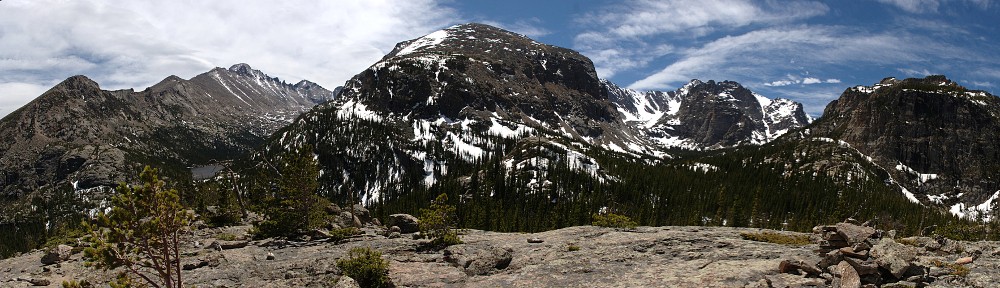
I really like Caribou Lake. It’s surrounded almost entirely by high, rugged mountain peaks. The forest it’s in is sparse, and its shores are grassy, providing wide-open views. The water, like most lakes along the Divide, is crystal clear. While eating my picnic lunch, sitting on a rock thirty yards upslope from the water, I could see fish swimming.
I arrived at the lake less than three hours after leaving the car. It was a little early for lunch, but I ate anyway. I ate about half my food, with the idea of having second lunch at the mine on the way back.
When I got to the lake, I thought I heard voices. I often think I hear voices, but that tends to happen to me in places I don’t expect to find other people. In this case, I did hear voices. I never spotted the other people, but I think they were climbing fairly high up a scree pile. At one point, I heard rockfall. It lasted several seconds, perhaps starting with a single rock but ending more like scree. The voices seemed to come from the same direction, but I never did spot anybody in that direction.
I didn’t circumnavigate the lake, but I did explore the north shore. I spotted several vintages of moose poo, and there were moose tracks on the lake bed near the outlet. I didn’t spot any moose, but they’re regular visitors here.
I stayed there for about an hour. I didn’t spend much time thinking about the hike back up the mountain, but I couldn’t help but notice it’s on the only grassy slope that goes all the way to the top. The trail looks to be perfectly laid out. The prospect of the hike out literally hangs over your head the whole time you’re there. But I had a plan.
I had a plan, but did I have the discipline? The plan was to never look up. I paused several times to take in the view below me, but I didn’t want to look up and see how much farther I had to go. I kept my vision on the ten or fifteen yards of trail between the toes of my boots and the brim of my cap. My discipline held, for the most part. On the hike down, I made a mental note that a rock outcrop the trail passes is quite close to the top. The first time I looked up, I was much closer to the outcrop than I expected.
It took me fifty minutes to make the climb, so a pretty good pace given the terrain. At the top, it was noticeably windier than it was a couple of hours ago. I took that peek at the outcrop after I heard the peal of thunder in the distance. Storm clouds were building. It looked quite dark indeed on the west side of Caribou Pass. I hoped it wouldn’t start raining until I was at the top.
At the top, I was greeted not only by the increased wind but also by the sight of storm clouds wrapped around Mount Jasper. I had barely gotten a couple of hundred yards down the trail, far enough below the pass that the wind wasn’t so bad, when it started to precipitate. It started, as it often does, with graupel. That was quickly replaced by a steady, cold rain. I began to wonder if the weather would cooperate with my plans for second lunch at the mine. There looked to be some blue sky to the west of this squall, so I remained confident.
Caribou Lake
Today’s beer
Caribou Lake
Deep in the Heart of Indian Peaks: Hopi, Iriquois, Apache
Caribou Lake and Satanta Peak
Approaching Storm
Stormy Jasper
The storm did pass soon enough. As it headed east, it continued to grow, dousing the valley below pretty good, but I was back in bright sunshine before getting back to the mine. I ran into a couple there, who told me they’d been watching a moose for the last half hour. They asked me how far up the trail the waterfall is. There is no waterfall up the trail from here. I mentioned the one before the Diamond Lake junction, across the valley, and said that with so little water running, it wasn’t obvious. “Ah, yes, that’s probably the waterfall we’re thinking of.” They wandered off, and I ate, and I never did spot the moose.
A bit later, I came across a backpacker. He said he hadn’t decided yet whether he’d camp at Lake Dorothy or the lower Neva Lake. I asked if he’d been to Dorothy before; it’s pretty desolate. He’d been there before, and he agreed. I think it would make for an incredibly windy night.
When I reached the Wilderness boundary, I met three young women sitting on a large boulder, lounging and chatting. They asked what there was to see on this trail. “Is there anything within twenty minutes?” No, nothing on this trail within twenty minutes. I didn’t have the heart to tell them I’d been hiking for seven hours. The boundary is only about a quarter of a mile from the parking lot.
I highly recommend Caribou Lake. It’s less than a ten-mile round trip, and the climb back up to the pass wasn’t the slog I envisioned. The lake is quite scenic, and there are some very nice campsites there. I will almost certainly make a return visit. Next time, I’ll make the short side-trip to a small, unnamed pond a quarter mile to the west.
It occurs to me that it might be a pleasant backpacking trip to hike in from Fourth of July trailhead, camp at the lake, and hike out to Monarch Lake.
I have a compulsion to collect things. It’s a mental defect. As a kid, it was coins and Hot Wheels. Growing up, I switched to books, magazines, records, CDs, and more. In a materialistic sense, it’s not healthy. I’m working on myself. It’s been a while since I’ve bought a book, and I’m trying not to buy a book unless I can’t get it from the library. I haven’t bought a CD or magazine in years now.
But I can’t help myself. I still collect things. Now it’s race tracks and alpine lakes.
Two days before this backpacking trip, I returned from a trip to Europe to drive on two race tracks – Spa-Francorchamps and the Nordschleife. Now it’s time to bag another alpine lake or two.
A side-effect of my lake collecting is that when I go backpacking, it’s more of an expedition than a “hey, let’s spend a couple of days in the back country.” I have to go somewhere new. I’ve been to a lot of beautiful lakes, but I’m driven to go somewhere new. As a bonus, we could make an assault on Pettingell Lake and maybe find Lake Solitude, which we missed last time. So that’s the expedition. Primary objective: Lake Powell. Secondary objectives: Pettingell and Solitude.
Lake Powell is quite remote. The guidebooks suggest getting there from the east side – via Black Lake and Frozen Lake. That route is well beyond my ability. Definite “no-go” terrain for me. So if I want to get to Lake Powell, I’m looking at a significant bushwhack up North Inlet.
When Gordon and I camped at Pine Marten before, the target was Lake Catherine, via Nokoni and Nanita. We made a loop, returning from Catherine down its outlet to the confluence with North Inlet, and down the valley to camp.
So we’ve already been through the terrain on more than half the route to Lake Powell. I said on that last trip that it was “an arduous bushwhack,” but I also said we managed a mile an hour. So that’s three and a half hours to Powell. Add some buffer, and nine hours should cover it, including a break. That’ll be Monday. Sunday is the hike to the campsite, and an attempt to reach Pettingell.
August 10-12
I’ve described the hike to Pine Marten before, so I won’t repeat myself.
We arrived at the campsite around 1:30. The first thing I did was set up the camp chair. When I bought the chair, I was wondering if it would be worth the bulk and weight on these backpacking trips, but I no longer have any doubts.
At 3:30, we headed up the trail to Lake Nokoni to get to Pettingell. I’ve been to the top of the ridge above Nokoni and didn’t like it. It’s steep – about as steep as I want to deal with. As a bonus, the footing is bad. But since I’ve done it before, I know I can do it again.
Gordon had put eyes on the lake on the last trip, but didn’t get there. So he had a good idea of a good route. It turned out to be about as steep as the slope above Nokoni. The footing wasn’t treacherous, though.
We enjoyed a nice dinner picnic break on the shore of Pettingell. We didn’t lollygag for long, though, as the sun had dropped below the ridge.
The climb above Pettingell was challenging. From Pettingell to the top of the ridge is about 330′ more than from Nokoni to the top. Gordon led the way. It didn’t take long for me to really start to blow! I was at maximum respiration. Deep breaths, as fast as the bellows would operate. Gordon would pause and let me catch up. He wasn’t even breathing hard.
I had a few minutes to recover as we crossed the relatively flat top of the ridge – thin forest, no deadfall, easy walking – before reaching the steep, potentially slippery descent. The view is great, so I just took my time.
Off the ridge and back at beautiful Lake Nokoni, Gordon stayed a bit to enjoy the surroundings. I was so adrenalized, I couldn’t sit down, so I headed back to camp. I got there a bit after 7, and Gordon was 10 or 15 minutes behind me.
Sunday night was cold. In my sleeping bag, I wore my thermal underwear, sweat pants, long-sleeved t-shirt, and my hoodie.
Monday morning, we had a guest visit our camp. Gordon and I were seated about 15′ apart, me in my camp chair, him on a rock. He said, “There’s a pine marten right behind you.” I couldn’t see it, so I got out of the chair and took a couple of steps toward Gordon before turning around. It casually loped out of sight. Neither of us stood a chance of getting a picture. That’s the first time I’ve ever seen a pine marten.
At a quarter to nine, we headed up the valley. It was rough going. An arduous bushwhack, no doubt. And we weren’t making a mile an hour. Going was fairly easy, as long as we could follow game trails. That was all too seldom.
The going got a bit harder after the confluence with Catherine’s outlet stream, because we were only now gaining any significant elevation.
About a fat half-mile from the lake, still about 700′ of elevation above us – a third of our total elevation gain – we talked timing. I wanted to be back at camp no later than 7. We could continue for an hour more; we might get there in that time, but even if we did, we’d have to turn around right away.
We stopped and had lunch, resting for only half an hour before heading back. On the return trip, we had as much difficulty finding game trails to follow as we did on the way up.
At one point, hours away from camp, standing in dense forest, a pile of deer pellets at my feet, looking for tracks, I said to myself (in a joking way) that I should consider the life choices that put me here.
We did stumble upon Lake Solitude. I was beginning to think it was fictional. We’d been through the valley twice without finding it. Sure, it’s on the satellite image and on all the maps and in the hiking guides, but it’s an elaborate fiction. But, finally, here it is, in all its … ordinaryness. Worth a visit only if you’re collecting lakes, or if you come across it on the way to somewhere interesting.
We arrived back in camp at 6. If we’d have continued another hour, we wouldn’t have gotten back until 8, around dusk. Not good.
Our return took us right through Pine Marten #2, now occupied by two women. We chatted a bit. They’ve visited a number of lakes that are on my “impossible” list – places beyond my range or skill. They said the same thing others have said – the way to get to Powell is from the other side. That route is farther out of my capabilities than today’s route.
I don’t want to make the day out to be miserable. Well, I sort of do. But there are always interesting or wonderful things to see. Following the tracks, we came across places where elk had bedded down for a night. One spot had a strong musky smell. I think the elk were here just a few hours earlier.
We came across a moose antler, an elk antler, what was probably part of a hipbone of a deer, and a couple of jawbones. On the steeper section, we passed by a couple of beautiful cascades and falls.
Pettingell Lake
Pettingell Lake
Bear poo?
Mt. Alice
Lake Solitude
Lake Solitude
Monday night was warmer. I slept better – in fact, one of my best nights’ sleep in two weeks. I guess nine hours of bushwhacking will do that to you.
Much of the forest that the trail to the camp goes through was burned a few years ago. Fires are a natural part of the forest ecosystem. (But the gigantic fires we’ve been having the last couple of decades is not natural.) I try to find the positives: one of the positives for a good stretch of trail is an abundance of raspberries. Raspberries need direct sunlight, so they’re thriving after the fire. I snacked liberally on berries both passes through this section.
On the hike back to the car, nearly at the Park boundary, we ran into a ranger. After checking our permit, he asked a few questions about wildlife. I mentioned that we saw a pine marten at camp. He said that a few years ago, he saw one there but failed to get a photo of it next to the Pine Marten sign – they don’t pose for pictures. I also said we finally found Lake Solitude. He called it a “mud hole”, so I’m not the only one with a low opinion of the place.
I’m a little disappointed we didn’t make it to Lake Powell. I knew it would be a challenge for me (Gordon could have made it – I slow him down considerably), but I’m a believer that one’s reach should exceed one’s grasp. You can’t find your limits without trying to surpass them. On the other hand, I finally bagged Pettingell Lake and Lake Solitude, and enjoyed a couple of days in the back country. Any time in the Park is a good time in the Park.
The continuing chronicles of Sleepless Dave: Last night, sleep was better until the nightmare started. It started innocently enough when two houseguests began to argue. Then another guest, leaving the “party,” got in his truck and pulled his trailer into my garage, and instead of stopping with the crash, kept trying to power through. This escalated into a fist fight before one of his friends came at me with a blowtorch, and it kept getting worse from there. The usual dream logic applies: it wasn’t my house, but it was my house, and the friends of friends were complete unknown to me. Yeesh.
I could hear cars on the track starting at 8. It’s the DTM cars running on the GP circuit.
I chatted with a couple of Dutch motorcyclists outside the hotel while waiting for Ryan and Laura. I asked if they were there to do laps. They told me bikes are no longer allowed and were sad they didn’t do it before the ban. They also said it was nearly as much fun riding the back roads here in the Eiffel mountains. True, from what I saw on the way here yesterday and on the way back to Brussels today, there is an abundance of Lotus roads in the area.
I’m not sure how we got there, but the topic of history came up. I don’t recall their exact words, but the gist of it was that Europe is rich in history, and America isn’t. It’s certainly true that, wherever I went in Brussels, I found “history”: old buildings, museums, war memorials, the Stolpersteine paving stones remembering Holocaust victims, statues of Kings, and on and on. But it’s also true there’s “history” in America. What we don’t have is millennia of European history. Spaniards built a church in the San Luis Valley at the end of the 16th Century. The cliff dwellings in Mesa Verde had been abandoned for a couple of centuries before the foundation was laid for the ruins of the castle above us. And, frankly, the vast majority of European history is about war and subjugation. We don’t have any Stolpersteine paving stones in Denver. But I digress.
Spa is pretty much halfway between the ‘Ring and Brussels; we used many of the same roads today as on the way here – back roads until near Spa, then expressway the rest of the way to Brussels.
Culture shock: the rest stops on the expressway have pay toilets.
Back in Brussels, Ryan wanted to try a lambic beer. He had a recommendation from one of his clients, but that brewery was closed. We tried another, same result. We ended up near the central square. We tried a white lambic – a bit fruity, a bit sour. I liked it more than Ryan did. But then, he’s not much of a beer drinker.
After they dropped me off at my hotel, I wandered in search of food for dinner and chocolates to take home. Success on both fronts.
I’m ready to go home.
August 8
I left my hotel at 8, thinking I had plenty of time to get to the airport. I walked to the bakery where I bought the delicious raspberry a few days ago, but they didn’t have any today. I “settled” for a couple of chocolate pastries. Then I walked to the bus to the airport.
The airport looked pretty busy. At the bag check, I asked a security guy if this was normal traffic. He said it was, but that some of the computers were down. Life in the modern world, eh? The line through security was pretty long, but I wasn’t worried because I had plenty of time.
On the other side of security, I found myself facing another long line. This was for passport control. They had a line monitor at the end of it, directing folks to the proper line. I didn’t notice there was more than one: the long one was for EU residents. All others were directed to a shorter line. Well, it looked to be shorter, but that was an illusion. I got to chatting with an American in line in front of me who was on the same flight as me. A frequent international traveller, he expressed concern or surprise that the passport people weren’t scanning documents – it was just a visual inspection.
After quite a while in this line, somebody came and made an announcement, whereupon a bunch of people left our line and went to a different line. Something about UK and US passports. After another announcement, closer to us this time, we found we were being directed to a different line. Just as we were getting to the front!
I guess this is where the computer issue was. In our new line, when we got to the front, we scanned our passports, which opened a gate. Next, we stood in front of a camera for a photo, and another gate opened. Successfully navigating this, we got our passports stamped. Finally, I headed to the gate, where I only had to wait a few minutes before boarding started. So much for having plenty of time. I could at last eat my tasty pastry.
The flight from BRU to IAD took off at 11 am. They did a meal service (I had a choice this time, not being in the last row this time), then turned off the cabin lights and had everybody shut their window shades. Nap time, everybody! It being not long after noon, I wasn’t sleepy. I tried reading, but my reading light was like a beacon in the dark, and I didn’t want to annoy my neighbors, so I played a couple of the computer games in the headrest of the seat in front of me.
Customs in the USA was a much different experience than in Europe. First was a passport check. All I was asked was whether I’d bought any expensive gifts. I misspoke: I said “Nothing more than 30€,” but I wasn’t thinking of the 45€ of chocolate I bought yesterday. Next, we claimed our checked bags by picking them up off one conveyor and putting them on another one a few yards down the hall. Presumably, if I’d been chosen for a search, they’d have flagged my bag. I saw no searches going on, so if there were any, they were in a separate room.
In this area, there are monitors on the walls. On these monitors, a succession of messages was displayed. They were all in English, and they all had what I took as a threatening tone. Each one said, “Do this and face prosecution!” or “Don’t do this and face prosecution!” Everything in the messages was common sense – yeah, you might go to jail if you assault a customs official. You might go to jail for assaulting anyone, though, right? It all seems very … unwelcoming.
The flight from IAD to DEN was run-of-the-mill. Again, I watched the flight map. It helpfully displays points of interest – cities, towns, mountains. Of all the mountains they have to choose from in Colorado – Pikes Peak, Longs Peak, the Maroon Bells – they chose Porcupine Hill. I’d never heard of it. It’s barely over 10,000′ high. Bizarre.
Not long after getting home, I sat at my desk to make some notes. It felt like I was still on the plane – my body had the sensation of the motion of the airplane cabin. I guess twelve and a half hours sitting in a metal tube will mess with your senses a bit.
The Nürburgring is only 100km from Spa. It would be senseless to come all this way to drive at Spa and not also visit the world’s most notorious track. Wandering around Brussels was the appetizer; lapping at Spa was the main course; now for the dessert.
August 6
The other day, when I was on the phone with the woman at my hotel, she said my breakfast would be delivered to my room the first morning but that I’d be served in the restaurant today. I assumed this meant I was no longer the hotel’s only guest. Poor assumption!
I walked into the restaurant at 8 and was greeted by a friendly dog. I didn’t see anyone and called out, “Bon jour! Good morning!” Nobody was there. But there was a table laid out for one, with all the items that were brought to my room yesterday. So I sat down and tucked in. A few minutes later, the gentleman who brought me my morning feast yesterday arrived. I have to say, it’s fairly odd being the only guest at the hotel and restaurant. I don’t expect it’ll ever happen to me again.
The drive from Spa to Nürburg was a pleasant excursion through rural Belgium and Germany. We were on back roads all the way. Even if the navigation system didn’t tell us we were only a few kilometers away from the town, we knew we were getting closer when we started seeing all the sports cars.
I couldn’t check into my hotel until after 5, and we couldn’t check in at Rent-4-Ring until 4, so we had some time to kill. We grabbed lunch (bratwurst and beer, with my beer being cheaper than Ryan’s Coke), then took a wander through the ruins of the 12th-century castle. They say you get a nice view of things from the top of the tower, but as my luck would have it, it’s encased in scaffolding, closed for renovation. They’re not going to renovate a castle that was destroyed about 350 years ago, but I guess they need to make sure it’s good enough that tourists don’t die when they climb to the top of it.
Nürburg is a unique place. My home race track, High Plains Raceway, is in the middle of nowhere. It brings quite a bit of business to the gas station and motel in Byers. Circuit de Spa-Francorchamps is surrounded by little towns. The track drives most of the visits to the hotels and restaurants in these towns. Aside from being close to a world-famous race track, though, they’re just normal little towns.
Nürburg takes it to a whole different level. The track is an industry in and of itself. Without the track, this place wouldn’t exist. BMW has its M test center here. There’s a mall here filled with stores I’ve never seen in any other mall. Want a driver’s suit or gloves? Stop at the race gear store. Looking for a new car? You have choices: there’s a store full of BMW M vehicles and a Caterham dealer. Scale models and memorabilia abound. The most normal thing at this mall was the Subway sandwich shop.
I was thinking we’d get to take our laps pretty much right after we registered, but that wasn’t the case. The track was having some sort of race driver training/education day. Touristenfahrten (“tourist drives”) didn’t start until 6, so we just sat for a while on the bench outside the rental office. It was a beautiful day, so why not? There really wasn’t much else to do.
There are dozens of places in Nürburg where you can rent a car and coach, hotels galore, even a casino and a roller coaster. To top it all off, there’s a Grand Prix race track here, too. The Nordschliefe, the track we’ll be driving on, hosted F1 races back in the 60s, but it’s far too dangerous for modern F1 cars. Today, they’re getting the place set up for a DTM race on the GP track.
At 5:30, we had our briefing. Today, the Nordschliefe is not a race track. It’s a one-way public toll road with no speed limit. Keep right except to pass. Pass only on the left; if you pass on the right, you’ll get ejected. Anybody can drive it – track rats in their Porsches, novices in VWs, and grandmothers in station wagons. You can drive just about any vehicle except a bus or a motorcycle. And, because it’s been closed all day, there’s a big line revved up and waiting to go.
At the ‘Ring, at least on Touristenfahrten days, you aren’t required to wear a helmet, which always struck me as odd. There’s no way I’d lap this place without a helmet. Also, the car I’m renting has a roll cage. I’d never drive a caged car without a brain bucket. Rent4Ring’s rule is that if you have an instructor, they’ll wear a helmet and therefore require you to also.
My coach, Nashe, had a pretty good American accent. I asked him how. A great way to develop an American accent is to grow up in Missouri, which is what Nashe did. He has been living here for five years. He used to race motorcycles. He’s the “new guy” at Rent4Ring with “only” about a thousand laps of the Nordschliefe under his belt. That’s about 13,000 miles.
The prospect of trying to drive fast around this track intimidates me. I’m all sorts of apprehensive about it. There are YouTube channels devoted to showing crashes here. Rent4Ring has a sign in their briefing room: “Don’t feed the YouTubers – Drive safely!” People die here every year. Let’s just say I have a healthy respect for the place. I’m not going to drive beyond my limits, but shit happens.
Nashe did a fantastic job of talking me around the track. I struggled with instruction at Spa, and I was worried about how it would go today. But it’s two very different sorts of instruction. Kostas was trying to teach me the proper racing line, which I would get to practice lap after lap. Nashe was telling me exactly what to do. “Stay right, there’s a Porsche coming up on you. Brake, brake, brake, let off, let the car go wide, give it some throttle, turn in now and keep it tight, give it some throttle and go as fast as you’re comfortable,” pretty much non-stop for the entire lap.
It took me about three turns to get comfortable with this sort of instruction. My pre-lap jitters were unfounded.
When we registered, I said more than once that I’d only do one lap. We reached the Karussel (about 8 miles in) before I knew it. It went by so quickly. Between there and the end of the lap, it was clear I had to go around again.
The second lap was a bit more hectic – more traffic. I didn’t check the time when I got on the track for the first lap, but they were running three lanes of cars past the card readers, so there was a steady stream of cars getting on the track, and not very many of them quit after one lap, so traffic was getting worse every minute. I haven’t checked the video, but I’m guessing I encountered at least thirty more cars on the second lap than I did on the first.
I always thought driving a car on a track required your full concentration. At the ‘Ring, it’s like that, but on steroids. Staying right when cars come up from behind, working out how to get around slower traffic, and driving fast, all with almost no margin for error, because if you go off the track, you’ll be in the barrier.
Two laps was plenty. If there’d been half as much traffic, I might have been tempted to go around again, but I knew it would only get worse. I don’t care how much you like driving on a track – traffic never makes things better. My first lap probably had as little traffic as you’re likely to get here, so I feel quite fortunate.
In Germany, beer is cheaper than Coke
Renovating the Ruin (not Renovating the Castle)
My car today
Skeleton key!
In the end, I had much more fun than I expected. I put it all down to the coaching. No amount of practice on a simulator or watching YouTube videos could prepare me to be both as fast and as safe as I was with Nashe. It was a lot of money – each lap cost more than a full day at HPR – but it’s truly a once-in-a-lifetime experience for me.
It was a full day – I didn’t get back to my hotel room until 9 pm.
My hotel is maybe thirty yards from the entrance to the castle ruins. I didn’t try to estimate the age of the hotel. Like at so many other buildings I’ve been in on this trip, I thought, jokingly, “This place isn’t up to code.” Small, steep stairs, the door at an angle to the little entry. And I mean little. It’s only an inch or so wider than my suitcase. The pièce de résistance was the skeleton key. Skeleton key, how quaint. The last time I used a skeleton key was in February of 1975, in the Soviet Union.
And now we finally arrive at the reason for this whole trip to Belgium.
I first saw Formula 1 at Spa on The Wide World of Sports in the late 1960s; you’d get about a fifteen-minute highlight clip from the broadcast with Jackie Stewart doing commentary. But it wasn’t until I started watching F1 in 1994 that Spa really grabbed my attention. For about thirty years, if you’d have asked me what my favorite track is, the answer was Spa.
I don’t golf, but I imagine my driving a car at Spa is akin to a golfer getting to play a round at St. Andrews. For me, a once-in-a-lifetime thing. Wow. I’m here.
August 5
I’m sorry to sound like a broken record, but I had yet another bad night’s sleep. Two and a half hours of sleep, about that much tossing and turning, then a couple more hours of sleep. It was raining the entire time I was awake.
My breakfast was delivered promptly at seven. It put the fare at my Brussels hotel to shame: a basket of bread (three different rolls and two pastries), orange juice, grapes, cold cuts, cheese, a few cherry tomatoes, peach yogurt, fixings for coffee, and an assortment of packets: Nutella, honey, two different jams, and butter. Far too much for me to eat!
Ryan picked me up at 7:20, and we were at the track a few minutes later.
First on the agenda was the drivers’ briefing. I’ve driven quite a few tracks now, and although there are many similarities, each track runs things their own way. As Dorothy said, “Toto, we’re not in Kansas anymore!” Here at Spa, things are quite different than any of the tracks in the USA. I’m pretty sure it’s a European thing and not just this track.
At home, we’re required to have our windows down. If you get in an accident, the glass from the side windows won’t go everywhere. And the rescue crew won’t have to break a window to get you out of the car. Here, windows have to be up. Even for convertibles!
At home, when faster cars catch up to you, you give them a “point-by”: use an arm signal to tell them which side to pass. At Spa, with windows up, you can’t do that. Here, you use your turn signal to indicate which side you’ll go to, and the overtaking car goes on the other side. That took me several laps to get accustomed to.
I will point out a few more notable differences later.
After the briefing, we met our instructors. Mine was Konstantinos Zannos (Kostas), a native of Greece now living in Spa. In over 70 track days, I’ve never had an instructor before. A couple of times, at Portland and COTA, I’ve given rides to instructors, but it wasn’t for coaching – they just wanted rides in a Lotus.
Kostas set up some helmet-to-helmet communications so we could talk to each other. In my car, top off, window down, and engine behind your head, without an intercom, it would be impossible to communicate other than by hand signals. In my Spa rental car, a BMW M240i x-Drive, a comfy coupe, we’d have had little problem. Still, a comms setup like this is the way to go.
During the briefing, it was mentioned that the most common accident on track is a driver going off in the first turn. This made me think of my day at Harris Hill, where I did exactly that. Naturally, today I again did exactly that. The Kemmel straight is the fastest part of the track. The track was still wet from the overnight rain. But most importantly, the turn is much tighter than I expected. I was tentative, too light and late on the braking. I missed it big time! It won’t be in the highlight reel, though, as I wasn’t running the camera in the first session.
I really struggled that first session, despite Kostas’ excellent instruction. It’s a new track in damp conditions (still wet from the overnight rain) in a car I’d never driven before, which is about twice the weight of my car and also a fair bit faster. On top of that, it’s a long lap – the longest I’ve driven. It felt like every time around, I’d forget half of what he told me the previous lap. I probably frustrated him a bit, but he was very patient with me. I had his services for an hour, where I drove a six-lap session. That was my second-longest session of the day. Later in the day, we had a good laugh about my off.
His instructions did help. On my next lap, my first without him, I was 9 seconds faster, and on the lap after that, an additional 7 seconds. I ran into him several times throughout the day. When I came back from those two laps, he asked how I did. I told him I did a 3:12. He asked if I thought I could do a 3:00. I wonder why he picked that time. Because it’s an even three minutes? Or what he thought a good (average? novice?) driver should do a three-minute lap in that car? I managed a 3:02. I don’t know if that’s fast or slow, but I’m happy with it. I showed consistent improvement throughout the day and was getting comfortable with the track.
He was very perceptive. I was very tentative those first laps. Rather than saying I was tentative, he described exactly how I was applying the brakes. I couldn’t have described what I did any better myself. I had a couple of moments where the car got a bit squirrely, and he diagnosed them immediately. Once, he told me not to watch the car ahead too closely, because I’ll follow them instead of going where I need to go. He was right. I realized I was doing that just a moment before Kostas pointed it out. He was very attuned to what the car was doing, what I was doing.
Almost every track day I’ve done, drivers are broken into groups, either by experience (novice, intermediate, experienced) or speed (fast, slow). Today, we had no groups. We could just go out any time we wanted. That was nice, but Ryan and I both agree that a fast/slow grouping would have made us happier. There were some very fast cars out there and some classic small sports cars, so the closing speeds were sometimes … frightening isn’t the right word – maybe unexpected is better.
One of the other big differences in operating is the way red flags work. At home, if a red flag is thrown, everybody is supposed to come to a prompt stop. Here, everyone is to proceed to the pits until whatever incident occurred is cleared up. Once cleared, the track goes green and cars can return to the track. Pretty much like F1. I suspect, with no supporting evidence, that our flaggers today also worked the F1 race.
Unfortunately, we had a lot of red flags. I lost count. I generally expect to get four sessions, 20 to 30 minutes each. I had more sessions today, but that wasn’t a good thing. There were several times I got only a couple of laps before the red flag appeared. Twice, it happened on my out lap. My lap timer recorded nine sessions: 6 laps, 3, 0, 3, 4, 9, 0, 3, and 5 laps.
My car rental was for 300km, and I had to buy my own gas. When I first registered, I thought 300km wasn’t enough. So when I got an email offering an additional two-hour session, I signed up. I wasn’t thinking, though, that it was just extra time, not extra kilometers. It might have come in handy had the weather been bad, though.
As the regular session neared completion, I knew I’d do my 300km without needing the evening session. RSR were kind enough to refund my money. They normally don’t do refunds, instead giving vouchers good for three years.
The gas pumps didn’t offer me receipts, so I don’t know how much fuel I used. Heck, until I get the credit card bill, I won’t know how much I spent. The cost works out to a bit more than $7.50 a gallon. I think I spent nearly $200 on gas. My car would have been half that, or less.
I had a short moment of panic when the fuel pump didn’t accept my Visa card. The whole trip, I’ve been trying to use my AmEx card, but many places didn’t take it. I had not been anywhere that took AmEx but not Visa, so when the pump declined my Visa, I thought I was in trouble. But the AmEX worked. A few minutes later, Ryan called me with the same complaint – his Visa wasn’t working. I offered to let him use my AmEx, but Laura had her AmEx card. I mentioned this to another driver a few minutes later, and he told me it had to do with a PIN number. If the card didn’t require a PIN, it declined the card. But… but… my AmEx card doesn’t have a PIN.
It took me a while to get used to the car. The fastest I’ve gotten my car is 121 or 122 mph. I’ve driven a Ferrari 458 and a McLaren 650S at HPR and got neither of those cars over 125 (not that they’re not easily capable of it). Today, I managed consistently to get the BMW to 138 on the Kemmel straight.
Ryan’s car was race-prepared. That is, it has a roll-cage, racing seats, and the fancy dashboard was replaced with basic gauges. It’s equipped with a 4-point harness. This is another difference between here and home. In the US, 4-point harnesses are not allowed. A 5- or 6-point harness is required if a harness is used. The 4-point does not prevent “submarining” – in an accident, the driver is not prevented from coming out of the seat below the steering wheel. You really want a harness that keeps you securely in the seat.
The seats in my rental car have substantial side bolsters. They keep you from moving very far laterally. By the end of the day, I was feeling it in my kidneys. I’m not saying I felt like I was getting kidney-punched, but I was getting pretty sore. In the Lotus, the seats have very little padding, and after a long day, I can get a little tender along my spine, but I find the seat is otherwise comfortable. And I like my CG lock. The day after Spa, I did feel a bit like I got a little worked over.
I brought the vent mounts I use in the Lotus for mounting the phone, but the vents in the BMW would not accommodate them. I like being able to see my lap timer. I think it’s an important tool. If I couldn’t mount the phone, I’d have to keep it in my pocket. I’ve done that before, and the data quality suffers. Badly. When he got in the car, Kostas put his phone in the cup holder. He said he does it all the time, no problem. I can’t see the timer, but at least I’m collecting the data. (Yet another difference – at home, we are to remove all loose articles from the car – nothing should be able to fly about the cabin in the case of an accident. I’d never leave anything like a phone unsecured.)
My breakfast
Today’s rental car – BMW M240i x-Drive
Me and my instructor
I got passed by these guys
F1 pit box markings
As is my habit, I try to talk to my Lotus people. Today, there was only one Lotus. I did manage to introduce myself, but it was a brief conversation. He’s Swiss, has run at Spa many times. He volunteered that it’s a six-hour drive for him. A man after my own heart – he doesn’t trailer his car, either.
All day, the car complained about low tire pressure. A warning showed up on the display – it took up most of the screen. I had to clear it every time I started the car. And I had to remember to do this before I put my gloves on. The low tire pressure is expected – at the track, we run pressures lower than appropriate on the road. The mechanics said they couldn’t configure the car to turn the warning off.
Fairly often, the dashboard would beep and flash red and tell me I needed to brake. It’s sensing cars that are a fair distance ahead of me that are in their braking zones while I’m still accelerating. (Listen for it, if you watch the video.) One time, I got a message that I had a serious drivetrain problem and should get service. I was low on gas, but I’d been lower earlier.
I completed my 300km just a few minutes before the end of the day’s session. RSR were serving champagne, beer, and snacks. Ryan and I had a beer with Kostas and a couple of guys he was chatting with. I mentioned that I’d like to go to England and visit the factory in Hethel. One of the other guys responded in a deep Scottish brogue, “Oh, a Lotus man!” He now owns his 4th Lotus, a V6 Exige not available in the US except as a track-only car.
The other guy in the conversation, Dave, a Brit, was looking for a particular one of the snacks being served. There were none at our table. He flagged down a server, who came by a few minutes later with another little basket of them. Kostas and the Scot gave him grief about liking them. They’re a Dutch treat called bitterballen. They said I should try one, so I did. They’re little deep-fried meat concoctions. After I bit into one, they told me they’re generally called “dog’s balls.” Ryan and I instantly asked if they’d tried Rocky Mountain Oysters.
All done at the track, Ryan, Laura, and I went in search of dinner. The first place we tried was closed. The second was open and looked to have many empty tables, but we were turned away because we didn’t have reservations. We ended up at a fast-food joint called Canadian Burger and Pizza. Outside stood an old Bob’s Big Boy statue. I had a BBQ burger. It was much like the BBQ burger I had in Brussels – not at all BBQ.